Episode Transcript
[00:00:00] Speaker A: I bring all this up because it really frames Scream and helps you understand why it was such a massive cultural explosion. Right. I mean, it changed everything. You had parodies in commercials and MTV Movie Awards and even the Oscars of, you know, what's your favorite scary movie? Right? Like, that was just. It was in the zeitgeist. It was in the culture. It was everywhere. Because if it came out and said, hey, horror sucks now. It's so predictable, it's so sexist, it's so stupid. Yeah, but we're gonna do it good
[00:00:35] Speaker B: in both of these films. Deal with, like, the commodification of violence and, like, what? What are you watching? You can't turn away.
[00:00:41] Speaker A: Welcome to Drive In. Dive In. I'm Jonathan. And I'm Luke, and this is a movie podcast.
[00:00:46] Speaker B: We really try to dig into the movies that we discuss and spoil basically everything as a result. So really recommend watching the movies before listening.
[00:00:53] Speaker A: And it's called Drive In Dive in because we pick two movies, like you'd to Drive in, that are thematic or related in some way that we find interesting.
[00:01:01] Speaker B: Ultimately, we're hoping to share our love of the cinema with you, and if we can challenge you to look at these movies from a new angle, all the better.
[00:01:06] Speaker A: You can find us wherever you listen to your podcasts and on social media. Drive In Divein.
[00:01:10] Speaker B: Thanks for tuning in, and we hope you come back.
[00:01:14] Speaker A: The Drive In. Dive in and swim.
[00:01:16] Speaker B: The drive in is closed.
Dive in head first, especially at the drive in.
[00:01:24] Speaker A: It's like a drive in.
[00:01:26] Speaker B: So let's just dive right in.
[00:01:27] Speaker A: Okay.
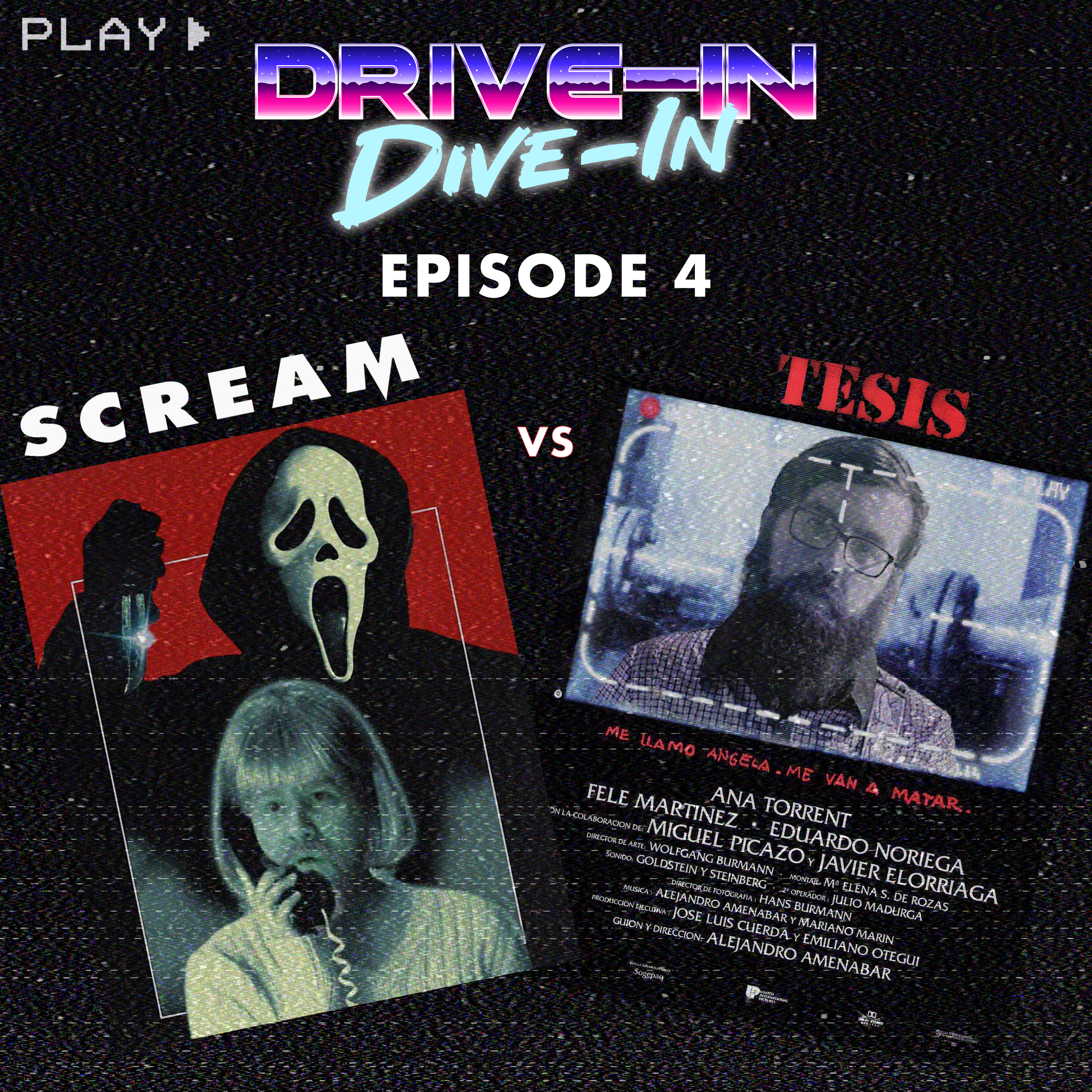
Welcome to another episode of Drive In. Dive In. I'm Jonathan. And I'm Luke, and we're here to talk movies. This is our first episode where we're doing a thematic comparison, which I'm pretty excited about. The movies are 1996's Scream and 1996's Thesis, or Thesis in its original Spanish. All right. And a quick note from the editor's chair as I'm putting this together. We lost about six minutes of Luke's footage when his computer crashed during the initial intro. So I've taken some of my comments from that time that help flesh out what we're talking about and inserted them, so if it feels a little choppy, that's why.
And then this was filmed in mid January of 2026, so before Scream 7 came out after the initial firings and controversy. So if you're listening and wondering why we're not talking about Scream 7 or any of the controversy around it, it's not really relevant to the conversation that we're having in analyzing Scream and Thesis and their relationship to each other and the culture at the time.
But, you know, just so we're clear, Free Palestine. All right, back to the episode. Throwing out the warning once again.
You know, if you have not seen these movies, stop now. You're like, why would you tell me to stop listening to your podcast? Because I don't want you to do yourself a disservice and spoil these movies. Just.
[00:02:54] Speaker B: But we do need to talk about some of these. Yeah, these contexts.
[00:02:57] Speaker A: And now for a quick plot summary of these, though I want to once again, really, really, really emphasize that if you haven't seen these, please, please watch these before listening to this podcast. And that's how much I care about you not spoiling these incredible films for yourself.
If you have any inclination that maybe you would watch it. If this podcast, like, convinces you that they're good enough to watch, consider this. I'm fast forwarding in time and telling you that you're going to be convinced and you should just pause this and go watch them and then come back.
For those that just cannot handle horror but still want to listen or, you know, are never intending to watch these movies but still want to hear us talk about them. Cool. Let's jump into the plot.
I'll start with Scream, because I've got that pretty well memorized. And then we'll do Thesis. So Scream takes place in a town called Westboro.
It's an idyllic California. I don't know if you'd call it a suburb, but town, I suppose, in wine country. And we open on Drew Barrymore playing Casey Becker in her home, popping some popcorn, getting ready to watch a scary movie home by herself, when she gets a phone call from a creepy voice that's a little seductive. And it asks her some fun questions, or at least seems a little fun at the beginning, like, what's your favorite scary movie? And they flirt a little bit back and forth, talking about scary movies before the caller drops the ever creepy line, I want to know who I'm looking at.
Which, of course, causes Casey to freak out. Lock all of her doors. Spiral. The caller keeps calling them. Every ring of the phone is just a new scare for her and a heightening of the tension.
And then she's forced to play a trivia game with the killers, answering horror questions. And if she gets any wrong, they're going to kill her boy boyfriend, Steve, which they do by disemboweling him on her pool deck as she Watches from inside. Then she gets another question wrong, and now it's her turn to die. So Ghostface chases her down and stabs her in the heart and then strings her up in a tree outside of her house. And just as her parents are coming home and they see her dead. So we meet our main five at the school. You've got Sidney Prescott, who is played by Neve Campbell. She's our lead. Her boyfriend, Billy Loom.
Best friend Stu Macher.
Sidney's best friend Tatum, whose brother is Dewey. The deputy sheriff and the fifth wheel of the friend group, Randy.
They're all talking about the murders, and the guys are being a bit callous, especially because, as we find out, Sidney's mom was raped and murdered a year prior, almost to the day.
And the supposed killer, Cotton Weary, is in jail. And the story had kind of become national news and made one of the local reporters, Gale Weathers, famous after she wrote a book about it. Well, Gale Weathers is back in town to cover the new murder, and she and Sidney have a confrontation.
And then the police, Dewey and the rest of the police start investigating the murders. We also find out, you know, that that day, Sidney's dad is leaving for a business trip that he can't get out of.
That night, Ghostface shows up at her house and tries to kill her, but fails. And very shortly thereafter, Billy shows up very conveniently.
And when a cell phone drops out of his pocket, Sidney gets real suspicious. The police arrest Billy as a suspect. Billy and Sidney's father kind of wind up being two of the main suspects at the time.
There's some suspicion thrown on Randy as well, because he's into horror movies and things like that. But it's a big kind of whodunit. And I'm going to stay light on plot, even though I'm going to spoil the ending and some other key things. It's still such a great movie. I don't want to spoil absolutely everything here. And I still really, really encourage you to go and watch it.
But, yeah, so there's curfew that is kind of put out for the town to try and keep all the kids safe. But they are having all of the kids over or all the high schoolers over to their house to have a party despite the curfew, because if we're all together, then we'll be safe kind of thing.
Gale finds out and follows them and gets a hidden camera in the party that she's going to be using. And, you know, I think she's kind of secretly hoping that Ghostface is going to show up and cause carnage and get her even more famous. But either way, she thinks it's going to be good footage for her report. Dewey is also on his way there because he's investigating the murders and, you know, kind of wants to make sure that everybody at the party is going to be safe. When he finds out about it, Billy shows up and he and Sidney reconcile, and she come and he convinces her to sleep with him. According to the very famous monologue by Randy that's happening at a similar point in time in the movie. That is one of the rules of horror, that if you break it, you die. So now Sidney has broken one of the cardinal rules and is in danger. And guess what? Oh, Ghostface shows up and stabs Billy. Also happening at the party, I think a bit before that, Tatum went to the garage to get a drink and gets killed by Ghostface using the garage door. Kid comes into the party, says that the principal has been murdered and strung up on the football field. So the party empties out with people rushing off to go and see his dead body, because these kids are super morbid.
And Gail and Dewey get kind of run off the road by some of these kids, but that leads them to see Sydney's dad's car hidden in the woods. And they realize that he didn't go on his work trip and is either still here and killing people or is in danger or is dead. They rush back to the party. Ghostface almost kills Randy, who stayed behind because he's drunk and he's watching Halloween and he'd rather just watch Jamie Lee Curtis, but gets distracted. And then Ghostface instead kills the driver of Gale's news van. Big confrontation that culminates at the house.
It seems that Ghostface kills Dewey and Randy, and then Billy shows back up despite having been stabbed. And Ghostface is unmasked to be Billy and Stu working together. Essentially, they're like, we're gonna go down in infamy and we will have been stabbed, and we're blaming it all on your dad. We've been keeping him in the closet here, like, tied up, and. And we're gonna kill him and say that he did it all and he stabbed us. Yeah. You know, long story short, there's a big confrontation, and Sidney and Gale manage to kill Billy and Stu. Stu gets a TV dropped on his head and Sidney puts a bullet through Billy's brain.
And that is more or less the end of the movie and the first of a franchise because it was so fucking good. Now, as for Thesis a bit more straightforward, despite still being a bit of a whodunit.
We open up meeting Angela, who is a university student in Madrid going to, I think, film school, or maybe she's going to be a writer, but she's writing her thesis on audiovisual violence and how it impacts the family and society. And when she's first on her way to school that morning, the commuter train she's on hits someone who committed suicide by jumping in front of the train. And as she's leaving, she's, like, really trying to look like she's really kind of hypnotized and drawn to seeing this carnage, but kind of, like, backs out at the last minute as we cut away.
And then she is talking with her professor, Professor Figueroa, to ask for him to help her find films that she can reference in her thesis. And he kind of discourages her from the thesis, but she's very adamant that, like, this is very important and it needs to be done.
So he's like, yeah, okay, fine. So she goes and talks to Kema because he's known for collecting violent films and pornography. And she goes to Kema's place with him that evening after school, and it's fucking dirty and filled with horror memorabilia, and he's kind of showing her, like, Cannibal Holocaust and other movies. While that's going on, Professor Figueroa is going into the school's film archives and goes into this almost hidden area and finds some unlabeled videotapes and grabs one and brings it to the screening room at the school to watch.
And the next day, she goes into the screening room, and I guess nobody else had gone in there yet. She finds Professor Figueroa dead, having died while watching the tape. Obviously, there is an investigation, but she steals the tape. She takes the tape from the crime scene before calling and reporting his death. A younger Professor Castro takes over Figaro's classes and the supervision of Angela's thesis. At Chemist's House, Angela brings the stolen tape and they put it in, and they realize it's a snuff film, and she stops it. And then later on, to kind of be brave, she watches it with the contrast all the way down, so it's a black screen, and she's just listening to it. And over the course of the movie, eventually, she and Kema watch it. And Kema ends up studying it and figuring out a bunch of things, including that he recognizes the victim as a student from their school named Vanessa who had gone missing two years ago.
And he also noticed that the person making the video used a camera with digital zoom, which there were only, like, three cameras at the time that had that. It was very new technology. And one of them is a camera that is able to be checked out at the school.
So they start looking for that camera, and while doing that, she sees this handsome dude named Bosco using that camera on campus. So he notices that she's watching him, and he kind of, like, catches up with her.
And they're talking, and he notices that she's got some newspaper clippings about Vanessa's disappearance. And he's like, oh, I have information about that case. And she's like, oh, cool. I'm doing a report about the disappearance. Can I interview you on camera?
So they're kind of, you know, she's playing him and suspects that he's the killer.
But during the interview, he convinces her that he's innocent, and he just really charms her. So she's kind of like, no, it couldn't be Bosco.
But Kema is like, no, no, Bosco is a psychopath. Like, it was probably him.
Then she comes home, and Bosco's there, and she's like, what the.
But he charms her family and her. And, like, well, not so much her, but she. He's already charmed her family and is invited to stay for dinner.
And then he tries to seduce her, but she resists his advances.
At school, you know, Kima asks a security guard to see the security tape of the video library on the night of Figaro's death to see what happened.
And that night, Angela has a dream that Bosco threatens her with a knife, then goes down on her and then stabs her, all while recording her on video. But it was just a dream.
The next day, Castro questions Angela about Figueroa's death and shows her the security footage of her, the body, and taking the videotape and is like, hey, I'm gonna go to the cops. And she's about to admit why she took it when Kema calls her and tells her to leave Castro's office immediately, saying he's involved in the whole thing. Castro tries to grab her, but she flees.
And Bosco's girlfriend confronts Angela. She explains that she, Vanessa, Bosco, and Kema were all kind of in this understudy program with Castro two years ago. Bosco's girlfriend says that she left when they made Vanessa take off her clothes for a short film because she felt uncomfortable and that she's always found Kema to be skeevy and that he was obsessed with the idea of snuff films. And so she thinks that Kema killed Vanessa. Angela confronts Kema, and he admits that he knew Bosco, but claims that he also left the group once things started getting out of hand, whatever that means. Kema brings Angela to the hidden tunnel, which is where all of the videotapes were that this one of Vanessa's murder had been taken from. We see that there's lots of others, indicating that there have potentially been lots of murders filmed and snuff videos made. While they're in there. The door closes, and they're locked inside.
They kind of run, and they only have matches to light their way. And eventually they find an editing room deep in these tunnels, and they kind of fall asleep in there. Angela wakes up alone, and she tries to leave and is grabbed and chloroformed. When she wakes up, she's tied to a chair. Castro's there videotaping her, and he explains that he only ever edited the videos, he never killed anyone, but that he has to kill her. And he promises it'll be quick. He takes out a gun, aims it at her head, and then he's tackled by Kema, who had been hiding. They wrestle with the gun, and it goes off and kills Castro.
Angela and Kema is escape, and then when they get back to Angela's house, her father tells her that her sister went to a party with Bosco. So Angela runs off to the party to save her sister, but when she gets there, her sister doesn't want to leave with her and isn't listening to her and insists that Bosco is in love with her.
And then, so, like, in order to convince her sister to leave with her, she goes over to Bosco and makes out with him and is like, see? He doesn't love you. Let's go.
Then the next day, Angela's like, look, we've got enough. Like, we need to go to the police. Like, we were not investigators, right? Like, let's do this the right way. And eventually, Kema agrees, but he's like, oh, I need to take a shower first. And while he's in there, Angela finds the same camera type, the same type of camera that Bosco had, the one that they've been looking for in Kema's belongings. And inside is a tape of Angela taken from outside her bedroom window. So she realizes that Bosco's been stalking her, and she. She dips. She's just out of there. She goes back home, tells her sister that she needs to stay safe and stay away from other people, and jumps in a taxi and goes to Bosco's house.
While all that's happening, she's being followed by a figure in a black raincoat that we don't see. Then at Bosco's house, he and Angela talk about their relationship and the lights go out. Bosco goes to check on the power and doesn't come back. When Angela goes to check on him, he's lying on the floor, seemingly unconscious. Kema had followed her and he knocked out Bosco. Bosco comes to and tackles Kema and a struggle ensues and Bosco is beating Kema.
And while Bosco is going to grab rope to tie Kema up, Kema tells Angela to go look in Bosco's garage. Angela goes out to the garage and recognizes that it's the room where the snuff film was recorded. Bosco ties up Angela and explains how he intends to torture and kill her on camera the same way he did Vanessa and all these other.
But she cuts the ropes with a knife, slashes Bosco, grabs his gun and shoots and kills him.
Then Kema is recovering from his wounds in a hospital. She goes to visit him, and on the television, there's a news report about the snuff footage. And they're like, okay, we're gonna play it for you now. And that's kind of like what's happening in the background as Kema and Angela are walking out of the hospital, planning to go on a couple coffee date. And that is the end of Thesis. Scream is one of my all time favorite movies. I'm an old head and I saw it when it came out. I was in high school. I was target audience. Matthew Lillard was already one of my favorite actors at the time. And this made me develop a massive crush on Neve Campbell. And just it kind of blew me and almost everybody else away when it came out.
You know, Scream really was this cultural shift, and we'll talk more about that. But, you know, as somebody who was there at the time and part of the core target demographic, I can concur with the fact that it really hit culture in a way that not very much has before or since. I'd say the. The next biggest movie that was a cultural shockwave like Scream was The Matrix in 99, maybe Fight Club to a lesser extent, but only with, like, dudes. Sure, sure, yeah. And then Thesis, I saw for the first time last year. I had had it on my watch list kind of since I joined Letterboxd. I've got my appropriate letterboxd horror hat on today. Because I did discover Thesis because of Letterbox. Nobody I knew had ever told me about it or talked about it, even in horror circles. But I was looking at the top 250 horror movies on Letterbo and was surprised by how high it was and decided, you know, to check it out and was absolutely blown away. It's now in my top 10 favorite movies of all time, not top 10 horror movies. Top 10 movies of all time.
[00:21:47] Speaker B: Yeah. I mean, similarly, as we were talking about earlier, just amazed that a student created this, a first film, while I think, as you mentioned, still finishing up school.
It was, and I can't recall if I had read that it was a project or a class that the student had failed, but it was almost like. Like a way for him to show up. Those professors improve. But I mean, just looking at it, it feels classic and timeless immediately. And we'll talk about it more once we get to the actual film in a way that just expresses a mastery that. I can't believe it's a. You know, it's his first film.
[00:22:22] Speaker A: Yeah. You know, there are some filmmakers that their talent is immediately evident and their voice is firmly defined out of the gate. And, you know, Alejandro Aminabar is one of them. He's made some incredible films. Obviously, Thesis, which we're talking about.
The others, is one of the best haunted house movies of all time. Sometimes the world of the dead gets mixed up with the world of the living.
Very near and dear to a lot of people's hearts. And then you have Open youn Eyes, which was remade as Vanilla sky and, you know, obviously superior to the remake, but even the remake is quite good.
And both of them are, in my opinion, underappreciated and underseen. Anybody who watches them loves them. But you ask anybody, you know, hey, have you seen vanilla sky? Maybe 20%, you ask them, have you seen the original?
[00:23:18] Speaker B: No, unfortunately, to the point of if your only exposure is American cinema, and you use the same, I think, metaphor for watching bad films as well, if you're not getting outside of that, you're missing so much good stuff. And a lot of the time, the American cinema is just a worse remake.
[00:23:36] Speaker A: Yep. Yeah, well, and, you know, Thesis has been on the remake block for a long time. It's still there. There are people that are actively talking about developing it as. As either a film remake or into a TV series right now, like in the 2020s, which it doesn't need.
It's a shame, because, you know, American cinema also has a lot to say, and that's Kind of why we are looking at these two movies like they are very different in a lot of ways.
One's an American film that is very much speaking to an American audience and the American horror landscape. The other is a Spanish language film made in Spain that is looking at things from a more global perspective. But. But they are. Oh, and one is by one of the most experienced and acclaimed horror directors of all time, Wes Craven. The other is a 22 at the time of filming, 23 at the time of release. Like, essentially film student shooting at the school where he went to film school.
You know, in those ways, really, really different.
But being made at the same time, released in the same year, and saying a lot of very similar things about horror and film and violence and voyeurism and, you know, culture.
Really fascinating stuff.
[00:25:00] Speaker B: Yeah. I think when you're someone like Wes Craven and you can make not one, but multiple films, deconstructing basically your own filmography, I think that you've reached a new level of not only excellence, but sort of like classicness, because that's really what I see Scream as is a deconstruction in the same way that Wes Craven's New Nightmare was a deconstruction specifically of the Freddy character.
I think that Scream is, and this is not a new idea by any stretch of the imagination, but a deconstruction of the film tropes of the past 20 years of horror, of the slasher tropes, et cetera, in a way that was able to take the fact that they were becoming so predictable and almost humorous to a point and weaponize that into something that's actually effective.
[00:25:47] Speaker A: Yeah, absolutely. And, you know, as you mentioned, like, this isn't Wes Craven's first foyer into meta filmmaking.
New Nightmare was incredibly meta and ahead of its time and rubbed people the wrong way because of that. Like, it was very much a you might not be ready for this, but your kids are gonna love it moment.
[00:26:08] Speaker B: In a town where movies go over schedule and directors go over budget, something far more evil is out of control.
[00:26:22] Speaker A: I can't guess you guys aren't ready
[00:26:24] Speaker B: for that yet,
[00:26:27] Speaker A: but your kids are gonna love it. Because he had that experience, he was really able to come into Scream and make a poignant statement while also making an excellent film.
And Kevin Williamson wrote the script. It sold like hotcakes.
I try not to regurgitate too much of what you can hear from other podcasts, so I'll keep kind of the making of stuff pretty brief. But interesting that Kevin Williamson wrote the script because he I think saw a documentary on TV about the Night Stalker or one of the other California serial killers and was staying at a rental house or at a friend's house and, like, noticed that the window was open and didn't recall opening the window and got super freaked out and called his friend who, like, started talking to him about horror movies to calm him down. And that's where the idea came from. And he just, like, had this flash of inspiration, wrote it, and the thing went essentially into a bidding war. It was the hottest script in the market at the time that was being shopped around.
And, you know, they were super jazzed to make it. Wes Craven was not the first person they went to, in part for the like. So, you know, in the way that Scream is a deconstruction of horror at the time and essentially kind of parading around a corpse for jokes.
Wes Craven was not the IT director. He wasn't hot at the time. You know, they went to Sam Raimi. They went to.
I. You know, I'm spacing on who else they did, but there was. It's a really long list of primarily horror directors.
And I think they even went to John Carpenter possibly, but they. Everybody turned it down and said the same thing. This is a comedy.
[00:28:41] Speaker B: Sure.
[00:28:42] Speaker A: And it took Wes Craven and his vision to figure out how to make it a horror film.
[00:28:52] Speaker B: And the thing is, like, all horror, not horror, but like slashers specifically, we're becoming comedy almost to the point where people would laugh at kills and things like, still to this day, if I'm watching Friday the 13th or something like that, it's more of a comedic experience because it's so overdone. Like, I realize that it's not intended that way, but it's so over the top and so predictable in these sorts of things. Like, not every twist, but when Scream's able to embrace that and, like I said, weaponize that in such an effective way, I think it really is a testament to finding that shift, that cultural shift, and then being able to repackage it in the same way that you brought up Cabin in the woods last time, repackages Evil Dead and those sorts of things, finding the way to make it fit the cultural zeitgeist.
[00:29:41] Speaker A: Yeah. And in that. That way, I think that both of these films are very much products of their time and very brilliantly specific to the technology of the era. You couldn't make the first Scream as it is and set it in 2026. And you see a lot of the struggles with that in the later Scream movies. Which I still really enjoy. But it's a reason why, in my opinion, horror is best set pre cell phone.
[00:30:11] Speaker B: Sure, sure, Walter.
[00:30:13] Speaker A: God damn cellular.
[00:30:14] Speaker B: Fucking right.
[00:30:15] Speaker A: Like, if once you introduce cell phones into the mix, especially modern smartphones, a lot of what makes horror good and interesting, like isolation and things like that just kind of stumble and are a lot harder to work with. And it takes a really adept filmmaker to make a film that is set in modern times that still feels scary.
Which is part of why I think found footage tends to work better, is because it's using the technology in a way that still feels isolating and immersive. I think that thesis is a bit more poignant in that its message and its commentary is a bit more timeless.
Whereas this Scream was very poignant and biting commentary for the time that is potentially lost. So I'm curious, what was the first time you saw Scream?
[00:31:29] Speaker B: I must have been maybe 12 or 13, probably at a friend's Halloween party.
I'm not certain that that's it, but that feels right.
[00:31:37] Speaker A: And had you seen or been aware of scary movies movie with the Wayans brothers before seeing Scream?
[00:31:45] Speaker B: Probably.
I most likely was. And I did find it interesting that Scream's original name was Scary Movie.
Nice little tie in there.
[00:31:56] Speaker A: Yeah. And I feel like as somebody who saw Scream in theaters opening weekend as a 14 year old, you know, like the difference in experience is vast and I think you can put yourself in the mind frame of culturally what it might have been like if you have an understanding thereof. But like at the time, and this has been said on other podcasts and in articles and whatnot, but just speaking as someone who was there, who lived it. Yeah, Horror was in a lot of ways a joke. Horror was something that was dying as a genre, struggling heavily as a genre.
You know, all of the classic villains were driven into the ground or being driven into the ground.
You know, we're talking six films for Freddy, nine for Jason at the time, you know, four.
Three or four for Chucky, I think.
God, I don't even know where Halloween was at the time on this. I think maybe five or six in and like Hellraiser had had three or four direct to video pieces of at this point. I mean, like, like any good ones, you know?
Yeah, they're questionable.
But like it's one of those things where as a genre it was struggling. Everything that was considered a tentpole IP was failing.
People were having a hard time making something new. Even the greats were really struggling. Like John Carpenter's vampires. I know it has Its defenders. But I saw that in theaters, man, and that thing stinks. And I love John Carpenter. He is one of my favorite directors.
You know, he has more films in my top 50 than almost any other director.
But God, that thing sucks. And it's just horror in general was trying to find its foothold, right?
And. And a lot of it was getting dumped straight to video. Now the shot on video DTV market was a whole other story. There was some really cool happening in low budget and lo fi.
It didn't look great. Most people wouldn't love it. But like, if you're a horror fiend like you look at Leaf Yonkers darkness, it will rule earth. No one will be safe. No soul will be spared. There will be no escape. Pray to die before they each alive.
Leaf Yonkers Darkness.
[00:34:46] Speaker B: This film is not yet rated.
[00:34:54] Speaker A: I'll have to figure out something that we can compare that to. But.
[00:34:57] Speaker B: Well, that even compares to Thesis in a way. Like the budget for Thesis was under a million dollars. I mean, I mean, that's a budget. But still.
[00:35:03] Speaker A: Sure, but still. Yeah, exactly. And you compare it to Scream, right?
Which was a big budget Miramax rollout.
But I bring all this up because it really frames Scream and helps you understand why it was such a massive cultural explosion, right? I mean, it changed everything. You had parodies in commercials and MTV Movie Awards and even the Oscars of, you know, know what's your favorite scary movie, right? Like that was just. It was in the zeitgeist, it was in the culture, it was everywhere. Because it came out and said, hey, horror sucks now. It's so predictable, it's so sexist, it's so stupid. Yeah, but we're gonna do it good while telling you that.
Scary night, isn't it? With the murders and all. It's like right out of a horror movie or something.
Randy, you get.
[00:36:03] Speaker B: Are you calling from work? Cause Tatum's on her way over.
[00:36:06] Speaker A: Do you like scary movies, Sydney? I like that thing you're doing with your voice, Randy.
[00:36:11] Speaker B: It's sexy.
[00:36:13] Speaker A: What's your favorite scary movie?
[00:36:15] Speaker B: Oh, come on, you know I don't watch that shit. Why not?
[00:36:18] Speaker A: Too scared?
[00:36:20] Speaker B: No, no, it's just. What's the point?
[00:36:21] Speaker A: They're all the same.
[00:36:22] Speaker B: Some stupid killer stalking some big breasted girl who can't act. Who's always running up the stairs when she should be going out the front door. It's insulting.
In both of these films deal with the commodification of violence and. What are you watching? You can't turn away Understanding things. I think that Scream is probably a little bit more about do movies make you violent?
And then the whole following the rules, everything is pre scripted.
But you also mentioned the technology of the time. Not only the cameras being more accessible for independent filmmakers makers, but you had some thoughts on like the cell phone and how that's changed horror movies.
Interestingly, I think the cell phone was inter. Or obviously it's integral to the plot of screen. But they use it so effectively as a tool for isolation rather than the tool that emits isolation, you know, or prohibits.
[00:37:17] Speaker A: Yeah, well, and it was a new technology at the time, in 1996. Like rich people had them, but that was about it. Like a cell phone bill was, you know, couple hundred dollars a month, you know, at. At the time. Right. Like you couldn't just buy a burner phone at 7:11, like you can now. Right.
So, yeah, I mean, using that fairly new technology to throw further mystery into it. And I think that's one of the things that Scream does really well. So like, there are movies that are good parodies, there are movies that are good satire, and then there are movies that are good satire while also being an exceptional film in the genre. Shaun of the Dead being another one. Right? Sure, Shaun of the Dead is biting and hilarious commentary with deep references, but it's also one of the best modern zombie movies, regardless of that aspect of it. And Scream is very much the same. The whodunit of Scream is incredibly clever,
[00:38:22] Speaker B: even to the point you bring up Sorrow of the Dead. I consider Funny Games to be a bit of a satire myself. And I think it has a lot in common with these came out of your. After them. The first one did. But sorry, you had a thought there prior to this.
[00:38:35] Speaker A: Slashers especially. But in general, like whether it's slasher or giallo, which is a lot of what this is tapping into. You had a killer, right? You had one person, and you're trying to figure out who it is.
[00:38:50] Speaker B: And sometimes it's not the person you thought. It's typically not the person you thought, but it's not.
Yeah, yeah.
[00:38:55] Speaker A: And whereas screaming had two killers, which blew everybody's fucking mind. Like nobody saw that coming at the time. Like, that was. That was fresh, that was new, that was super clever. And it explained all of the. What would otherwise be plot holes, right? If somebody's watching it for the first time and they don't know the ending, they might be like, wait, how did the killer get there so fast? How could one person string Drew Barrymore up in the tree like, you know all these things, but as soon as you know that it's two dudes, one of who is very tall. Like now, okay, everything makes sense and everything tracks, everything. Clocks and. And thesis.
Technically, there's one killer, but it's two people.
[00:39:41] Speaker B: It's a group effort.
[00:39:42] Speaker A: Yeah, it's a group effort. And like I say to people, like, part of me, I want to. I want to really re. Watch it again, like, with a. More detective's eye, because, like, I wonder if Kemma wasn't originally involved and bailed. Like, it's certainly not hinted at that much, but, like, there's enough question there.
He certainly was not involved by the toy.
Yeah,
[00:40:14] Speaker B: it's interesting.
I do think he knows more than he was letting on because as we find out partway through the movie, the girlfriend knew something was going on.
Yeah, I would have to watch with that context. I like to think. No, I think that he's more of the. He's meant to be like the. The consumer of the snuff films and the film itself is representative of. Once he actually experiences the violence, he's able to, like, rid himself of that need to consume it. But.
[00:40:42] Speaker A: Yeah, that makes sense. But either way, there are, you know, you're kind of like going back and forth between Kima and Bosco and the teacher, and then it turns out, but it's everybody except Kema. And, like, Kim is still a creep in his own.
[00:40:56] Speaker B: Yeah, he's still like, stalking her. I don't know why she ends up going out with him at the end. That made no sense to me.
[00:41:02] Speaker A: You know, Trauma bond, right?
[00:41:03] Speaker B: Yeah. Yeah. She's like, I'm so traumatized that I'm just going to date this guy who stalked me.
[00:41:09] Speaker A: Oh, man. Well, you know, when she was obsessed with the guy that wanted to kill her, the stalker feels just, you know, like a better. A better option. Right. But, yeah, so they both are. Are very, very smart genre films. You know, whodunits, slash slashers that are elevating and giving a spin to the genres that they are playing in to give an unexpected ending. And, you know, I think some people who have consumed a lot of horror and go back and watch Thesis for the first time may feel like the killer is very obvious, but you got to put yourself in the 1996 shoes. Same thing with Scream. You know, I think that that's why I asked you if you had seen Scary Movie before seeing Scream, because I feel like there is a difference in the viewing experience if you've already seen the parody of something before you see it. Right. It kind of lessens a lot of the impacts.
[00:42:09] Speaker B: Yeah. I can't recall. It's so jumbled in my memory that we can assume, but.
[00:42:13] Speaker A: Yeah, but it's like, you know, it's one of those things where it's like I'm. As a dad of a toddler, I'm trying to fig out how to shield my son from the knowledge that Darth Vader is Luke's father before I can get him to watch the Star wars movies. Right. Like there are, you know, and I'm really excited for him to, when he's old enough, watch Terminator and Terminator 2. Because Terminator 2 had one of the best plot twist reveals at the first act break of all time. That was completely spoiled by the marketing. And now we're far enough out from the marketing that if you can, like, it's also one of those things that it's like, so in the culture, like, you come with me if you want to live. Like, I feel like you really, like, I've got to get them to him. Right. When he's old enough, before he's seen any of the parodies or commentary, you know, or references out there.
Because like, like imagine seeing Terminator 2 the way it was intended. James Cameron intended you to view it where for the first 30 minutes, Arnold is the bad guy.
[00:43:30] Speaker B: Sure.
[00:43:31] Speaker A: And he is chasing them. And then all of a sudden, like that scene, that hallway scene is so good. If you don't know that twist like
[00:43:42] Speaker B: it is, he pulls the shotgun out of the rose.
This is the same reason that I. I do my best not to watch trailers anymore. And if I watch a trailer, I'll watch the first 10 seconds. You know, just because these marketing.
I'm just gonna say hacks. And I used to work in marketing, so I can say that.
I know you work in marketing.
I'm not calling you a hack. These guys, like, I don't understand. What do you, like, you just spoiled the whole movie. Do people actually want that? Are people so thoughtless? I don't understand.
[00:44:12] Speaker A: Yeah, it really shocks me. There are some production companies and studios out there that have a habit of putting the final shot of a movie in the trailer, not just a scene from the end, the final shot of a movie in the trailer. And what made me stop watching trailers was the trailer for Amazing Spider Man 2. I saw it. I was like, yeah, that's really cool. And my now wife and I went to see it on a date when we were dating in theaters. And I'm just Waiting for that epic shot from the trailer of Spider man jumping at the metallic rhino. I was like, I want to see. Like, I'm skeptical of doing the rhino as a mech suit, but that's interesting. And that fight looks like it's gonna be badass. And I'm just like, waiting and waiting. And I look down at my watch and I'm like, that's going to be the last shot of the movie, isn't it? And it was. And so from there, before we hit the third act turn, I was able to figure out the rest of the movie because that's the way my brain works. And I just, you know, I was super disappointed. Whereas, you know, my wife, she can watch a trailer and then two days later have forgotten what was in it and be surprised by what happens in the movie. And, you know, I respect that. I just. My brain does not work that way. So I just stopped watching trailers. I don't even read Synopses.
[00:45:33] Speaker B: I think it's enviable to a point. My mom can watch the same three shows over and over. But anyway, I think we're digressing. Yeah.
[00:45:41] Speaker A: But I say that in part because my viewing of Thesis was really interesting because again, I don't read Synopses, let alone watch trailers. I go in as blind as possible.
So you get to the part where she finds the Figueroa, the older professor dead after watching it, and I was like, oh, it's gonna be like a VHS that kills anybody that watches it. That's so cool. And it was my first thought as well.
[00:46:08] Speaker B: Yeah.
[00:46:09] Speaker A: And this came out before Ringu, so I'm curious if they saw, like, the filmmaker for Ringu saw this and was like, oh, that's a cool idea.
[00:46:36] Speaker B: Oh, I have a lot of thoughts on that whenever we dive, like, specifically on Thesis, but I'm gonna hold it for right now. I want to hold it for right now.
[00:46:42] Speaker A: Yeah, for sure. But, yeah, and. And so, you know, I was very, like, enraptured. Didn't know what the road was going to be or where it was going to take me throughout Thesis. And. And so, like, as it dove into the, you know, the snuff storyline and all that, it was just. It was really fascinating and kept me engrossed the entire time.
And, you know, it's one of those snuff films, as a topic, are really interesting because there's a lot of movies about them and there's not a lot of evidence that they actually exist, but they were very much in the cultural window of the era. Because you had Charlie Sheen calling the FBI because he got so like. It's interesting that Charlie Sheen came out with this story or maybe other people found out about it because of the FBI report. But like, my question is, who are your friends and what kind of movies were they getting for you, Charlie Sheen, that you thought they gave you an actual snuff film, but it wasn't. It was Guinea Pig, Flower of Flesh, something like that. One of the guinea pig films that was, you know, dubbed and dubbed and dubbed to the point that it looked. And I mean, the effects in that movie are incredible anyway, but then you have it a multi dubbed vhs and suddenly you think you're watching an actual snuff film. So he called the FBI and then you had. There was a serial killer in Japan who was obsessed with the guinea pig films and recreating them.
And.
Yeah, so it was whether or not there were any actual snuff films ever in existence. It was something that everybody was aware of and people were making movies about them. You know, you got 8 millimeter and 8 millimeter, 2 snuff to the resurrection and a bunch of other movies. There were like four or five movies prior to Thesis that dealt with it as well.
[00:48:34] Speaker B: Well, and it's interesting too, because I think that is the. The primary distinction between Scream and Thesis is Scream is very much about direct nods to horror films simulating violence. And Thesis is very much at the core of actuality of violence, almost like documentary style.
And I think that Thesis was made in an environment, I believe Spain had only been a democracy for like 20 years. There was a huge amount of cultural upheaval and change. There was probably a lot of kind of conservative thinking that they were breaking through and like satanic panic type concern.
And I think Thesis is directly addressing that in a way that's much more of like a traditional classic film. And Scream is like completely just subverting that and doing its own thing and like laughing at the audience.
[00:49:24] Speaker A: Yeah, absolutely. And, you know, they both play with expectations in really clever and interesting ways because they're so aware of the environments in which they are setting themselves and debuting. Right. So with Thesis, you know, you have Amanda Bar making all those commentaries that you already mentioned, but then also deciding not to show the actual snuff violence on screen, which is, in my opinion, part of what makes it a masterful film.
It would have been really easy to just try and shock the audience.
But allowing getting them to use their imaginations is going to be significantly more shocking than anything you could put on screen. Especially in 1996. And it allowed him to make a more visceral commentary because he was not being exploitative of the viewer or the characters or the actors that were in his film.
[00:50:34] Speaker B: Yeah, that is an interesting thing I had noticed in Is typically, it's almost like the first person view from, like, Halloween or something like that. Typically, the monster is not on screen or the violence is not on screen in Thesis. And there's this really interesting sequence. They play with mirrors a little bit, but at the very end where when what's his name, Bosco is still in the predatory status and he's off screen, but you see him in a mirror. And then a little bit later, they directly inverse it where Bosco's on screen green.
And Angela, Angela, however you say her name is in the same position and seen as more the Predator. And that's it. Once she realizes who he is now, obviously she doesn't do a lot of good with that information, but once the roles are reversed to a point.
[00:51:27] Speaker A: Yeah, it's a really interesting approach to things that is very much manipulating the visual language of the genre of horror in the same way that Scream manipulated the narrative language of horror at the time.
You know, you've got, obviously the two killers being a big surprise, but there's a lot of.
I mean, there's not much in Scream that isn't a subversion in some way or the other. And it's very much true of Thesis as well. But like. So Drew Barrymore gets killed in the opening scene. Something you may or may not remember, something that younger folks who are listening to us may or may not know, unless they've listened to other commentaries on the movie Scream.
That was a massive surprise. Drew Barrymore was nicknamed, like, her nickname was America's Sweetheart at the time in 1996. She was like one of the it women of cinema and leading in romantic comedies. And just like. I mean, she was dynasty. She was Hollywood dynasty. Right. Like, she. Her parents, huge names, you know, in Hollywood. And she had been in front of the camera since ET and was just, you know, this girl, slash woman who America was really fond of and Hollywood was very protective of in a lot of ways. And she was billed as a star.
So everybody went into that movie expecting her to be the final girl, which was not even a term.
Well, actually, I'm trying to think of when that book came out, but I'm
[00:53:14] Speaker B: sure there's still the context of she's the lead actress, this whatever.
[00:53:18] Speaker A: Yeah, the one who survives. Right. Like, that was just. Everybody believed that. And she was originally cast as Sidney.
She is the one. One that chose as an homage to Psycho to be the one that was killed in the opener. As opposed to the leading woman. Right. She. She chose to be Casey because she wanted to homage, you know, one of the OGs and. And psycho. And she's like, wes, like, how much would it blow people's minds if you murder me in the first 10 minutes that way? It's kind of like that psychedelic, you know, trip thing.
Always play with their minds.
[00:54:05] Speaker B: Sure. Well, and I believe the actress.
The lead actress was not unknown, but much smaller. Right?
[00:54:12] Speaker A: Yeah. So this was also so like. Yeah, that's another thing that looking back on it, if you just sit down and watch it now, you're gonna see a lot of really huge names and be like, oh, these are all big people. Nah, man, these are all TV stars.
Like, these were not Hollywood stars. That was part of how they kept their budget tight. Right?
Because, yeah, it was a bit. It was a big script, but it was still a Miramax film. Like, we're not talking aaa. It was still a horror movie. So they had to manage their budget. And part of the way they did that was by hiring television actors. And the.
Kevin Williamson was a TV writer. He wrote Dawson's Creek. That's also part of why Scream is as good as it is and why it. Why Kevin Williamson was, like, the hot screenwriter for a while is he had built a career on writing believable and endearing teenage characters.
[00:55:07] Speaker B: Sure.
[00:55:07] Speaker A: And now he's making a movie using those same writing techniques and those same characters, or that's. Those same character methodologies and killing them on screen, not just killing them.
[00:55:19] Speaker B: Yeah.
Talk about believable and endearing. Stu is one of the best characters in any movie of all time.
[00:55:27] Speaker A: 100%, man. Like Matthew Lillard is.
He will forever be one of my favorite actors. He's done some of my favorite roles, especially, like, in my formative years. Like, I already talked about hackers and how big that was. And I thought that serial killer was just so fucking cool. And then you've got Stu Macher, who is just hilarious and endearing in this, and then SLC punk, you know, I mean, there's just, like, he. Just one movie after another. I was just like, this guy plays these characters that just, like, speak to me in. In ways that are really something else. And, yeah, apparently funny, because I knew
[00:56:06] Speaker B: him from Scooby Doo first, I think.
[00:56:10] Speaker A: There you go. And, you know, Shaggy, another formative. Right.
[00:56:12] Speaker B: Character, was the best. The best character in the film. So.
[00:56:15] Speaker A: Yeah. And he.
Stu. Stu was the. According to Kevin Williamson, the most underwritten character, almost everything we see on screen was brought by Matthew Lillard. And a lot of his lines were ad lib.
[00:56:30] Speaker B: Sure.
[00:56:30] Speaker A: And like, that just speaks to his talent. Right. And I think one of the things that he, or he and Skeet brought to it that was probably not on the page was the.
The gay undertones of their relationship and the homoeroticism and like, the idolization of Billy by Stu, which we can get into a little more later, but in rewatching and like.
Because I have seen scream over 20 times, probably, but, like, really sitting down and like, looking at nuances.
It's a very meticulously crafted film.
And there's some really interesting things with the relationship between Stu and Billy that in my opinion, have some telegraphing information about the killer that I think, like, makes it an even more interesting watch.
But we can, you know, dive into that a little later. I think we're still, you know, kind of more talking top level.
[00:57:32] Speaker B: Yeah.
I mean, I'm happy to transition if you are, but.
Yeah, at its core, we're talking about two films that are about how kind of like the. The gaze of the viewer upon violence and how that affects people and how it's represented in media and similarly, maybe more so in Thesis. But how the gaze of the camera or the lens back is. Is like where that conversation lies and where all the meaning is. Is derived from.
[00:58:01] Speaker A: Yeah. And they both do such an interesting job of that. Right. The lens, it's self is like this visual form of commentary that has some just incredibly interesting things to say that are never, like, exposited on. Which is. Which speaks to why they're both so endearing for people. Right. Like, obviously we're talking about, you know, snuff videos in Thesis, but, like, there's. Where she wakes up. Well, she thinks she wakes up. She's having the dream and there's the camera in the corner and Bosco is there. There to make out with her while cutting, you know, cutting her. Right. Like, and. And there's the.
The stalking element and just all of the. The interview scene. There's like all, like everything is just through the lens. Everything is the. The separation of the person, the. The filmmaker from the subject, you know, through the lens and. And. Or being gray by being on the other side of the lens. Right. Just really interesting and like, examining the vulnerability of being in front of a lens.
[00:59:07] Speaker B: Well, even.
What was his name?
Chima. Kima.
[00:59:12] Speaker A: Kima.
[00:59:14] Speaker B: Figuring out the Camera from the digital zoom. Now we know that he has more context, but then being like, oh, the digital zoom, they ruined the lens shot sort of thing.
Bosco is constantly asking, what color are my eyes? He talks about eyes a lot in of front.
[00:59:31] Speaker A: Yeah. And I love that you brought up that thing of figuring out, oh, it had to be one of these cameras because digital zoom is a new technology.
That's just one of the many things about both of these that the reason they work is because they're set in 1996.
I mean, it's like you couldn't redo. Well, I mean, you could redo thesis in modern day, but it's not gonna be the same. And a lot of what made the unraveling of the mystery so clever is going to be lost. And similarly, in Scream, the newness of cell phones as a technology is. Is lost in modern, you know, times. Which is part of why the sequels to Scream, no matter how good they are, will always feel different.
You know, which, the latest one, like three is the one I like the least. And even that is a pretty entertaining movie. Right. I really like a lot of them, including the most recent ones, but they, they have a very different feel because they're set in modern day and you know, it's a very. Like you're commenting on yourself thrice removed. Anyway, I won't get down that rabbit hole. But point being, they use lens, lenses in really interesting ways to tell stories, right? Like the hidden, hidden camera in the party on top of the TV that has a 7 second or a 30 second delay back to the news van, right?
And you've got Jamie Kennedy in his best role ever sitting on the couch yelling at Jamie.
In Halloween.
[01:01:15] Speaker B: Yeah, in Halloween. Yeah.
[01:01:16] Speaker A: He's behind you.
[01:01:18] Speaker B: Wow. Exactly.
[01:01:19] Speaker A: What happens him while he's being filmed? Like it's this, like he's yelling at the subject of a lens while being the subject of a lens in the same scenario. And like it's just there's, you know,
[01:01:31] Speaker B: I think there's even one extra step there which I, which I very much enjoyed. The delay created a situation in which the guy in the truck is yelling as it's happening to him. Yeah, he's watching it happen to someone else as it's happening to him. So it's like four levels removed.
[01:01:45] Speaker A: Yep, yep. Yeah, exactly. It's just, I mean, like, stuff like that is incredibly smart and a very meta commentary without sitting down and saying, you know, being the subject of a lens and commenting. I like, they don't need to use words to say what they're saying. And, you know, despite that being shortly after one of the most famous monologues in horror, which is the rules. There are certain rules that one must abide by in order to successfully survive a horror movie. For instance, number one, you can never have sex.
Big no. No. Big no.
[01:02:23] Speaker B: I'm a dead man.
[01:02:24] Speaker A: Keep him impossible. Sex equals death.
[01:02:26] Speaker B: Okay.
[01:02:27] Speaker A: Number two, you can never drink or do drugs.
No. The sin factor. It's a sin. It's an extension of number one. And number three, never, ever, ever, under any circumstances, say, I'll be right back. Because you won't be back. I'm getting another beer.
[01:02:44] Speaker B: You want one?
[01:02:45] Speaker A: Yeah, sure.
[01:02:46] Speaker B: I'll be right back.
[01:02:50] Speaker A: You know, there are rules.
[01:02:53] Speaker B: I. I just keep coming back to that Downey Jr. Quote.
I'm a dude playing the dude. It's like the dude watching a dude being watched by another dude being watched by, you know, like. Yeah, there's so many layers and it's just circular.
[01:03:06] Speaker A: Yeah, it's. It's so smart. And, you know, I. I know I have nostalgia glasses to it for, you know, a bit that people who see it for the first time in a modern lens, especially those who didn't live in the 90s, aren't really going to, like, get it. But, like, there's a lot of stuff that is just so indicative of the time, like, you know, chatting 911 because you can't get to your house phone because you don't have a cell phone.
Yeah. And then on a filmmaking side with Scream, something that I think is really interesting is the phone voice was cast. It was a person. Person doing that voice. His name is Roger Jackson. You like scary movies, huh? What's your favorite scary movie? So it's not vo. It's not dubbed in. They had him in a separate room on set, closed off from talent with a mic on an actual cell phone, making an actual. All the phones were live.
So, like, in that opening scene, he's calling Drew Barrymore as Casey, and she's picking up and he's talking to her, and she doesn't know exactly what he's gonna say. She's got a sense of it because of, like, the script, but, like, the dialogue for him was more generic and. And so a lot of this, the reactions are more genuine because of that. And it's a live, actual conversation. They're not just pretending they're listening to something they're hearing.
[01:04:38] Speaker B: You can play to it so much easier. Easier. And then the guy on the other end of the phone can get context clues and through the audio that he's hearing and things like that. I think that's. That's pretty genius.
[01:04:47] Speaker A: Yep. Yeah, absolutely. And, like, I mean, it just. It sets up the phone as a terror device in such an interesting way. And I. You know, there are some people whose. I don't know that it's a criticism, but they'll say that the opening sequence of Scream is the best part of the movie. And. And I can see justification for that. You know, I disagree because Stu Macher's not in it, but Neve Campbell's not in it. But. But it is really masterful. And the line, I want to know who I'm looking at.
[01:05:24] Speaker B: Why do you want to know my name?
[01:05:25] Speaker A: I want to know who I'm looking at is one of the most chilling lines in horror. Like, it's so smart the way everything just turns on a dime. Right up to that point, she was kind of. Of losing herself. Like, you could tell that she was still cautious because she locks one of the doors as she walks by it. But she's, like, getting a little charmed by him. She's having fun flirting with this random voice that's kind of sexy.
And then there's that line. And then it's like, oh, I'm in trouble, you know?
[01:06:01] Speaker B: Yeah, well. And immediately back to the vision, to the voyeurism, whatever is. And then obviously, that sets up, like, a microcosm of what you're supposed to expect for the rest of the movie, which is what they deconstruct for the rest of the film. Right.
But it immediately tells you what you're dealing with and then rips that all down and says, nope, you were wrong.
[01:06:21] Speaker A: Yeah. Yeah, exactly. And, you know, you've got the meta satire in there with the phone call, you know. What's your favorite scary movie?
Yeah, Freddy. Yeah, those movies are scary. Yeah. The first one, the rest of them sucked. Which Wes Craven want to take out because he felt it would make him sound like an egomaniac. He did not write that line.
But Drew Barrymore was like, dude, you directed six, so you're still saying your movies suck. And he's like, oh, okay, all right, I'll keep it in.
The viscerality in that scene really sets the stage.
I have a fan made unedited director's cut. And it's only 10 seconds longer. But those seconds are all violence.
You know, when Steve gets gutted, you actually see the intestines fall out.
You get a longer hold on KC Hanging before the push in shot. And the push in shot is slowed back down.
So that chaotic, jumpy push in to Kaycee hanging from the tree that informed so much of editing and shooting of horror after that. I mean, that in and of itself, along with the soundtrack birth, this whole style of like teen horror, that was not intentional. It was a standard push in. And the MPAA was like, you need to shorten that. And so they had to go in and remove every other frame.
[01:07:56] Speaker B: Well, in, yeah, I had read they had submitted it like eight times or something. They almost got an NC17 rating, which to me is wild, I don't think. I don't know how bad those 10 seconds are, but that these rating systems have certainly changed since 1996 is what I'll say.
[01:08:10] Speaker A: Yes, absolutely. Yeah. I mean, you know, there's certainly more gore, but it's nothing that is like, so shocking. But I think, yeah, MPAA was more defensive back then. It's also dealing with high schoolers as the victims, which are children.
Right. So there's that. But yeah, like the scene where Ghostface grabs her from behind and very methodically looks to make sure that he's going to stab her in the heart and then stabs her in the heart.
They wanted that cut differently or they wanted it shot differently or something like that. And he's like, no, that's the only shot that we got. I can't. I can't sub it out. And so he pushed back on it and was able to keep it.
[01:08:52] Speaker B: Sure.
[01:08:53] Speaker A: But he intentionally shot additional footage of Drew's body. The additional, like, guts falling out of Steve and a few of the other kills. He shot Long Hunger knowing that the MPAA would push him to cut. So he did more than he wanted in the movie to give him room to cut down to essentially what he wanted, thereby kind of scamming the MPAA with their violence. It's just. That's one of those interesting coin flips. That's why part of why Scream is like this Other side of the coin 2 thesis. Whereas thesis is intentionally withholding the violence and the gore and. And leaving it up to the imagination.
Wes is pushing the envelope and pushing back on the MPA and doing everything he can to just eek. Under an NC17 rating.
[01:09:47] Speaker B: Right? Yeah. It's interesting because Thesis feels like a more violent movie, but it's mostly because of implication.
[01:09:57] Speaker A: Because of the implication.
[01:09:59] Speaker B: You do see a couple of scenes of, I would say, pretty extreme brutality, but not gory brutality.
And the gore is typically implied partially for budgetary reasons, but it also Just works extremely well.
And, you know, the same thing. Constantly talking about, like, lenses and eyes framing in how all these things are being framed.
That even goes in the context of both Scream more so. But both of them deal with the news and how the news frames things. The news in Thesis just plays one of the snuff films on, like, national television. And everyone's watching it. And then those two are finally free of it and they can watch away. Good for them. And then Gale Weathers in Scream and the way that a. She has framed things to be successful. And she's selling violence to people in this.
And that's kind of, you know, a mirroring of, like, slasher films and selling violence on the news. But then she also shows herself to be actually legitimately trying to get to the truth of the matter. Making sure, like, an innocent man isn't executed, etc. But she. She certainly spins the story in a way that, you know, book sales and such.
[01:11:05] Speaker A: Yeah, yeah. Well, yeah. I mean, she's certainly, you know, out to get hers.
But a lot of the perceived enmity between her and Sidney is because she's pushing for a truth that Sidney doesn't want to know. Right, right.
Which is certainly interesting.
Whereas you have in Thesis. Right. You've got Angela. Angela pushing for a truth that she ultimately doesn't want to know, but thinks she does. And we see that from the opening sequence where she's trying to see the body on the tracks.
She's trying to frame it as an academic curiosity, but she has a morbid pulling to violence. The same way that she's criticizing society for.
[01:11:56] Speaker B: Yeah, and I hadn't thought about that, but it's the same microcosm that Scream does. It does the whole movie in the first couple of minutes, or how you. You know, and then spends the rest of the movie deconstructing that. What it's set up.
[01:12:08] Speaker A: Yeah, exactly. Exactly. For being, in a lot of ways, very different movies.
They feel very much like two sides of the same coin and very much birds of a feather. Like, they're very in step in a lot of ways from. From that, you know, framing in the opening and the, you know, kind of the final commentary at the. The end and the deconstruction throughout to the meta and the lenses. Like, there's just. There's so much that they were very clearly tapping into the same vein from totally different parts of the world completely unaware of each other.
Just so. So fascinating.
[01:12:47] Speaker B: Well, in both of them, the center part is, like, set in a school and at, like, dinner Parties.
And they both end at, like, a fun farmhouse out of the city as well. So two more obviously. One is somebody doing a graduate level thesis and the other one's high school. But there are similarities there that are just.
They were probably trends that were kind of informing this thinking, but just even more similarities.
[01:13:16] Speaker A: Yeah, absolutely. And a lot of interesting commentary, both overtly and subversively about relationships and monogamy or lack thereof, and manipulation through relationships. Right. In both of them, you have the killer manipulating the female lead into romance to essentially deflect themselves and to kind of lure them into their trap. But then you have. Have.
You know, Thesis is a bit more normal in its commentaries. It's mostly about cishette relationships.
Whereas in Scream, the surface is kind of what we're talking about. And the manipulation both of these guys are using part of, like, initially. Oh, why would they kill Casey and Steve? What's that about? Well, because. Because Casey and Steve burned Stu and Stu wanted them dead. Right. Like, Stu was angry at them.
But, man, go back and re. Watch Scream through the lens of Stu being in love with Billy, and Billy being a psychopath who's incapable of loving anyone, but uses people's love for him to manipulate them, to put them in the positions he wants them to get them to do what he wants. Right.
[01:14:43] Speaker B: I mean, yes. I have a thought. I want to circle back to, but before, like, when they're just. First of all, it's hilarious. They're just stabbing each other at the end.
[01:14:52] Speaker A: Yeah.
[01:14:53] Speaker B: But you had mentioned the kind of homoerotic undertones before. And it's vaguely sexual in a way.
They're just sitting there stabbing each other. It's like the only way that Billy knows how to express himself is through, like, murder.
[01:15:08] Speaker A: Yeah.
[01:15:09] Speaker B: And so Stu is, like, happy to be stabbed by him and then keeps letting him do it. He's like, you stabbed me too many times, man. Feel a little woozy here.
[01:15:18] Speaker A: Take any more?
[01:15:20] Speaker B: I feel a woozy air.
Absolutely hilarious. But going back to, like, basically the. The killers need to, like, sexually conquest these women before they can kill them.
[01:15:32] Speaker A: Right.
[01:15:32] Speaker B: Um, and then the incels are the good guys. Yeah. In both movies.
[01:15:37] Speaker A: In both movies.
[01:15:39] Speaker B: But the three rules, right? Like, don't have sex, don't drink or do drugs, and don't say, I'll be right back. I just realized that at the very end of Thesis, she has sex. She drinks an alcoholic drink and then says, I'll be right back. Yeah, yeah. I'm not kidding. Like, she does. And not exactly. I'll be Right back. But in effect.
And that's when things go downhill for her. I mean, they'd already encountered, like, you know, resistance before. But that's like, when the Predator gets her. And that's really crazy.
[01:16:11] Speaker A: Yeah.
[01:16:11] Speaker B: You can actually. I can point those scenes specifically because I just watched it this morning. But, yeah.
[01:16:16] Speaker A: Yeah, it's fascinating how much they wind up saying very similar things in different ways.
Yeah. And, like. But going back to your point about the Stabb being vaguely sexual, so there's a really great deconstruction of the slasher.
I. You know, I'm a bad feminist in that. I don't remember the author's name, but she wrote a really excellent book. It's the book that coined the term the Final Girl. But it also breaks down the slasher genre as an exploration of, you know, essentially misogyny on film. Film. And the knife or the weapon is essentially a phallic representation that is always penetrating.
And the blood splatter is the money shot. Like, it's very. Like, it's a very sexual genre through that. Like, essentially exploring sex through violence. And it's based on. You look at Randy's rules, modern morality tales. Right.
You don't do the moral thing. You get violently, you know, fucked to death by a knife, to be as crass about it. But that's essentially what the movies are saying back in the day. And so Scream was turning that on its head and making that commentary of, you know, that was already kind of out there. And other people were making similar commentaries. That also lends to, again, the relationship between Billy and Stu. If the knife is a representation of the penis and stabbing is penetration and they're stabbing each other.
[01:18:04] Speaker B: Right, right.
[01:18:05] Speaker A: Like, it's. You know. But there are. There are moments, like, where.
Where they're talking to Sidney in that final scene and Stu comes up behind Billy and gives the most, like, longing look like. And. And, you know, Matt Lillard and Skidor have come out and said, yeah, that's how we played it. Like, as far as we're concerned, we're the first gay couple of horror. And I think that that's really fascinating. And I ment, if you watch it again, try and pinpoint who does the killing.
[01:18:38] Speaker B: Yeah, I was thinking about that as well. And I think your point is not to steal your thunder, but that Stu may not have actually killed anyone.
Which is further supported by the fact that Gale Weathers and the cop don't die.
[01:18:51] Speaker A: Right.
[01:18:51] Speaker B: Because I believe that was Stu chasing them.
[01:18:54] Speaker A: Yeah. And whenever Ghostface has a pratfall it's usually Stu.
[01:18:59] Speaker B: Right.
I also love how he's just running, like, tripping over couches and stuff like that.
It's like, kind of funny, but actually makes it scarier in a way.
[01:19:08] Speaker A: Yeah, yeah, yeah. You know, it's. It's the viscerality of, like, this is just a crazy person. You know, there's no supernatural elements, but it felt supernatural because there were two of them and people didn't realize it. But yeah, there's. I was paying really close attention to the shoes this time because that's like, the thing that you see of the killer, for the most part, is the boots. Right. And Billy wears black boots. Stu wears black sneakers.
So, like, anytime you see the boots, that's Billy.
And then it's also a dead giveaway in the opening scene where we see the whole friends group for the first time. Billy's got on his black boots, Stu has on his black shoes, and Randy has on these neon green shoes.
It's like he is not the killer.
[01:19:53] Speaker B: Right, Right. Well, and then Randy's supposed to be the fall guy. He watches all the horror movies. He works at the. He's the one that. Again, to relate to Satanic Panic. I know it was a little bit afterward, actually. This would have been probably around the Columbine panic. Right. A couple years after it was a few.
[01:20:08] Speaker A: So before we can talk about that a little bit. It was before, but there were still concerns. But it was post the West Memphis Three, for example, so the Satanic panic was still there.
[01:20:23] Speaker B: But doom was 93. Doom two, I think was 95. And those were even before Columbine, obviously, like, lumped into, like, over depiction of violence in video games and that sort of thing.
So, yeah, I think even Randy even calls it out in the film. He's like, yeah, if this was a classic slasher movie, I'm the guy you would expect.
But then I would end up not being it, because you shouldn't. I'm red herring.
And then that's kind of what it is.
[01:20:51] Speaker A: Yeah, exactly.
But, yeah, no, I know for certain, obviously, partially because, like, I was a freshman in high school in 96 and Columbine happened later.
But they had to change Scream 3 3.
Yeah, they had to completely rewrite Scream 3.
It was originally supposed to take place somewhere else. And one of the sub storylines was that Stu was still alive and had been, like, building a cult of high school students who were committing a bunch of murders in the name of Ghostface. Obviously they couldn't do that.
[01:21:38] Speaker B: I would like to see that. Movie.
[01:21:39] Speaker A: But yeah, I mean, sounded awesome, right? Yeah.
But then, yeah, speaking to, like, how much of a cultural titan the Scream franchise was, the first movie that ever had to rewrite its ending because the script got leaked online was Scream 2.
[01:22:02] Speaker B: Sure.
Yeah. Well, I'd also heard that they didn't want probably Internet, but leaks for the first one, so they filmed extra scenes or had some fake scripts and things like that.
[01:22:13] Speaker A: They film multiple endings. Endings, I think, for all of them, definitely for two and three, in part because of that. But yeah, the initial ending for Scream 2 was totally different and somebody found it and stole it and leaked it online. And it's the first ever instance of a script being leaked online and causing them to change production as a result. So. Because everybody wanted to know who was going to be the killer in Scream 2 before it even came out, because that's how big this movie was. And, you know, I kind of said to you when we were talking about doing this episode, I think that if Thesis had been English language, not subtitled, and gotten an international release, it would be as big as Scream, if not more so, you know, and I think the only thing that might have held that back is to your point, the fact that it feels more visceral and violent despite showing less. And I think it's because the subject matter is so grimy and grungy. And you also have, you know, the, the settings. Every setting in Scream is gorgeous, right? The houses are incredible, multi million dollar houses in wine country. The suburb is a perfect, idyllic suburb, which is the point, right. It's the contrast of the violence to the setting. Whereas, like, Kema's apartment is the dirtiest fucking place.
[01:23:39] Speaker B: It looks like a psychopath.
He's not doing himself any favors.
[01:23:44] Speaker A: Don't be suspicious. Don't be suspicious. Don't be suspicious. Don't be suspicious. None at all. Right? And then they're like down in the tunnels under the school and like, it's a grimy movie.
And you know, when you're talking about the fact that it feels so much more violent than Scream, it reminded me of Texas Chainsaw Massacre, one of the original slashers, which is often remembered by people as one of the most violent, violent or gory movies that they've ever seen. And it's another one where almost everything happens off screen. Very little actual violence in the film whatsoever. Like, it's actually visually very tame. But the idea and the sound and like the, the terror that Tobe Hooper is able to invoke makes everyone remember it as this horrible Horrifyingly gory film. So.
[01:24:37] Speaker B: Well, I mean, if you look at Texas Chainsaw and Thesis, both of them, you know, relatively low budget films, they're using a lot of natural lighting, a lot of the key lighting. And Thesis is like they'll have a TV on at a certain angle and that's giving the key lighting.
[01:24:51] Speaker A: Yeah.
[01:24:52] Speaker B: Probably because they didn't have a lot like an actual gaffer.
And I think that that's part of what makes it look so classic. It looks more like a Hitchcock film than it does like a Hollywood slasher film. I think it shot more like a Hitchcock film as well. It's very.
It's like a lot Labyrinth, I feel. Very much so. When you're going through the tunnels and they do a lot of really interesting things, like with lighting, as far as, like the matches. When they're walking down the tunnel with the matches.
Yeah. I think it just uses lighting to capture a much darker, grittier atmosphere where Scream is like, all super well lit.
There's like no dark corners to hide in because they don't need to. Because they're just like, hiding socially.
[01:25:32] Speaker A: Yeah, exactly.
There are so many techniques and decisions in Thesis that are so smart and have been vamped so many times. Right. Like in different ways.
Yeah. The match scene is brilliant.
We've already talked about it. But not showing the violence. And like, when she turns the contrast all the way down so she can listen without seeing it because she's too afraid to look like. I mean, like, so smart and so, like edgy and visionary.
And you can see things like that still being borrowed today.
[01:26:17] Speaker B: Sure.
[01:26:18] Speaker A: It's just fucking. It's so smart. And he only did one other horror movie, which is crazy.
He's had a great career. Who am I to criticize? But I wish we got more horror from him, you know?
[01:26:28] Speaker B: Well, only two types of people can make movies about what you do.
So he was a film student. He made a movie about a film student. That makes sense. Very young in your career. Or you're like, at the end of your career, like Wes Craven. You're like, now I can make movies out what I've done.
If you're somewhere in the middle, no one cares.
[01:26:43] Speaker A: Yeah.
[01:26:44] Speaker B: So maybe he felt like he got that out of his system.
[01:26:47] Speaker A: Yeah, you mentioned. I kind of brought up Ringu and you said you had some thoughts about Ringu and.
[01:26:54] Speaker B: Oh, not Ringu specifically.
[01:26:55] Speaker A: Vhs. Yeah.
[01:26:58] Speaker B: So Thesis has.
It's not like it's a unique trend, but like the duo Killer in the Basement sort of thing.
And there were two other specific pieces of media that I am a huge fan of that I almost refuse to believe have not seen that film.
The first one would be Stieg Larsson's Girl with a Dragon Tattoo where Martin Vonger and his father, I forget his name, basically do the same thing that they're doing in Thesis. He just keeps the videos for himself, but he's not like distracting.
But they're doing the exact same thing that they're doing in Thesis in a very similar setting.
And then the other one is a video game, Life is Strange, which there is almost no way. I would love to speak to the writers on that. There's almost no way because there are so many parallels and I don't know if you've played it, but I don't want to spoil too much. But if you liked Thesis, you would like. Well, I can't speak for you, but I believe you would like Life is Strange.
[01:28:01] Speaker A: Yeah, it's been at the top of my game queue for a while. I just have not sat down to play it. You know, it's one of those where
[01:28:10] Speaker B: like, well, mild spoiler. So apologies.
[01:28:12] Speaker A: No, it's fine. It's totally fine. I will do my best to forget. But yeah, like, you know, I. Not to get too much on a gaming tangent, but like I sadly like play mostly casual pickup put down games because I have a three year old and even before that, like once I got into this career, it's pretty busy and like I. The last game I played through was Cyberpunk 2077 when it came out because I took two weeks off of work.
Wake the fuck up, samurai.
We have a city to burn.
Like, I literally blocked out vacation for it.
[01:28:56] Speaker B: If it helps, I think Life is Strange is like a 20 hour game, so significantly shorter.
[01:28:59] Speaker A: Yeah.
[01:29:00] Speaker B: Um, but yeah, and also apologies if you haven't read or seen Girl with a Dragon Tattoo, but the parallels are uncanny.
[01:29:07] Speaker A: Nice. Yeah, it's, you know, I mean, it's got to be a widely influential film and unfortunately not a lot of people have seen it. Like, I think, you know, I could ask anybody else that I talk to on a regular basis. Hey, have you seen Thesis? Including like the people in my industry and most of them will say no, which is a shame. Like it is.
[01:29:27] Speaker B: Well, neither of those are American media either, right? Life is Strange is Canadian and Sieg Larsson was Swedish, right?
[01:29:35] Speaker A: Yep. Yeah. And you know, I mean remade as a film with Daniel Craig. So some people, you know, will know Girl with the Dragon Tattoo at least.
[01:29:45] Speaker B: But the Swedish films were Better, but sure, yes.
[01:29:50] Speaker A: Yeah, but yeah, man, it's, you know, two hugely influential movies. One of the them wildly popular, the other sadly under underappreciated and underseen, but saying really fascinating things.
Essentially the same things at the same time. And one went on to spawn a ton of sequels and the other launched a really successful career. I mean, the guy won a ton of awards for thesis too, like as a 23 year old in, you know, know the Spanish film scene. No, not in America, because in 96 they really did not give a shit about foreign films, unfortunately. But yeah, I could talk about Scream, you know, kind of for forever, but yeah, I think, you know, I don't want to like dive into the sequels and things like that because we're just, we're just talking about the og but
[01:30:47] Speaker B: this is the part where you're gonna get mad that I don't know if I've seen any of the sequels except for, I think number six. Was that the one with Jenna Ortega?
[01:30:54] Speaker A: She was in five and six. Yeah.
[01:30:56] Speaker B: Okay, I saw one of the ones with Jenna Ortega in it.
So I know you're going to hate me for that, but maybe you'll have to dive in.
[01:31:03] Speaker A: I definitely recommend it. Okay, so I'll get on just a little bit of a kick about them. So three is the bottom of the valley of the series.
In mine and most people's opinions it's still entertaining, but as mentioned, it suffers from having to be rewritten short shortly before going into production. But I. It really like elevates the meta commentary eventually, maybe to a satirical degree, but in my opinion, in very, very smart ways.
There's the Stab franchise starting in the second film, which are the movies based on the books from Gale Weathers and the actual accounts of what happened in Wood Woodsboro.
So you've got that initial meta commentary of like they are making movies about the things that happen to us. Right.
And there's in the third. I think it's the third.
Maybe it's in one of them. I'll have to, you know, they blur a little bit in my mind, unfortunately. But Sidney gets chased onto the sound stage in which they have, have a recreation of her house. And so she's being chased through her house by Ghost Face. But it's a sound stage and a movie set. And like, it's just so smart. Like, and, and, and, and then Four. Most people hate Four. I really liked Four.
The opening of Four is possibly my favorite. And I'm not gonna spoil why, but it's just like it Just cracks me up.
But yeah, I think, I wouldn't say two is my favorite opening but seeing it in theaters and when you see it, you'll see why like super memorable.
Just like out of the gate. It's like you thought the first one was meta, like strap the fuck in.
[01:33:01] Speaker B: Sweet. Well, I look forward to it. I'm definitely in that mode of thought right now, so maybe I'll watch it tonight.
But yeah, these, these films were a fun watch. I think that I've prattled on about my thoughts enough on them. Hopefully, hopefully everyone found them interesting.
[01:33:18] Speaker A: Yeah, yeah, I'm sure, you know, well, hopefully, yeah, I say I'm sure they did well, hopefully. Yes, hopefully you all found our thoughts interesting.
I hope that you took the time to stop and go watch these before coming and listening so you didn't get everything spoiled. And I hope you enjoyed the watch man, because there are two really pinnacle horror films from the 90s that in my opinion still hold up and offer great, great entertainment.
[01:33:46] Speaker B: Well, you know, as usual this has been the drive in, dive in and I don't know if we've selected our next set of films yet, but we have ever growing list of things that I'm really excited to get to. I think maybe we might get out of the, the horror franchise for a little bit. Kind of take a lighter tone.
[01:34:04] Speaker A: But yeah, absolutely. You know, I know we've got Naked Gun on the list and we, and we've got some other, you know, classic stuff in there.
So we'll, we'll do definitely something light hearted after this and you know, keep cruising.
So yeah, thanks for listening.
[01:34:23] Speaker B: See you.