Episode Transcript
[00:00:00] Speaker A: And if a bunch of kids in the neighborhood are saying that there's a blob from outer space that is eating people and the people they say it eat have disappeared, maybe listen to them
[00:00:09] Speaker B: just, like, look into it a little bit.
[00:00:12] Speaker A: Oh, it's just another high school prank. Welcome to Drive In Dive In. I'm Jonathan. And I'm Luke, and this is a movie podcast.
[00:00:20] Speaker B: We really try to dig into the movies that we discuss and spoil basically everything as a result. So I really recommend watching the movies before listening.
[00:00:28] Speaker A: And it's called Drive In Dive in because we pick double features, sometimes more, but usually two movies like you'd get out of Drive in that are thematic, part of a series, an original in a remake, or related in some way that we find interesting.
[00:00:40] Speaker B: Ultimately, we're hoping to share our love of the cinema with you and maybe inspire you to see some movies that you haven't watched before or wouldn't otherwise see. And if we can challenge you to look at these movies from a new angle, all the better.
[00:00:50] Speaker A: You can find us wherever you listen to your podcasts and on social media. Driveindive In.
[00:00:54] Speaker B: Thanks for tuning in and we hope you come back.
[00:00:58] Speaker A: The drive In Dive in is.
Driving is closed diving head first, especially at the drive in.
It's like a drive in. So let's just dive right in. Okay.
[00:01:14] Speaker B: Hey there.
[00:01:15] Speaker A: Welcome to Drive In Dive In. I'm Jonathan. I'm Luke and I work in film and television marketing. Well, marketing in general, but a majority of my clients are film and television. You've probably seen some of the work that I've done. I won't be talking about it on the podcast because I don't talk about it publicly, but that is primarily what I do.
[00:01:34] Speaker B: Yeah. I came to Jonathan and asked at one point if he could help me learn a little bit more about the film industry.
My background is in professional game design, but I'm looking forward to diving into our double feature today.
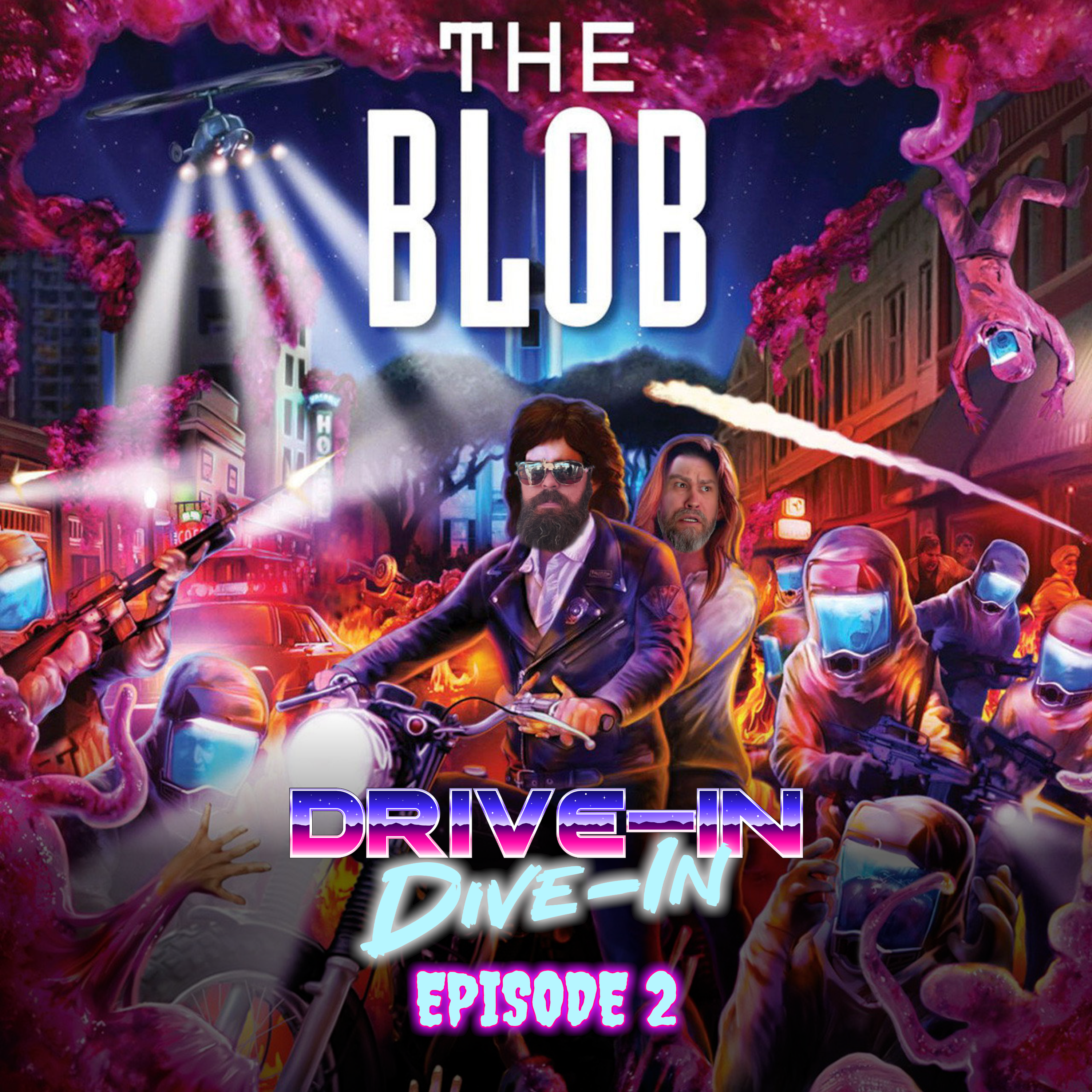
[00:01:47] Speaker A: Thanks for joining us. Hope you stick around. And today's double feature is the Blob.
So we got some great feedback after posting our first episode, asking us to give summaries of the movies for folks that want to listen but haven't seen the movies and don't necessarily have the time, which I think is a great idea for the next few episodes, which we've already recorded. I'm just going to give a quick rundown, but starting with the new episodes, it's something that Luke and I will do together.
We're going to keep it short and concise. And I'm going to kind of like dance around potential spoilers here and there. Obviously I'm going to like talk about the endings and basically all the main beats and some core things that we might discuss in the episode. Just kind of giving you top line notes of what you need to know in order to enjoy the episode. If you haven't seen the movie starting off with 1958 version of the Blob, at the beginning we meet Steve and Jane, your quintessential high school American sweethearts of the era, who see a meteorite crash nearby. While they're making out in Steve's car, Barney, an old man, finds the meteorite and the small Blob inside attaches to his hand. He runs out into the street screaming, gets hit by Steve's car, so Steve and Jane take him to the doctor. Doctor sends the teens away. Barney's body disappears, the nurse gets eaten by a blob.
While they're gone, Steve gets into a drag race altercation with some teenage ruffians before coming back to the doctor's house just in time to watch him be devoured by the Blob. They go to the police station, but they're hand waved away because they're teenagers and they're clearly just doing a prank. And a good deal of the runtime is Steve and Jane trying to get the adults to listen to them running from the Blob and rallying their friends to help. At one point, they hide in a walk in freezer and the Blob stops chasing them after it kind of like oozes under the floor and feels how cold it is. The Blob gets big for meeting people. It attacks a movie theater, which finally forces the adults to believe Steve and Jane about the Blob. The main characters get trapped in a diner with some other folks. They figure out it can't handle the cold, so everyone in town runs and grabs all the fire extinguishers they can find and they use them to freeze the Blob. They then ship it off to the Arctic, victorious and happy that the threat is vanquished. Now, in the 1988 version of the Blob, it takes place in a ski resort town in Northern California, which is an important point during an uncharacteristically warm start to the winter season. At the start, we meet the football star Paul and his cheerleader girlfriend Meg, your quintessential American teenage couple at a football game with nearly everyone from the town in attendance. Then we meet teenage Ruffy and Brian as he tries and Fails to jump his motorcycle off a broken bridge.
He has to go borrow some tools and parts from the mechanic shop where he works, but gets harassed by a local deputy on the way.
The meteorite crashes into the woods and an old vagabond finds it. The Blob inside attaches to his hand. We cut to Paul picking up Meg for a date. Then we cut back. Brian finds the vagabond with the Blob on his hand and tries to help him. The vagabond runs into the street and gets hit by Paul's car. The three take the old man to the doctor. Paul and Meg wait to see if he's okay and Brian bounces before the cops get there. Paul goes to check on the old man, finds him half gone, thanks to the Blob. Chaos ensues. A good deal of the early runtime is the teenagers trying to get adults to listen to them about the Blob. The Blob chases our main characters in a diner. They hide in a walk in freezer. The Blob stops chasing them because of the cold part of it freezes to the ground and shatters into blob sickle crystals. Creepypastor for some reason comes by and finds those Blob sickle crystals and saves some of them. The Blob kills a whole bunch of people. Then the government guys in hazmat suits and guns show up to quarantine the town and deal with the Blob. The teens flee from the government guys because they don't trust them. The Blob attacks a theater. Then chases Meg, her little brother and his friend into the underground aquifers. Not sewers. These are aquifers because it's a ski town. You've got all the snow melting at the end of the season. And they go. It goes into the aquifers. It is not sewers as I've heard other people talking about this movie incorrectly assume. It specifically says in the movie that they're aquifers. And if you understand that it's a ski town and a ski resort town, you get why. So then Brian tries to foil the government workers plans to save the town. Everything culminates in a standoff with a giant blob in the middle of town. Brian uses the town snow machine to ram the Blob and try to freeze it, but just gets caught in the process. Meg saves him from the wreckage. Pulls pins on some grenades from the government guys that were also in the wreckage. Well, the bodies of government guys that were also in the wreckage, which blows up the snow machine, freezing the Blob in the process and turning it into a mountain of blobsicle crystals. The town rejoices and begins their cleanup process. We think that's the end. But then we cut to sometime later. Somewhere warm, the creepypastor is giving a doomsday sermon. Then we see that he still has his fragment of the Blob in a glass jar, which is now thawed and hungry. And that is the end of the Blob. 1988.
[00:06:54] Speaker B: I enjoyed these much more than I thought I would. Especially the.
Where we watched the Blob and then the 1988 remake of the Blob. And I was pleasantly surprised, especially by the remake and its. Well, we'll dive into the details later. But yeah, it was a great suggestion.
[00:07:10] Speaker A: Awesome. Yeah. You know, it's funny, at the end of the last episode, I called the 1958 version the Black and white version. It's not. It is full color. But I remembered it being black and white. For whatever reason, it just aired on cable a lot on Turner Classic Movies and Sci Fi Channel. And I think because it was such an old movie as a kid, I just kind of like put it in the old black and white movies column in my head.
So that was when I put it on. I was like, oh, no, this is full color. And that makes total sense because the Blob is raspberry jam.
[00:07:44] Speaker B: Well, it's funny, I like to do a little bit of light research and I read somewhere and don't source me on this, but the director wanted it to be in black and white. But the reason that they chose color was for that, like so that the Blob could be colorful. Otherwise it just looked kind of strange, right?
[00:08:02] Speaker A: Yeah, it would be a very weird movie in black and white. I think it would look very different. So definitely glad they went color. We don't often get too much into like the nitty gritty of making of and accolades and whatnot. But I do like to touch on it some, especially when it's notable. Like here, 1958, we have Steve McQueen in his first starring role playing a 17 or 18 year old when he was in his 30s and looked about 42.
[00:08:29] Speaker B: I was about to say I was surprised. I believe he was 29, maybe not even 30 yet. The man looked much older than he was. I was like, why is this 45 year old playing a teenager? No, much younger.
[00:08:42] Speaker A: That's crazy. Yeah, well. And you know, smoking will do that. There's at least one scene where you can see some Haze or some smoke behind him because he was such a cigarette fiend, like such a smoker that he wouldn't even put down his cigarette. So there's somewhere he's holding the cigarette behind his back.
[00:08:59] Speaker B: Oh, like in a. So that he just has it.
[00:09:02] Speaker A: Yeah, yeah. So that he can take drags in between shots.
[00:09:08] Speaker B: That is debilitating, to say the least. I'm surprised that any director would put up with that. Although my understanding is the. Pretty much the whole cast was pretty. I don't wanna say amateur, but this was kind of their first big project, so it would make sense that maybe you can get away with a little bit more. And then of course, he becomes a superstar and you can do whatever you want.
[00:09:27] Speaker A: Yeah, exactly. Exactly. Which, you know, you wouldn't know it watching this movie if, like you had never heard of Steve McQueen before and you watched this.
I don't think you would pick him out and be like, that guy's going to be huge. Like, he wasn't really. In my opinion, he wasn't quite yet the Steve McQueen that we get later in his career. He didn't have that.
[00:09:46] Speaker B: No, I think you're right.
More.
I forget her name. But I think his co star, the female lead, was probably more notable than he was in this film. Although I don't think there were any, like super strong performances. Nothing that stands out to me.
[00:10:00] Speaker A: Yeah, it definitely is not a movie made notable for its acting. It was just a legendary creature feature. And I think the movie theater scene did a lot for it. Going to see a movie in the theater and then the blob happens in the theater. I'm sure psyched a lot of people out back in. Obviously, I think we. I think we should talk the first one before we get too much into the new one. But.
[00:10:25] Speaker B: But it's so hard not.
[00:10:28] Speaker A: And like it's. It's such a good remake, man. Why can't they bring back or remake good shows like BJ and the Bear? Now there's a concept I can't get enough of. A Man and his Monkey. I told you before, you watched it without trying to hype too much like that. The Fly, the thing.
All 80s, you know, all notable filmmakers remaking 1950s B movies into something legendary. And it's a shame that this doesn't get the recognition that the other two do. But there is a lot of charm to the old the Blob, especially the theme song written by.
Of course, now I'm spacing on it, Burke Bacharach.
[00:11:23] Speaker B: Okay.
[00:11:24] Speaker A: I don't know Maybe too young to know Burt Bacharach. He was a pretty big singer at the time.
And I'm pretty sure in the first or second Austin Powers movie, he has a cameo. And literally, Mike. Mike Myers is. Austin Powers is like. Ladies and gentlemen, Burke Bacharach.
[00:11:40] Speaker B: I do recall this.
[00:11:41] Speaker A: Yeah.
[00:11:41] Speaker B: And I do remember starting the film and it's like.
It has, like, lyrics and.
Are we watching a Saturday morning cartoon? This seems very. It did not seem kind of thematically appropriate, but it was funny.
[00:11:56] Speaker A: Yeah. Very, very off the wall, very tongue in cheek, but very, like, trying to tap into the weird zeitgeist. You know, Rock and roll was super new.
[00:12:06] Speaker B: Oh, sure.
[00:12:07] Speaker A: You know, at the time.
And Beach Boys were getting really big. And I think they were just kind of trying to like, hey, we're cool, it's the Blob Come check it out on your date with your honey.
[00:12:27] Speaker B: Babe we're cool, it's the Blob
[00:12:33] Speaker A: Come
[00:12:33] Speaker B: check it out On a day
[00:12:39] Speaker A: yo,
[00:12:40] Speaker B: hey, it's the block.
Well, it certainly felt like they were trying to tap into the, you know, obviously the car culture, the rock and roll culture, potentially, as people who didn't quite understand it. I don't know if I'm reaching too far there, but it felt very caricature driven.
[00:13:03] Speaker A: Absolutely. And that's, you know, certainly because it was somewhat new.
Something interesting that I didn't realize until I was kind of doing some research and looking into the culture around the movie. When it came out, the term teenager did not exist 10 years prior to this movie coming out.
[00:13:24] Speaker B: Okay.
[00:13:25] Speaker A: It was an early 50s thing.
That age bracket was not classified any differently because by that point in time, they were in the workforce.
[00:13:36] Speaker B: Sure.
[00:13:37] Speaker A: But as industrialization came out and child labor laws started. Started getting passed, now you have all of these kids who do not have factories to go to after school.
You have the rise of the automobile. Because think about it, we're in 58 when this came out, Right. Like, everyone having a car and cars being inexpensive was also very new within 10 years or less. Right. So this is all new in a very scary way for some people.
For older people, Right. You've got all of these miscreant teenagers running around, around. You know, it's where the whole greaser vibe came from. And, you know, surf culture, like, all this stuff was all very culturally new. And this term teenager was coming up. So of course they make a movie. They start making movies about them because they need somewhere to go. It's a new demographic that has money, that has modes of transportation. They have Cars, they want to go somewhere, so they're going to go to the movie, they're going to go to the drive in, Right? They're going to go see movies. So let's make movies about them.
[00:14:42] Speaker B: They're gonna race their cars in the street and be rebellious and go to the diner and let's go up a little battle. What?
[00:14:49] Speaker A: Yeah, exactly. So, I mean, that was just something that was really fascinating for me to think about. That a lot of what you're seeing there with the way that the car culture and the teenagers are depicted is kind of like how the Internet was depicted a lot in the 90s.
[00:15:02] Speaker B: Do you know anything about hackers?
Can you jam with the console cowboys in cyberspace?
[00:15:08] Speaker A: What?
People didn't really get it, but it's what the kids were doing and they're trying to fit it in to this motif and this narrative.
[00:15:17] Speaker B: Well, there's certainly this element of anti authoritarianism in there. Like the police are useless and none of the adults listen and it's up to the kids to go and save the day and all that sort of thing.
Realistically, I think the only adults that are helpful are maybe the diner owner through necessity, out of.
Although it is one of the places where the teenagers would actually have some.
Like, that's where they'd hang out. So there's maybe some sort of empathetic connection. But yeah, I definitely see it as opposed to maybe a cautionary film about this, like a reefer madness or that sort of thing.
This is more playing up the, I don't know, the value of that teenage rebelliousness, but at least showcasing it as some sort of entertaining thing rather than holding it up as a caution.
[00:16:08] Speaker A: Oh, for sure. Yeah. I mean, they're definitely the actual hero of the tale.
[00:16:14] Speaker B: Although the good one is the one that's less rebellious. Like, he's still rebellious, but he's like, does the good the right thing more so than not.
[00:16:24] Speaker A: Right? Exactly, exactly. You know, and by the end, the girl, you know, saves the boy and he's like, I will have children with you. Like in his eyes, he doesn't say it, but you can tell. That look is that 1956.
[00:16:39] Speaker B: She's proving herself worthy, right?
[00:16:43] Speaker A: Which, like, there are a lot of. There are definitely some similarities in the characters, you know, the teenagers. Thankfully, the adults aren't all haunted house husbands is what I like to call the trope where, like, regardless of evidence or lack thereof, they just refuse to listen to the person that knows what's going on.
It's, you know, the most tired and frustrating trope with a lot of haunted house movies is the husband is like, honey, quit being crazy. You need to get friends. It's just a new house. Right.
[00:17:15] Speaker B: With my wife, I've actually had the conversation. I'm like, okay, if you ever come to me and you tell me there's a ghost or an axe murder, we're gonna make a pact right now. We just believe each other. Because I don't want to be a haunted house husband.
[00:17:28] Speaker A: Right, Exactly.
[00:17:30] Speaker B: Maybe let's approach it methodically. But, yeah.
[00:17:32] Speaker A: Hashtag believewomen.
[00:17:34] Speaker B: Well, and believe it. When you know someone that you're purported to love tells you that there's something bothering them, regardless of whether it ends up being real, they at least think it is.
[00:17:42] Speaker A: Right. And you know what? To those of you out there that are listening, a vast majority or a large majority, I won't say vast, but a good number of incidents where people are convinced that there is a ghost in their house.
They have a gas leak.
[00:17:59] Speaker B: Oh, sure. Like inventory, gaslighting. Yeah.
[00:18:02] Speaker A: There's a carbon monoxide leak, and you are being poisoned. And so, like, if your loved one starts having delusions, you think having delusions, or they are convinced that your house is haunted. Either. Maybe it is. Maybe you're on a portal to another plane of existence. Maybe you have a gas leak, or maybe they're having a psychotic break. Either way, no matter which of those it is, you should listen to them and investigate and support. Right. Like, that's. And if a bunch of kids in the neighborhood are saying that there's a blob from outer space that is eating people and the people they say it eat have disappeared, maybe listen to them
[00:18:39] Speaker B: just, like, look into it a little bit.
[00:18:42] Speaker A: Oh, it's just another high school prank. Well, it looks like we've got a high school prank on our hands. The fit today, since we're talking aliens, is.
[00:18:51] Speaker B: Oh, nice.
There we go.
[00:18:54] Speaker A: Yeah. The Faculty. Another classic teenage alien movie.
[00:18:59] Speaker B: Maybe we'll have to do that one.
[00:19:00] Speaker A: Yeah, it's good. We'll have to. Maybe that and Invasion of the Body Snatchers. Because there have been a lot of Invasion of the Body Snatchers.
[00:19:08] Speaker B: Sure.
[00:19:08] Speaker A: But then it's like, do you do the original or do you do the 78? Because the 78's better, but the original is the original conundrum. We'll figure it out.
[00:19:16] Speaker B: Well, as we just found out, sometimes the original isn't. Well, yeah, you just implied that the original is not better.
[00:19:21] Speaker A: Yeah, I don't think there is such a vast degree of Difference as there are with the other ones we talked about, it's just the 78 is better. Whereas these like, you know, the Blob. The original Blob is very fun and it really does shine a light on a lot of things happening culturally at the time. We already kind of touched on teenagers and we'll get into some other stuff, but it doesn't have the quality or the talent behind it that the 88 version did.
[00:19:51] Speaker B: Yeah. I'm actually interested to hear your thoughts on kind of the inspiration behind the Blob.
Obviously it's sort of like indiscriminate, all consuming, growing thing.
And I'm not certain, I'm not certain if it's ever codified, but is it some sort of anti consumerism thing like zombie films are.
Is there something political in it? Is it just.
I'm not sure, but if you have any thoughts on that.
[00:20:20] Speaker A: Yeah, absolutely. So there are two sides to the coin in the 1958 version in my take, and I'm. People have talked about this a lot. You know, there are some other takes. There's a whole other discussion to be had regarding the 88 version. So I want to focus on the original first. I think from the actual filmmaker's intent and more on the surface level.
[00:20:41] Speaker B: It's the Red Scare, evil and godless communism.
[00:20:45] Speaker A: Right. We are. We're pushing quite literally. Yeah, quite literally. Yeah, exactly. It is red at the end.
Spoiler alert. You know, this is a good place to say this. Kind of meant to say it in the intro. We'll try and tack it into the intros that we add on to all the episodes. But we analyze films here. We're gonna spoil everything in the movies we're talking about. If you haven't already seen the 1958 and'88 blob, I definitely recommend seeing them. Definitely. At least watch the 88 version before listening to this because I don't want you to cheat yourself. Oh, wait, look, darling, don't cheat yourself. Treat yourself. With the 58 version, the blob is red. It comes from outer space during the height of the space race. Right. And that competition and the Red Scare, nuclear war scares kids having to do drills under their desk in case of nuclear warfare.
And at the end it gets defeated by sending it back to somewhere cold.
[00:21:48] Speaker B: Oh, okay, sure.
[00:21:50] Speaker A: Like on the surface, like it is communism. Right. That they intend the Blob to represent on a deeper level and probably unintentionally, it very much reflects the xenophobia of America at the time that was Funneled into the Red Scare.
[00:22:13] Speaker B: Okay.
[00:22:14] Speaker A: And in that, I kind of mentioned when I suggested this episode that it is a very Lovecraftian tale for two reasons. One good, one not great.
The good side of that is it is an indiscriminate, incomprehensible being, creature thing from beyond whose motivations are largely unknowable. Other than that it consumes and grows, it looks, sounds, acts nothing like us, adheres to no properties of any living thing that we can comprehend and is spooky in that sense. Right. It threatens the whole of existence. Had it not stopped at the exponential rate it was going.
[00:23:01] Speaker B: Yeah. It would have overtaken. It's interesting because much like Color out of Space, that's what it's called, isn't it?
[00:23:09] Speaker A: Yes.
[00:23:11] Speaker B: Also an excellent film made recently based on that.
But yeah, it's also this world ending threat that's defeated by kind of a localized. At a smaller scale. Yeah.
[00:23:21] Speaker A: So, you know, you've got that side of the Lovecraftian and then you have the bad side of the Lovecraftian tale, which is the xenophobia. Right. I am a big fan of the lore Lovecraft created.
His writing, often not so much in large part because it is widely driven by his hatred of the other. Shadow Over Innsmouth is arguably one of his best tales. Like, it has a lot of really iconic moments and imagery that have influenced horror ever since in a lot of ways. Right.
But if you boil it down and if you actually like read the letters that he wrote about it, things like that, it's about race mixing and how horrifying that is. The main character learns that they're part fish person in Smith Ian.
And that's the big horror reveal.
[00:24:22] Speaker B: Right.
[00:24:23] Speaker A: It's a rehash conceptually of another story he did about a white ape monster and this guy finding out that he's bored ape.
[00:24:32] Speaker B: I mean, even similarly in this film, especially with older films, I like to keep an eye on kind of the racial breakdown. I believe the only non white person I saw was working the candy counter at the theater. Yeah, I could be wrong on that. But that's the only one I remember seeing.
[00:24:46] Speaker A: Right.
Yeah, absolutely. You know, so it's a lot of, you know, this town is the picture perfect godly white America, you know, and the blob is the other. It is Russia, it is communism, it is atheism. It is all of these things that are threatening the perfect way of life in America. Right. Your heroes are the quarter, the football star. I don't remember if he's Quarterback, but the football star and his girlfriend. Right. In that sense, it's like dark side version of Twilight Zone. It's very much a Twilight Zone episode, but with the wrong kind of message.
[00:25:32] Speaker B: Well, and it's funny, and I hope I'm not jumping too far ahead, but I feel like the remake really subverts that. Like, directly subverts that.
So I don't know if you want to jump to that, since we're on the subject, or we'll pin it.
[00:25:45] Speaker A: We'll pin it for a second, sure.
But yes, 100%. Like, some really nice subversions in the sequel, which is part of what makes it really smart and a good. Not sequel. Remake. Sequel, not good. Remake. Great. There was a sequel, Son of Blob also. Yeah, I think that was the final version that had a bunch of names, but one of them was Son of Blob.
[00:26:08] Speaker B: I like the name.
[00:26:10] Speaker A: Basically, the Blob comes back, does blob things again. But yeah, so it is an interesting Lovecraftian tale in that it harkens to a lot of what Lovecraft's horror was about and is a very accurate depiction to the kind of alien that Lovecraft imagined was real. If aliens were real.
[00:26:32] Speaker B: Well, and also just this idea that they don't generally even have, like, a super intelligence. It's more of just like. Like their horrific and enormous power is simply enough without any sort of meaning needed to be behind it. Just this dumb God creature sort of thing, right?
[00:26:54] Speaker A: Yep. Yeah, yeah, yeah, exactly.
This gibbering thing from beyond space and time.
And, you know, they defeat it with good old American ingenuity and clever thinking and teamwork. And, you know, the first one wraps up really great ending. Ending. Probably one of the best parts of the movie. I mean, directly following some of the worst special effects you'll see back when
[00:27:24] Speaker B: they use, like, balloons filled with jelly and things like that.
When it overtakes the diner car, it
[00:27:32] Speaker A: literally drew its hand animated on top of the cell. Yeah, I.
Computer generated. Before computers existed, like, literally just hand animated special effects, really. I mean, pushing it for the time, you know, good for them, but does not hold up.
And then, yeah, dropping it in the Arctic, you know, super smart and, like, there's a line at the end that makes it like, wait, did they know about global warming back then? I don't think it can be killed,
[00:28:07] Speaker B: but at least we've got it stopped.
[00:28:10] Speaker A: As long as the Arctic stays cold.
Like, was that a setup or was it a cheeky, like, we're good forever, like, throwaway line? Right.
May have not intended it to be as ominous as it was, as it is now, but certainly an ominous feeling now with that final, final line in the original.
[00:28:32] Speaker B: Well, and it gives a lot more context, obviously in modern context, but that we can use for this kind of criticism of the thinking at the time, at the very least, if it was not meant to be referential, because that's how we got here, as you said. Actually adds a better flavor to the ending. Unfortunate flavor, but yeah, yeah, absolutely.
[00:28:55] Speaker A: The sequel is a wild story in how it came about and so thankful that it did. But Chuck Russell and.
[00:29:09] Speaker B: Oh, the remake.
[00:29:10] Speaker A: Yeah, the remake. Sorry, the remake. Did I say sequel again?
[00:29:13] Speaker B: Yes, but I'll assume henceforth.
[00:29:15] Speaker A: Assume henceforth. If I say sequel, I meant remake.
[00:29:19] Speaker B: Yeah.
[00:29:20] Speaker A: Actually, before I get into the making of, let's talk about the pedigree of this movie. Man, Chuck Russell, this is one of his best, but he also. He did the Mask. He did some, you know, one of the. Jim Carrey's big Three during his breakout year, which was a very hard push forward in CGI technology and still holds up pretty well. But more than that, his writing partner, Frank motherfucking Darabont, like the arguably, you know, probably not arguably, one of the best screenwriters and filmmakers of all time
[00:29:56] Speaker B: is this the one who was involved in Nightmare on Elm Street.
[00:30:00] Speaker A: So they both also did Nightmare on Elm Street 3 Dream warriors, which is the best of that series. That's kind of what really cemented them because it did Gangbusters. It was the best blockbuster wise and audience and critic reception at the time of the series really kind of helped them move forward. Frank Darabont is best known for making the best movie ever made, the Shawshank Redemption.
[00:30:30] Speaker B: Oh, sure, yeah.
[00:30:31] Speaker A: Written and directed and came out the same year as the Mask, which is really funny because they worked together on some really great stuff and then went and did their own thing. And Chuck Russell gave us the Mask, which is super fun and helped launch two careers and push special effects forward, but is largely an entertaining movie. And Darabont gave us the best movie ever made.
It's an interesting. Have you seen Shawshank?
[00:31:03] Speaker B: I actually saw part of it maybe two days ago on the background in the bar. But yes, I have.
I need to sit down and do a real watch through at some point, though.
[00:31:13] Speaker A: Yeah, for sure. I mean, some people are going to scoff at me saying it's the best movie ever made, but it is my number one. I don't think anything will ever see it. And it is largely considered the best screenplay of all time, Darabont, is in the short list of unquestionable best screenwriters ever to do it. Up there with William Goldman and Billy Wilder as, in my opinion, kind of the three or three of the best screenwriters of all time. Especially when you look purely at writing and not auteurs or writer directors.
[00:31:46] Speaker B: Well, and I would argue that it's pretty evident that the.
The caliber that you're mentioning. I think my only complaint with the remake is that it feels a bit compressed at the very end in my suspicion, given that from what I can tell, they're using a lot of custom sets and giant props, and the special effects are pretty crazy for the time. They probably ran out of time or money.
The movie's only about an hour and 25 minutes long.
I think it would have have benefited from another 10 or 15 minutes.
I certainly would have benefited from it.
But, yeah, that's my suspicion at the very end that there was a cut for time sort of thing.
[00:32:27] Speaker A: I think that's certainly part of it. They were given money, but not as much as they wanted. And it changed production company hands multiple times.
There's a whole rigmarole about this movie getting made. Just like with the Fly, with two of these three and maybe even the Thing. I know the Thing had a little bit of back and forth, but the Fly and the Blob specifically had a lot of bouncing around from production company to production company in the course of actually getting it made. But basically, Russell and Darabont worked together, were friends and co writers collaborators, and wanted to make a feature together.
They ended up getting hired to do Dream Warriors.
Absolutely knocked it out of the park.
It's so good. With the exception of one thing about the end that I won't specifically say because I don't like spoiling things for people that haven't seen them when we're not covering that movie and have not warned. But if you haven't seen Dream warriors, go watch the first, second, and third Nightmare on Elm street movies. The second one's not tied to Dream warriors, but it's really good and underrated.
[00:33:45] Speaker B: Maybe we'll have to do those soon.
[00:33:46] Speaker A: Yeah, you know, I'd be interested. I don't know if you've seen them or not, but, like, I'm always.
[00:33:51] Speaker B: I've seen the first.
[00:33:52] Speaker A: Okay. Yeah. Definitely curious to know your thoughts on them.
I was really excited to try and start getting Allison into more. My wife Allison, into more horror because she's not super into anything that's not zombie or, you Know, kind of that whole vibe.
And so I showed her the first Nightmare on Elm street and she was like, that was stupid. I was like, ugh, Dreams dashed. I thought we were gonna watch the whole series together.
[00:34:21] Speaker B: It's supposed to be a bit silly, I think.
[00:34:22] Speaker A: Yeah.
[00:34:23] Speaker B: I feel the same way about Hellraiser in some ways. Like, you could look at it that it's kind of stupid, but I like stupid things.
[00:34:29] Speaker A: Yeah. Fair. Yeah. You know, nothing wrong with some stupid fun every now and again, like the Blob, but.
[00:34:34] Speaker B: But unfortunately, and from what I recall, and I have some notes here, but I can't find it in there. I think the remake did not do very well in theaters, but maybe did well once it hit home video release.
[00:34:47] Speaker A: Yeah, yeah, it definitely struggled a lot.
It opened up against a lot of really big movies. It was a good year for cinema. And it just kind of struggled in the landscape of what was in the theaters at the time. So it did not do great in theaters. It definitely has gotten leg.
Became a cult classic. It got really popular on home video. It got played on HBO all the time and kind of became this thing that people knew more about and has gotten a really big fan base as a result.
People have come back and grown to appreciate it both for how well it's created, how well it's written and produced, but also the special effects, which are some of the best practical effects of all time. Up there. Again with the Thing and the Fly and Alien.
[00:35:38] Speaker B: It actually had a lot more in common with the Thing than I thought, than I expected. Even having seen the original first.
The level of gore and that kind of dark, gritty tone, in some ways, I think it exceeded the Thing in some scenes. I don't think as a general rule it did, but very impressed.
The first on screen Kill is one of the most brutal I've ever seen.
[00:36:01] Speaker A: Yes.
[00:36:02] Speaker B: The actor I'd read was, like, actually suffocating in the suit, which. Not good. Don't like that. Suffocating on Strawberry Jam does not sound fun to me.
[00:36:12] Speaker A: No.
[00:36:12] Speaker B: But, yeah, once I saw that, I knew I was in for a very different film.
[00:36:17] Speaker A: Absolutely. And we'll talk a little bit more about exactly why on that in a minute. But just on a technical level and a kill level. Yeah, man. This movie.
I saw this kid. I saw this movie as a kid. This movie fucked me up, man. Like, straight like that kill traumatized me.
It is so impressive. It is so well done. It looks so good.
I'm not going to spoil the magic of how some of those shots were done. But if you watch with the commentary, there's a commentary track on one of the more recent Blu Rays that has the head of the VFX and Chuck Russell and they talk about it and you're like, wow, that is fucking clever.
[00:37:01] Speaker B: Yeah. I have to wonder how some of it's done without. Because I don't believe there was any computer.
No cg?
[00:37:07] Speaker A: No. And Chuck Russell really wanted to use cg, but they could not get it to look good. So everything is practical. Which is, like, interesting to see him go on and do the mask because he was trying so hard to push CG and he thought it was gonna be a really good solution for the Blob, but they couldn't get it to look good. So everything is practical. There's no C.
There are green screen shots. There's a lot where. Well, sorry, blue screen for the time where they did miniature stop motion and then blue screen. So, like, when it's going up the wall behind him. Right. Stuff like that. The movie theater when it's coming out. Oh, gorgeous shot, right?
[00:37:51] Speaker B: Yeah.
[00:37:52] Speaker A: So good. So much better than the jelly being pushed through in the first movie.
I.
For at least a year, years. One of my most, like, vivid memories as a kid is whenever I was taking a shower or, like, moving around the house checking the ceiling because I was convinced that the Blob was gonna come down and fucking eat me for lunch, man.
[00:38:21] Speaker B: Yeah, I think for me, that was after I played Halo for the first time as a kid thinking that there were flood zombies. But, yeah, definitely, definitely impressed with the level of kind of graphic violence.
I think that it looked good, which was the surprising part.
There's slasher films and there's movies with horrific implications of violence. But this looked good, and that made it even more horrifying. I had a much easier time taking the remake more seriously than the original. It took that. That tone, that grittier tone. And as we'll get to it, really subverted a lot of the philosophies that I disagreed with that were being espoused in the original.
[00:39:03] Speaker A: Yeah, absolutely. I mean, there is so much care that was put into every aspect of this. And I think it's partially because of the way that it was made. So a. Was Darabont and Russell, like, doing a movie they wanted to do.
They wanted to do something original, but they knew a remake would get them produced. Chuck Russell himself went to the original filmmaker of the 1958 Blob, talked with him, pitched his idea. People had been trying to remake it for forever and he had said no, but he just. He really resonated with what Russell had envisioned and the treatment and, you know, that they were going to really do it justice. And so he agreed to license the rights for a dollar.
[00:39:53] Speaker B: Oh, a gentleman's bet.
[00:39:55] Speaker A: Yeah, yeah, yeah. They shook hands on it. And, you know, so I think that Russell especially really wanted to do right by him and right by the film and the concept. And it was, you know, one of those movies that he always loved growing up.
And speaking of that quick tangent, our female lead, did you recognize her?
[00:40:18] Speaker B: Yeah. From Saw.
[00:40:19] Speaker A: Yeah.
[00:40:20] Speaker B: I didn't recognize her at first, but when I was looking through the cast list and then it was evident.
[00:40:25] Speaker A: Yeah.
[00:40:25] Speaker B: It's so interesting seeing the actress and I can't forget her. I can't remember her name right now, but just in this different context. But still, there's so much similarity between just, like, the strength of, like, overcoming and being the kind of the overwhelmingly, like, what do you call it? Adamant force that gets it done, as it were.
[00:40:49] Speaker A: Shawnee Smith. Shawnee Smith is the actress Shawnee Smith.
[00:40:52] Speaker B: Right. Her character was, I believe, Amanda in Saw.
[00:40:56] Speaker A: Yeah. Hello, Amanda. But fun fact that I wanted a tangent on that.
James Wan said he cast Shawnee Smith as Amanda because he had a crush on her growing up. He has also said in interviews that the Blob was one of his favorite movies growing up. Up. Shawnee Smith was Amanda in Saw because of the Blob.
[00:41:13] Speaker B: That's great. Yeah, maybe. Hopefully he wasn't too weird about the crush thing, but other than that.
[00:41:19] Speaker A: Yeah, I'm sure it was an innocent thing. They seem to have a good rapport. They put so much care into all of this. They really wanted to push special effects forward and were doing everything that they could. Even the opening sequence is very deliberate and intentional in a lot of really interesting ways.
The cinematographer specifically wanted to get shots of the town empty because everybody's at the football game. Right.
[00:41:47] Speaker B: Sure.
[00:41:47] Speaker A: In part to show like, this is such a small town, it is emptied out. But also to see it all while it's idyllic, to see it all while it's picturesque. So that at the end when it's all chaos. You have that juxtaposition in the bookends.
[00:42:02] Speaker B: Yeah. A direct comparison there. I've got to imagine living in. I think it was a small town in Alabama or something like that living there. I believe.
I believe it was shot in Louisiana.
[00:42:14] Speaker A: Louisiana. Used to be.
[00:42:16] Speaker B: It was shot in Louisiana, Northern California, because they said they're like an hour from Sacramento and Being from Sacramento, I promise nothing around here looks like that place.
Yeah.
[00:42:24] Speaker A: Yep. Yeah, you're right. Yeah. And they used. Just like in the original, they used a lot of the town as extra.
And that's a fun comparison. It's very easy in the first one because making movies was such a novelty.
Like half of the cast running out of the theater are looking at the camera and smiling, which is hilarious. But you can play Spot the Starstruck extra in the 88 version and there are crane shots where you've got them just looking right up at the camera.
Yeah, wonderful. Wonderful, Stu. Yeah. So, you know, even just from the outset, they're really intentional. They're thinking a lot. And I love that the last shot of the town is this cemetery backing up to the football game where everyone is just like death is looming directly behind them. And I thought that that was a really smart, subtle thing. The cinematography, I think, is excellent. The performances are great. Shauny, obviously we've already talked about. But then you've got our boy Johnny Drama just absolutely killing it as the mullet laden bad boy and someone that you wouldn't expect to be who he was. Right. Talking about subverting expectations.
[00:43:44] Speaker B: Yeah. Well, they immediately set it up like it's the original, where you expect the football player to be the good guy and the bad boy to take the place of the.
The racers, who to some extent are helpful later on, but are kind of the initial antagonist.
So I do love that it immediately kind of flips that script with watching I forget the football player's name, but Paul. Watching Paul completely disintegrated.
Yeah, yeah.
[00:44:15] Speaker A: I mean, just really, really smart. And I think that is part of where Russell and Darabont shine as a duo. Is Darabont really great at making believable characters with realistic relationships that you can connect with? And you see a lot of that throughout and roll the dice on whether or not those people are dying, man. Chuck Russell's like, kill him.
And that is one of my favorite things in film and tv.
Part of why the Exiles is one of my favorite comic book series is the ruthlessness of a writer to not be married to any character, to have the gall to say, no one is safe, anyone can die at any moment because then you really care. Right. There are a lot of things that made Game of Thrones really good, but spoiler alert, Killing Ned Stark at the end of the first book season one, man, that was it. I was like, holy shit, I am sold.
You got me hooked, man.
[00:45:23] Speaker B: No, I did not expect there's no
[00:45:25] Speaker A: reason to expect Paul to get brutally killed on screen.
[00:45:31] Speaker B: And then you have Brian, who immediately gave me, even visually. What's his name, James Hurley. Vibes from Twin Peaks. In fact, a lot of the film had kind of that aesthetic. But, yeah, You know, he's the bad boy motorcyclist who you at first think is maybe culpable in.
I shouldn't give Twin Peaks spoilers.
But immediately culpable for a crime and then you find out is anyway.
[00:46:25] Speaker A: Yeah, but we're given a little bit more justification for the way the police treat Brian than we were the way that they treated Steve McQueen in the original.
And I love that. With a writer like Darabont, you don't need a monologue.
Right. You get one line from the sheriff or from the deputy to Brian. Congratulations.
For what?
Well, I hear you have a birthday coming up. No more juvie hall, right? Yeah. Right.
Now. You mess up now and you're in the majors.
I'll see you around, Flag.
It's like your birthday's coming up soon, Right. What do you care about?
Means I get to try you as an adult, Buddy.
[00:47:15] Speaker B: For what? He seems like a pretty good guy, actually.
[00:47:18] Speaker A: Yeah, but I mean, that tells you so much about their relationship, about the town. Right. About who both of them are as characters.
Just really, really smart. And then you have stuff from Chuck Russell that you're just like, come on, buddy. Like the old urban legend joke about getting the prophylactics and then the father of the date being the guy that you bought the condoms from. It's very, very silly, very unnecessary, but doesn't really detract from the movie too much.
But, yeah, I just. I love that no one is safe. You get really, really connected to the sheriff. And I think it was. Was it Ms. Penny, the. The woman who was working at the diner and their relationship?
[00:48:06] Speaker B: Yeah. Kind of the mother figure for Brian. Sort of.
Yeah. You don't see much of the diner in that one, but at least there was a little bit of a throw in.
[00:48:16] Speaker A: Yeah. And those two characters. Oh, Fran, right? It was Fran and Sheriff Herb, I think.
Great rapport. Yeah. Her relationship with Brian, even with that initial shock, you're like, we're meeting our dirty dozen. We're meeting our final five. Right. We're meeting these core characters that are definitely going to live and make it. It, like, not only is that not true, but she gets killed in probably the second or third most brutal.
[00:48:45] Speaker B: I mean, the kid was pretty brutal, too.
[00:48:47] Speaker A: That's true. They're all pretty brutal.
[00:48:48] Speaker B: Another character you thought was gonna make it. At least I assumed.
[00:48:51] Speaker A: Yeah. Yeah. But yeah, the technical marvel of that phone shot is so choice. And then just.
You don't even see the sheriff die on screen. Like, he is just in the blob, pressed up against the phone booth right before it crushes Fran. Brilliant. And then. Yeah, killing kids. You know, nobody's safe. Kids aren't safe. Nobody's safe. Just getting dragged under the water. Man. That was.
[00:49:18] Speaker B: And he pops up, like, all burned.
[00:49:21] Speaker A: Yes.
[00:49:21] Speaker B: Which I assume was a stunt double, but it was.
[00:49:24] Speaker A: Yeah, it was a little person stunt double who's apparently, like, super, super well known in the industry and has done a lot of really awesome stuff. Stuff.
Yeah. Russell had very good things about putting
[00:49:39] Speaker B: a kid in, like, plastic or rubber prosthetics and throwing them in the water. But I don't know. They did a lot of crazy stuff they did.
[00:49:45] Speaker A: It was the 80s. Yeah. No, the stunt team definitely did a lot there. And, yeah. I mean, I love the evolution of Meg. I love that it's not just like Brian does everything right. Like, he has his moments, including driving the snow machine into the Blob, but then he's fucked and she has to come and save him and help actually save the day. She has her Ripley, you know, get away from her, you bitch moment, which is wonderful.
It was pointed out in the commentary when she first grabs the rifle and turns the safety off and it kind of like just bra. And she gets that surprised look on her face. She apparently had minimal weapons training and that was a real reaction.
[00:50:34] Speaker B: I hope it was filled with blanks.
[00:50:36] Speaker A: It was.
[00:50:38] Speaker B: But, yeah, as you said, it's an evolution. She's not immediately powerful. Right. In fact, I think you see a clear timeline of whenever she's faced with a new obstacle, steeling herself in a new and unique way. I think especially when she's leading the kids through the sewer sequence.
I think that that's when you see it really clicking in and it's just like, okay, well, someone's got to do this. Someone's got to take charge. No one's listening. No one's able to help, regardless.
And then also just dealing with watching horrific death after horrific death, but also persisting through it. Right. I think it's very easy to kind of give up in a situation like that.
And then, as you said, finally getting that rippling moment at the very end. And it is a.
A partnership between her and Brian, but I think that he doesn't really show much character growth or development. I think it's really her movie. I think he's pretty flat throughout.
[00:51:37] Speaker A: Yeah, agreed, agreed. You know, if anything, his arc isn't for him to change, but to prove himself to the town.
Not because he wants to, but because, like, he's like, I was fucking wrong.
[00:51:51] Speaker B: Right?
[00:51:54] Speaker A: And I'm not a fuck up. I just saved all of you. Right?
Get off my fucking back.
And I mean, talking about subverting expectations, we go from a movie about an alien, amorphous blob that is a kind of representation of Russia and the Red Scare and xenophobia.
And now we'll start getting into the thematics. In the 88 version, man.
[00:52:21] Speaker B: Man.
[00:52:21] Speaker A: It's a chemical weapon made by the American government. They're coming in. They were probably going to kill everybody in that fucking town, you know, And Brian's the only person that was like, no, do not.
We should not trust them. Let's not trust them. Let's. Let's get the fuck out of here.
[00:52:40] Speaker B: Well, and it's a completely anti. Like, the first one was very like, go, America. Democracy, as you say, if that's the red skin.
But this one definitely has that, like, late 80s, like, cynical attitude. Don't trust the government.
You've got the E.T. guys come in. I think they use the same E.T.
woods that they shot for E.T.
[00:53:02] Speaker A: right.
[00:53:04] Speaker B: In that.
Also leaning into Twin Peaks with the shadowy corporation or shadowy organizations that are just completely untrustable and unknowable that are doing horrific things.
[00:53:19] Speaker A: Yeah, absolutely. And I think that's part of what makes all three of these movies that we keep talking about, like the 1980s remake trio, so good, is they're not just interesting stories with solid, deep characters and incredible special effects and shocking gore. They're also really deep, layered stories that say so, so much. Right. Like, the Fly was Cronenberg's exploration of his mom dying of cancer. Right. And the way cancer overtook her body.
Right.
And then, you know, the Thing is. The Thing, you know, there's a lot going on there. The Thing was very much like making commentary on the AIDS epidemic and a lot of other things that were going on.
[00:54:15] Speaker B: Well, and do you know if it had any direct inspiration from the Blob? I know that there was the Thing from Outer Space. I think that was potentially inspirational.
[00:54:24] Speaker A: That was, according to Carpenter, the Thing from Outer Space was his primary inspiration. Yeah. I mean, I'm sure the Blob was in there a little bit, but, yeah, it was primarily a pseudo remake of the Thing from Outer Space.
[00:54:36] Speaker B: Sure.
[00:54:37] Speaker A: And then, yeah, in the 88 blob, right. You've got all of the mistrust of the American government as various things are bubbling to the surface or coming to light right from Agent Orange and chemical warfare exposure and all of the shit that happened in Vietnam, all of the mistrust that came out of the Vietnam conflict in the first place.
MK ULTRA was at the very least like bubbling to the surface as a conspiracy theory. And you were at a point in the tension of America and American politics where conspiracy theories had been proven right a bunch of times. And like there were all the questions about JFK that were still fresh. There were all the questions about everything else. Iran Contra was another one where the government was proved to be lying. It was just like all of this. You, you can't trust the government. You can't trust the government. They lie, they're doing sneaky shit. They're not going to take care of us, they don't care about us. And that's a lot of what you see in, you know, the surface messaging of what's going on here. Where are we going? Back to town. Arborville is under quarantine until we've isolated that organism and checked everything living soul for signs of infection. In the meantime with your prisoners. Not at all.
[00:56:01] Speaker B: You're my patients.
[00:56:03] Speaker A: Sounds like the same thing to me.
[00:56:05] Speaker B: Not only can you not trust the government in this case, they are actively undermining you and doing things for they might consider it the greater good or whatever it is, but potentially sadistic reasons even because it seems as if the well meaning men in suits who appear at the beginning going to help them, but then by the end they're just like randomly and wantonly killing people effectively for the sake of selfish research or some element of sadism even.
[00:56:35] Speaker A: Yeah, absolutely. And it's interesting to see the kind of evolution of threat in the film and reflects kind of, I think a prescient outlook on the country because the threat starts assumed to be external, turns out to be the government trying to control via violence, via war, via scare tactics.
And that doesn't work. And the blob is defeated, right? The small town pushes back fascism, which like Russell has said that like that whole thing is specifically talking about the rise of authoritarianism in America. Do you suppose an army of guys
[00:57:28] Speaker B: in plastic suits show up every time a meteor falls?
[00:57:32] Speaker A: Shoot him. That's a direct order.
[00:57:34] Speaker B: That's what a Nazi would say.
[00:57:36] Speaker A: He's like, yes, that is what we
[00:57:37] Speaker B: were talking about that post Reagan push for unsupervised authority.
[00:57:42] Speaker A: Yeah, absolutely. Yeah, exactly. And like, you know, a Lot of the fears that people were having that, you know, National Guard was going to come into their state and try and take over.
[00:57:52] Speaker B: That would never happen.
Right.
[00:57:56] Speaker A: And I love, love, love the ending of 88 because of that, because it very much reflects exactly what happened. Right. The threat went from being external, obvious government, hard push authoritarianism to subversive, looming threat of evangelicalism.
[00:58:20] Speaker B: I mean, effectively with the greatest spreader of. We don't need to get into philosophical religious debate, but the best way to spread the idea that. You should trust me, bro. Right.
That you should capitulate to authority.
[00:58:32] Speaker A: Right. Well, and even beyond that, I mean, part of what made Nixon and Reagan successful was the Southern strategy and playing to Southern Baptist and evangelical Christianity and aligning with people like Robert.
Right. Robertson. Roberts. Pat Roberts Robertson. The focus on the family.
[00:58:52] Speaker B: Oh, sure. But you've got that whole, like the Billy Graham era. You've got.
There's a long alignment between the evangelicals and specifically kind of the. Well, I'll say the fascist. Right. At this point. And I'm allowed to say these things because my dad's a pastor, so I can.
[00:59:11] Speaker A: No, yeah, 100%. And I mean, you can. There's a very clear political line. Right.
Because Southern Baptists until The mid late 80s, I think, were pro abortion. They were pro choice and a majority of Christianity was pro choice.
Because as you and I know, there's nothing in the Bible that really talks
[00:59:37] Speaker B: about it, just instructions on how to do one.
[00:59:40] Speaker A: Exactly, exactly. But not getting too into that. What happened is, is after integration with schools and basically the end of segregation, the end of school segregation and requiring all schools to admit everyone, Jerry Falwell and some other people that headed up Christian colleges were really angry that they had to let black people into their schools.
And so they got with and conspired with conservatives and conservative think tanks and they figured out that they couldn't run on or convince the nation to align with them on, you know, letting them operate things their way based on race because that ship was sailing.
So they focused on abortion.
[01:00:35] Speaker B: Well, and this gets a little bit into the.
The fears you were expressing associated with the original Blob film. Right.
The perfect white American town.
And now we get to the remake where there's a lot more, I guess, hopelessness and despair against those sorts of structures than there would have been, even to the point of, again, actually showing a child death on screen, which is not only shocking, but I think very specifically showing that no one is safe, but for very different reasons than the first one thought and rule Three, no one is safe.
[01:01:15] Speaker A: Yeah, it very much speaks to the fact that America was no longer feeling safe. Right. You couldn't, like there wasn't the hoorah, the quarterback's always going to win and the American small town values are always going to be there. You know, like big box stores were coming in. The Christian right was both forming as a political bloc and shifting and evolving in scary ways as they were starting to become very militantly anti choice and focus on the abortion front for the reasons previously mentioned as a method of getting a foothold on things. And they were a large reason why George H.W. bush won as well.
But yeah, I think that a lot of what the Blob was trying to say is like, hey, America's not safe, you're not safe. Democracy isn't safe. Right. What's the saying? Like democracy is at threat every day. Right. Like it requires constant upkeep and diligence in order to make it work.
And there are constant threats.
[01:02:19] Speaker B: Oh yeah. I mean the remake specifically I think espouses stark individualism and self reliance as opposed to like this sort of community thing. Even at the end. I think that the, the end of the first one was a communal kind of fighting back, whereas the second one was really just the two leads that really got anything done. I mean there was other people trying to help. There was the, what is it, the one scientist who had his hero moment, who thought that he was going to blow it up with grenades, that did literally nothing. He gave his life for it.
I think that that's another stark contrast. And it is. These two people stood up as self sufficient and capable human beings and they had to get it done. They couldn't rely on their community.
[01:03:07] Speaker A: They were the whole, like, they were right the whole time. You know, kind of like the first one, but in, you know, in a different way.
But like if folks would listen to them, maybe things would be a little better.
And then, you know, you've got the pastor, you know, Reverend Meeker stealing. Yeah. Some of the Blob and just like waiting to unleash it to bring about Armageddon. Because evangelical Christianity is a death cult that wants the end of the world. And like, I feel like that ending was very, very blatant. The next authoritarian threat to America is going to come from the church and they're 100% right. And like, I think that it was very poignantly stated. I think that a lot of people could watch that and just be like, oh, that guy was so creepy. He's so crazy.
[01:03:56] Speaker B: Yeah.
[01:03:56] Speaker A: You know, which is what I thought. You know, for many years until we were where we are now. And then it's like. Like, yeah, they saw this playbook coming and.
[01:04:04] Speaker B: Well, and I'm curious too, because was that tag a setup for continuation that they didn't get because of the box office failure?
[01:04:14] Speaker A: Yeah.
[01:04:16] Speaker B: The Lord will give me a sign.
I would have loved to see what. What came of that. He. That's the real son of Bob, the little. The little bit he has in the jar.
[01:04:30] Speaker A: Yeah, definitely. Big regret that we never got a scene sequel.
I'm very sad about that. And yeah, they did want to. They set it up for a sequel hoping that it would be successful and they would be able to continue on.
But unfortunately, it did not.
[01:04:45] Speaker B: Well, fortunately for us that we at least got the 1988 remake. And I'll be honest, whereas we enter a new era of everything being a remake of a remake of a remake, I would be surprised if we were to see another one. In fact, I think it's been long enough that it'd be interesting to see it with modern effects. Effects.
[01:05:01] Speaker A: Yeah, you know, I think it would be really great. I'd like them to, you know, stick to practical effects as much as possible. I think that there are some elements of the Blob that could certainly be done with CG more than convincingly enough with the right studio. You know, I think all of the stuff that they did, or a lot of the stuff they did in miniature, a lot of the stuff that they did stop motion could be CG and work, you know, much better with the right care and consideration.
[01:05:28] Speaker B: Give it to Guillermo del Toro or somebody like that. I think that would be really interesting.
Who to my understanding, uses quite a few practical effects.
He likes the aesthetic.
[01:05:40] Speaker A: Yes, he definitely does. And, I mean, he also started doing indie productions. You'll see a divide as these older directors stop working, where a lot of them are kind of of holding on to old Hollywood in a lot of ways, whereas newer ones are like, let's use cg.
But Russell was one that always was like, let's use cg.
You know, he got introduced to it a little bit with the Nightmare on Elm Street 3 production. And he desperately wanted to use it for the Blob on this, but wanted this to be good and refused to use bad effects. And it wasn't until the scorpion came. Well, I mean, in the middle mask, it was great.
[01:06:25] Speaker B: I'm sorry, were you about to say the Scorpion King cg?
[01:06:28] Speaker A: What was bad?
[01:06:30] Speaker B: Okay. Yes, I was going to say, I Was going to say he was 10 years out from good. Any, like reasonably good CG?
[01:06:35] Speaker A: Well, I was going to say, like in the mask, it.
[01:06:37] Speaker B: It.
[01:06:38] Speaker A: It works because it's supposed to be cartoony.
[01:06:40] Speaker B: Right.
[01:06:41] Speaker A: It's not trying to look real. Right. And they're doing a lot of interesting effects where they are stretching actual footage as opposed to texturing things. But he's like, let's use cg. Let's use cg. Right. And like, I mean, he does banger after banger for a while. Right. The mask is really good. I love Eraser.
Bless the Child is a solid horror, you know, action horror movie. And then the Scorpion King is terrible and the CG is terrible and he does a lot of nothing. And then he did the remake of which Board, which, as I mentioned to you, was really disappointing with some terrible cg.
Almost all of.
Almost all of the gore was CG and very bad.
Super disappointing. He made one of the best practical effects movies of all time.
[01:07:31] Speaker B: Completely switched to CG and everything was.
[01:07:33] Speaker A: Yeah.
[01:07:33] Speaker B: Went downhill from there.
[01:07:34] Speaker A: Yeah.
[01:07:35] Speaker B: Well, let this be a cautionary tale. Don't over rely.
Star Wars Episode 2. Would like to enter the conversation here. Over. Reliance on CG is not always a good thing.
[01:07:45] Speaker A: Yeah, absolutely. Absolutely. It can be used really well. And you know, I think the best usage are CG enhancements of practical effects.
You know, I think there's. I recently rewatched Final Destination 2 in October for one of the horror challenges I was doing.
And there's some really good kills, some rough ones. But one that I think is really great, that mixes a bit of CG with practical is the one where the guy gets sliced by the fence as it flies by him. Cause he gets cut like twice and then falls into three sections, right. The top and bottom slide away off of the fe.
And that was like he was in it on the top so that his arms and face were full emote. And then he had like green screen on the bottom of him and was kind of suspended. And the other parts were prosthetic and fell away. And then they used green screen plus 3D touch ups.
[01:08:45] Speaker B: Oh, that's cool.
Rather than. Today, many a filmmaker would be tempted just to do that all as a digital effect.
[01:08:52] Speaker A: Exactly.
[01:08:53] Speaker B: No, I love that sort of thing.
It's something that gives me hope for the forthcoming Odyssey film. My understanding is there's a lot of practical in it.
[01:09:01] Speaker A: Yeah, no, it should be really good, but. Yeah, man.
So the Blob. Love the Blob.
[01:09:09] Speaker B: Thank you for sharing it with me.
[01:09:10] Speaker A: Yeah. As much as it traumatized me as a kid. It's a favorite now.
I don't think childhood is complete without being traumatized. Traumatized by a horror movie here or there. You know, I mean, maybe that's just me.
[01:09:24] Speaker B: Oh, no, I think you're probably correct.
[01:09:26] Speaker A: Well, it's not going to be anywhere near Halloween time by the time folks listen to this. But, you know, we hope you had a good Halloween season nonetheless.
Hope you had a good Halloween season, Luke.
[01:09:37] Speaker B: It was reasonably good. We didn't do too much, but yeah, hopefully we can get back in filming these a little more regularly so that in, you know, mea culpa. But.
And looking forward to watching some more films.
[01:09:53] Speaker A: Yeah, absolutely, absolutely. I definitely, you know, hopefully we can keep it up, keep up a decent pace. So next we're going to do A Fistful of Dollars and Yojimbo.
[01:10:05] Speaker B: Yeah, I think that I have seen both of these before. It's been some time, but I really remember enjoying Yojimbo Rainbow.
And I had heard that Fistful of Dollars was at least based on the same source material, if not directly influenced by the Kurosawa film itself. To the point that I think that there may have been a legal dispute.
But I'll have to go do some research on that.
[01:10:31] Speaker A: Yeah, if you have the time and can find a copy, I do recommend reading Red Harvest first by Dashiell Hammett before rewatching these. It's a very breezy read, very, you know, old school pulp detective novel.
You could probably read it in like two or three days if you read fast. And it's. It's very cool. It's a very good book and a very easy read.
[01:10:54] Speaker B: Yeah. Well, thank you everyone for listening to the Drive in, dive in. We're looking forward to diving into some new films with you soon.
I've been your host, Luke.
[01:11:04] Speaker A: And I'm Jonathan.
[01:11:06] Speaker B: And we'll see you next time later there.