Episode Transcript
[00:00:00] Speaker A: As someone living in Hong Kong, trying to figure out your place in this world, your place in this new kind of like, country structure, and you also live in an area that's been kind of subjugated for a very long period of time. There's a lot of those themes running around in this.
[00:00:13] Speaker B: Oh, 100%.
[00:00:14] Speaker C: Yeah.
[00:00:14] Speaker B: I mean, that is like a core aspect of everything that Infernal affairs was really saying. Welcome to Drive In.
[00:00:20] Speaker D: Dive In.
[00:00:21] Speaker B: I'm Jonathan.
[00:00:22] Speaker A: And I'm Luke.
[00:00:23] Speaker B: And this is a movie podcast.
[00:00:27] Speaker C: The Drive in, Dive in and swim.
[00:00:30] Speaker A: Drive in is closed.
[00:00:32] Speaker C: Dive in head first.
Especially at the drive in.
It's like a drive in. So let's just dive right in.
[00:00:41] Speaker D: Okay.
[00:00:46] Speaker A: Welcome back to Drive and Dive in, everyone. As always, I'm Luke. With me is my co host, Jonathan.
[00:00:50] Speaker B: What's up?
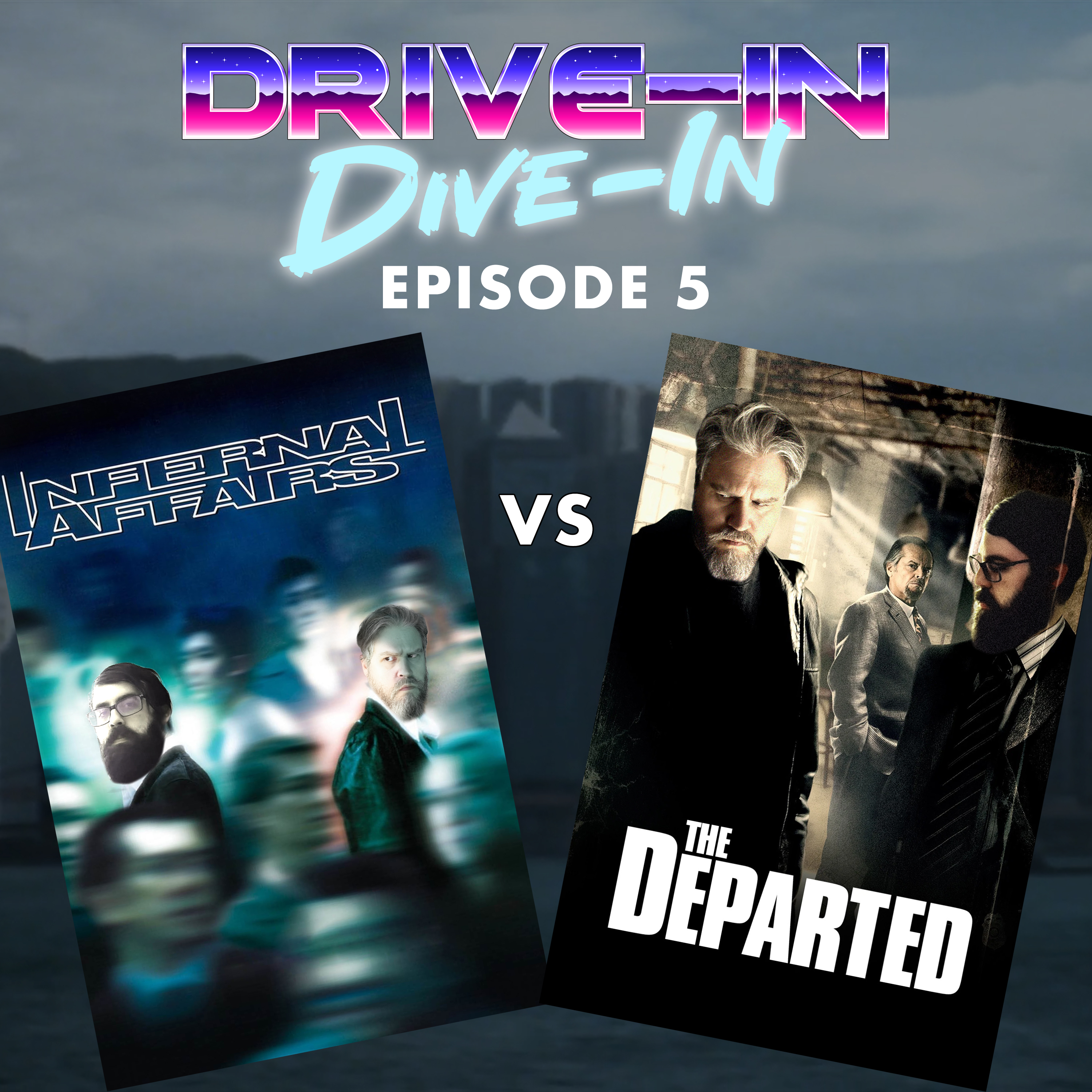
[00:00:51] Speaker A: And today we're talking about two interesting, if confusing films. Infernal affairs and the Departed.
[00:00:57] Speaker B: Yes. Yeah, a couple of really excellent movies. Infernal affairs being the original. The Departed being one of many, many remakes of Infernal Affairs. It's a great movie. It was incredibly popular, successful, and lauded in Hong Kong and Chinese cinema, but didn't make it much outside of that until it started getting remade. And, you know, we'll dig more into all of that, but as we've started doing after the first episode, thanks to some feedback, shout out to my friend Megan for giving the suggestion. We are going to do plot summaries for the movies before diving in.
[00:01:34] Speaker D: In a world full of secrets, who can you trust? Chan is a police detective so deep undercover, only one man even knows he exists. He spent 10 years living as a criminal operating deep within Han's Triad. Lao is a rising star in the Hong Kong police force who's been secretly working as an informant for Han his entire life.
When Hans Triad and the Hong Kong police both discover they have a rat, Lau and Chan are assigned to track down themselves.
The cat and mouse vortex that forms leaves a trail of bodies. In the end, only Lao survives the carnage, doomed to live a life of perpetual hell. Loyalty, honor, betrayal. Infernal Affairs.
In a different world full of secrets, who can you trust? Billy Costigan is a police detective so deep undercover, only two men even know he's a cop. He's spent months living as a criminal in order to infiltrate Frank Costello's mob syndicate. Colin Sullivan is a rising star in the Massachusetts State Police Force who has been secretly working as an informant for Costello his entire life. Life. When Costello and the police force both discover they have a rat Billy and Colin are assigned to track down themselves.
The cat and mouse vortex that forms leaves a trail of bodies in a river of blood.
In the end, no one survives the carnage. Lies, betrayal, sacrifice. How far will you take it? The Departed.
[00:03:16] Speaker A: Yeah. Plot summaries for these two films are a bit of a doozy. I mean, Infernal affairs does not hold your hand.
[00:03:22] Speaker C: You want me to hold your hand?
[00:03:24] Speaker A: I don't know if that's a hallmark more of like the Asian cinema or just, you know, that, that film itself, but it gets you right in with this group of young men.
[00:03:35] Speaker B: Yeah, we meet Lau as part of Han's gang as he is going into the police academy as a double agent. And then we meet Chen as a standout in the academy. We kind of first meet him as he's being tested by the principal of the school and SP Wong, who's going to wind up being his primary point of contact. One really distinct thing here that is different. In the Departed, we fast forward 10 years, right. We have different actors. Like, we see them as like 18, 19, 20 going into the police academy. We fast forward 10 years, we now have different actors. So we don't recognize them until we're tipped off on who they are. And they're obviously not going to recognize each other either. One of the really poignant moments I find, which is, like you said, this doesn't hold your hand. It just expects you to pick up and follow everything it's doing. We see a funeral procession and we see Chen hidden in the shadows of an alleyway, standing at attention, saluting the funeral procession for the principal from the police academy, who was one of two people who knew that he was actually a cop and not just a criminal.
So starting off the movie with only one person in the world as his lifeline and anchor to his real identity. So then they do their respective jobs during a drug deal that goes sideways for both parties as they kind of keep knowing each other's moves as they pivot, which makes both sides realize that they have a rat.
[00:05:07] Speaker C: You dirty rat.
[00:05:10] Speaker B: So, I mean, in the first 15 minutes, we're fully in the inciting incident. Like they know that each other exists, but they don't know who they are. And the cat and mouse, or cat and cat, rat and rat, whatever begins, right?
[00:05:23] Speaker A: Yeah. And the pacing is just incredibly fast.
The Departed takes like way longer to get to this point.
[00:05:29] Speaker B: Yeah, you're talking. You're talking 90 minutes versus 151 minutes. Sure. So like. Yeah, it's significant.
Significant difference.
[00:05:39] Speaker D: Yeah.
[00:05:39] Speaker B: I mean, the. The pacing through this is incredibly tight.
[00:05:42] Speaker C: Damn, we're in a tight spot.
[00:05:45] Speaker B: You gotta pay attention while you're watching, for sure. So Lao and Chen are tasked with finding themselves in their organization while also trying to find the other person in the other organization without their bosses realizing that's what they're doing. Lao has Han get everyone in his gang to fill out so he can do background checks and try and search in the police records to figure out who the mole is. At the time, there was an actual mandate from China. This is shortly after the handoff of Hong Kong from Britain to China, where companies had to create mutual funds for their employees. So when they're like, oh, he must be setting up an MPF for us, like there was a actual government sanctioned reason for them all to have to fill out these forms with their identification information in it. So they were more than happy to. They didn't think anything of it. Kyung, one of the other gang members, doesn't know how to write Bodyguard because he probably flunked out of school. So Chen shows him on the envelope and corrects his writing on there, which makes a lot more sense than in English, like in the Departed. But it still works in the Departed when they do it.
[00:06:46] Speaker A: Yeah, where he just respells it exactly the same way. We'll get there.
What are you stupid?
What are you stoned or stupid?
[00:06:55] Speaker B: So Chen builds a relationship with his court mandated therapist, and this is the only relationship he has that's not built on lies.
We learn something that even Chen doesn't know. His ex girlfriend's daughter is actually his kid. She kept it a secret because she thought he was a criminal, so he doesn't even know he has a kid. He runs into her and she tells him that her daughter is four, but she's really six, which would have made her his. Sp Wang held out for over 10 minutes while Hans Men beats him up off camera trying to get the identity of Chen. He never gives it up. They throw him off a roof where he lands on a taxi right after Chen gets out of it. Right in front of Chen.
Now Chen's father figure and the only person who knows and can prove he's a cop is dead. He is severed from his true life and is in free fall. Lao is blamed for SP Wang's death by the entire department, which I think is a really nice thing they did here that they didn't really do. In the Departed, Lao uses Wong's phone from the evidence after his death to call Chen, not knowing who he is and Proposes they work together. Chen comes in thinking he will finally get his life back. Lau leaves him in his office to go open the personnel file and restore his life. While Lao is gone, Chen sees the envelope where he wrote Bodyguard on it realizes that Lao was Han's rat and jets before Lau can get back. Lau sees the envelope, realizes what happened because everybody in this movie is really fucking smart. Deletes the personnel file, effectively burning Chen's true identity forever. They meet up on a roof. With some more great cinematography, Chen plans to bring him in. Inspector Big B shows up and shoots Chen in the head, revealing he was also a rat working for Han from the same school as Lao. As they ride the elevator down, Lao kills Big B, sets him up as the mole to close out the Internal affairs case. Chen is buried with honors next to SP Wong. His ex girlfriend and secret daughter are there. Dr. Li finally realizes he isn't lying about being a cop. And that's the end. Lau goes on to have a prestigious career, we assume.
[00:08:57] Speaker A: I had been doing a bit of reading about how part of that. What could be seen as, like, success in winning is actually kind of like an ongoing suffering. And that sort of idea.
[00:09:07] Speaker B: Yeah. Unless you watched this in mainland China where there was an alternate ending filmed where Laos criminal activity is exposed and he's arrested because you're not allowed to.
[00:09:18] Speaker A: Bad guys can't win in China.
[00:09:19] Speaker B: Right, Exactly. Bad guys can't win. You can't promote crime. So Lao had to get his at the end of the.
The Mainland China cut.
[00:09:28] Speaker A: Yeah, that makes sense. That's Infernal Affairs. And then the Departed is, you know, very similar. There's some key differences.
[00:09:33] Speaker B: I mean, they got the same shit over there that they got here, but it's just there, it's a little different.
[00:09:38] Speaker A: Example, when we meet Colin, we meet him as a kid and see him, like, growing up. Seeing Frank as, like, this. Almost like a father figure, right? Taking care of him, that sort of thing. And then we don't meet Billy until he's already an adult in the academy. Queenan's the. The police chief. Dingham's the guy who runs the undercovers.
[00:09:58] Speaker C: You know what we do here?
My section.
[00:10:02] Speaker A: Sir, yes, sir.
[00:10:03] Speaker C: I have an idea, sir. Whoa, whoa, whoa.
[00:10:04] Speaker A: Let's say you have no idea and leave it at that, okay?
No idea.
[00:10:09] Speaker C: Zip. None. If you had an idea about what
[00:10:12] Speaker A: we do, we would not be good at what we do, would we? We would be cunts.
You calling us cunts? They basically convince him to go undercover.
[00:10:22] Speaker C: So what do I do?
There's money behind this operation. You won't be paid as a regular cop, but there's a bonus involved, tax free.
We can't conceal that you were a trainee. You'll be convicted of a crime. We're thinking a guilty plea to assault and battery would make sense. Given your nature.
You'll do enough jail time to convince anyone this is no setup. You'd be on probation, see a court ordered shrink, the whole nine yards.
[00:10:52] Speaker B: You want to serve the Commonwealth, this is your chance.
[00:10:55] Speaker A: A lot of the next bit is very similar. Instead of Morse code, it's like T9 texting, which is. I thought it was kind of funny. I remember back when I was using those old Nokia phones, I could do it without looking, so it makes sense to me.
[00:11:06] Speaker B: Yeah, that was, you know, not to age us, but yeah, the, the scene where the phone's in the pocket and he's doing T9 is actually really smart use of the technology at the time. And like, yeah, back in the day you could text and drive while keeping your eyes on the road because you didn't have to look at your phone. Hey, would you keep your eyes on the road?
[00:11:26] Speaker A: Colin ends up getting some. I believe he gets some court appointed therapy. And then they kind of combine a lot of the female characters from Infernal affairs into that character who's the therapist and his girlfriend.
[00:11:36] Speaker B: Billy hooks up with Madeline Collins fiance.
Billy trails Costello to meeting in the theater with Colin but doesn't see Colin.
[00:11:47] Speaker A: Oh yeah, that theater scene was almost exactly the same the way it was shot too with like he's silhouetted from the back and he trails him out afterwards.
[00:11:54] Speaker B: Yeah, I mean a lot of the beats are very similar on a high level. Right. Colin has Queenan followed by cops to the meeting with Billy on a rooftop.
[00:12:04] Speaker A: He ends up getting thrown off. Then there's only one person left though. So that is one difference here is that we still have Dingham left who never TR Colin. Right. Then there's eventually the shootout in the warehouse. Colin does execute. Frank thinks that he's like scot free. And then he can continue his own investigation to make sure that he's extra scot free. And it is remarkably easy to delete personnel files. Apparently both of these police departments, there's not even like a confirmation. You just hit delete and it's gone. Billy sees the envelope and realizes who he is.
Since I'm recording,
[00:12:54] Speaker C: Don't find this cheese eating rat bastard in your department. You can assume it won't be me who pays for it.
Now why Would you have to remind me of that?
Would I be any good at what
[00:13:07] Speaker B: I do if I didn't fucking already know that? Frank, you gotta trust me. I can get the rat. You just gotta let me do it my way, Frank.
[00:13:16] Speaker C: Just let me do it. Let me do what I do.
[00:13:19] Speaker A: So that's very similar as well. The hi Fi stereo isn't really. Earlier.
They mention it a little bit when they're moving into the new. When Colin and the therapist are moving into the new apartment and everyone shoots each other in what I like to call the elevator of death with his, like, four bodies piled in it by the. By the end. But in the end, when we see, you know, Billy getting commendations and buried with honors and things like that, Dingham comes back to execute Colin. Is that about covering?
[00:13:45] Speaker B: Yeah, yeah, that's pretty much it. Yeah.
And, you know, a lot of the beats are the same. I feel like they are two very different tellings of the same story.
Very different. And a lot of ways, even though when you boil them down to their key plot points, you're like, yeah, that's the same, that's the same, that's the same. But, yeah, before we get into all that, and this was your pick tackle, why'd you pick these movies to compare?
[00:14:08] Speaker A: Yeah. So the Departed, I think, is pretty much every young man in my generation knows fairly well. I think it's kind of part of that Tarantino Scorsese kind of corpus that is very popular, and I really wanted to get to know it better and kind of see where it came from. I had heard previously, perhaps from you, perhaps from someone else, that it was based on Infernal Affairs. So I saw that for the first time maybe a year ago.
Just watched it for the second time for this podcast or actually watch it twice. So I guess the third time, second and third time, I wanted to kind of explore what makes it so compelling. Again, as you've just heard, it's really hard to keep it straight in your head, even what the plots are, but it's really compelling when you're watching it. And then also just like the way that it's exploring all of these ideas of violence and identity. And in a way, I guess I think one of the reasons that it might be very compelling to young men in their early 20s is this almost exploration of masculinity in a way, and what honor means and that sort of thing.
[00:15:07] Speaker B: Yeah. And there's a lot of stuff about masculinity in the Departed. Especially there's when Costello is Dying, you
[00:15:16] Speaker C: know, I'd never give you up here.
[00:15:19] Speaker A: Like a what?
[00:15:20] Speaker C: Like a son to you?
Is that what this is about?
All that murdering and fucking and no sons.
[00:15:31] Speaker B: You know, impotence and virility. Right.
Madeline is pregnant at the end of the movie and we don't know whose baby it is.
[00:15:40] Speaker A: Well, we also know that Colin has, you know, some performance issues and is obsessed with the idea that he's. He says, I'm not a homo. He's always talking about how he's not gay.
[00:15:50] Speaker B: Yeah, yeah, exactly. Which, like, you know. Yeah. We could just say at the top. The Departed is problematic as. Fuck.
[00:15:57] Speaker A: Yes, yes.
I would normally never use that terminology in such a crass way, but, you know, they use much worse. Yes.
[00:16:05] Speaker B: Yeah, yeah. It's like, you know, I.
Quick thinking, like, people are always like, oh, Mark Wahlberg steals every scene he's in. Like, he's like, you know, the standout in the movie. And it's like, what? Mark Wahlberg did a great job of playing a bigoted Bostonian. Really, What a surprise. It's almost like he trained for it his whole life.
But obviously, both exceptional films, I was excited to really break back into both of them.
I saw Infernal affairs first. I was. You know, I've been super into Hong Kong cinema and Korean cinema for a long time. But, like, especially when I was a teenager, I just, like, got really into that kick. It was around the time that you had Saturday anime on Cartoon Network and Sci Fi Channel. So, like, getting into anime and then getting into Asian cinema and, like, just finding these, you know, at the time, hidden gems. Because international cinema wasn't as talked about or prevalent, especially in the days when you had to go to a specific store that actually carried import DVDs and have an international DVD player that could play PAL and other region coded stuff in order to even see these movies.
So I was already a big fan of Infernal affairs when the Departed came out. And I will say I had to warm up to the Departed. My initial take after getting out of the theater, seeing it opening weekend was Infernal affairs was better. Like, it's good, but like, I was a teenager, you know, it was good, but Infernal affairs was better.
[00:17:38] Speaker A: I watched it before. It was cool.
[00:17:39] Speaker B: Oh, no, I wasn't a teenager. 2006, I was 24. But still, you know, pretentious jackass. Like, you know, the original was better.
[00:17:47] Speaker A: He's a pedantic, pontificating, pretentious bastard.
[00:17:50] Speaker B: I will say. Just to caveat out of the gate, I rate Infernal affairs, as I believe a 9.8 or a 9.9 out of 10.
The departed, I rated a 9.7. They are both exceptional movies. And even though I'm going to favor Infernal affairs in my conversation, like it is real close between the two of them, they're both exceptional movies. And getting to rewatch, I think. I watched the Departed three times in prepping for this.
Watched Infernal Affairs a few times with some commentary tracks and some other stuff.
Just really appreciating the very different telling of the story that Scorsese gives us. But. Yeah, which one did you see? You saw the Departed first?
[00:18:31] Speaker A: Yeah, yeah, I saw the Departed first. But it's interesting because a. It's kind of the time period. Right. I'm a bit younger than you are, so the Departed was already very famous and popular by the time I was kind of entering that age and starting to explore filming.
But you mentioned early 2000s being a time where international cinema was becoming much more available.
You had things like, I believe you needed international DVD players, but I believe PlayStation 2s could play international DVDs. So that's one thing that was useful.
[00:18:59] Speaker B: Yeah. And certain Xboxes as well.
[00:19:01] Speaker A: It seems really prescient with. You know, you mentioned earlier about how Infernal affairs is set in Hong Kong. Right after kind of, the British gave Hong Kong up and China was. Was assuming it. And it's kind of entering a more geopolitical space, generally speaking, during this same time when international cinema is starting to become more available. I would assume. I haven't done a whole lot of thinking like this on this, but I would assume that that has something to do with this sort of search for identity as someone living in Hong Kong, trying to figure out your place in this world, your place in this new kind of country structure. And you also live in an area that's been kind of subjugated for a very long period of time.
There's a lot of those themes running around in this.
[00:19:42] Speaker B: Oh, 100%. Yeah. I mean, that is like a core aspect of everything that Infernal affairs was really saying. You've got Lau's girlfriend and her book plot about multiple personalities. And, like, obviously there's the direct parallel of, like, these guys are living double lives. But, like, everybody who had lived in Hong Kong prior to the handoff was a British citizen, and now they're a Chinese citizen. And what does that mean?
[00:20:09] Speaker C: What does that mean?
[00:20:10] Speaker B: And a lot of things changed. Something really interesting that I learned is that prior to the handoff, There was a limit on how tall buildings could be in Hong Kong. And then when they built the new airport, they wanted some really big structures there, and they removed that limit. It was one of the first laws that was passed after the handoff. So by the time they're filming Infernal affairs, the skyline in Hong Kong is completely different. And all of those tall buildings are these, like, behemoth structures, like obelisk monuments to the future of Hong Kong as a Chinese territory. So that in and of itself, was like speaking without words in the cinematography.
[00:20:59] Speaker A: Well, it's interesting because, you know, there's all these rooftop scenes. They're using kind of the skyline to set it. The rooftops also become this sort of separate space, almost like a liminal sort of area where you can place these elements of intense action and violence and drama, but that don't really have a lot of. Like, there is environmental storytelling in that, you know, that's where you are, but there's not. You can focus just on, like, the characters.
[00:21:25] Speaker B: Yeah, absolutely. And the duality and lack of assuredness. Not knowing what the future is going to bring. Not knowing, you know, what it's going to mean for Hong Kong or for you as a person and where you stand in that and where your allegiances are going to lie, if you're a good guy or a bad guy. Right. Lao's girlfriend is like, I don't know if he's good or bad.
That. That all is very intrinsic and nebulous. And you have the two sides represented in the two characters. You have one that is constantly trying to get back to the past and another that is constantly looking to the future. I will say one thing that the Departed does significantly better than, not significantly, but does better than Infernal affairs is its characters and its character development. It is primarily a character exploration and a crime thriller. Second.
But Infernal affairs has some incredible characters. Obviously, the women characters are significantly better and deeper, even though they have less screen time. But their motivations actually make sense and, like, they're significant to the plot in ways other than just being, you know, an object for the men. It's also subtly done in Infernal Affairs. Right. We talked about the funeral scene at the beginning, and then, yeah, the. The rooftop scenes and the. The ways that those moments are isolated from everything else that's happening and kind of acts as this framing of everything that's going on internally with Hong Kong citizens post handoff.
[00:22:55] Speaker A: Well, there's got to be some sort of connection there with kind of the history of The Irish in America, and especially even thinking to the skyscrapers and how a lot of the construction workers that constructed them would have been kind of marginalized Irishmen that were not even seen as first class citizens for a very long time, far too long in American history.
[00:23:15] Speaker B: Yeah, no, that's a great point. And we do get a decent amount of that in Costello's monologue at the beginning. Right.
[00:23:21] Speaker C: 20 years after an Irishman couldn't get a fucking job, we had the presidency.
[00:23:27] Speaker B: He's talking about the way they came up while also being incredibly racist. But he, you know, talks about the fact that the Irish were in similar positions to the other marginalized communities, but they, through organized crime and other methodologies, took theirs for themselves.
[00:23:45] Speaker C: No one gives it to you, you have to take it.
[00:23:49] Speaker B: And I think you're right. There's definitely parallels there in kind of like the dual identity of, you are Irish, but you're Bostonian, but you're American, but you're a cop or a criminal or both. Like, and just kind of juggling all of these identities and what they mean to you and what it means to be a man and everything else. Right, but they are kind of, as I mentioned, two super different tellings of the same movie. Obviously, you know, we've already talked a lot about Infernal affairs is commentary on the handoff and the way Hong Kong citizens of Chinese descent were feeling at the time. Whereas the Departed, the more I watch it, the more I realize it reframes the same story as a fian tale.
[00:24:28] Speaker C: That's Faust. He's gonna make a deal with the devil.
[00:24:32] Speaker B: Like Costello is Mephisto and Colin sells his soul for a loaf of bread and some comics and some groceries and, like pocket change at the beginning, which
[00:24:43] Speaker A: funnily enough is the same that, like, he has the bag at the very end when. When he dies.
[00:24:47] Speaker B: With the same stuff in it.
[00:24:49] Speaker A: Yeah, exactly.
[00:24:50] Speaker B: Yeah. And like, you know so much of Costello's screen time, like a surprising amount of it when you look at his total screen time is spent actively clashing with the church or speaking against the church in a very Mephisto esque way.
[00:25:05] Speaker C: May I remind you, in this archdiocese, God don't run the bingo.
[00:25:11] Speaker A: May I remind you that pride comes before the fall.
[00:25:17] Speaker C: How's Sister Mary Teresa doing?
Had a tasty relationship before she took her vows.
Enjoy your clan as cocksuckers. Pay him.
[00:25:30] Speaker B: Colin has sold his soul for success and the things that he wanted because his father was a janitor and he never had anything. But now he's A cop. But he's bankrolled by Costello as his co signer. So he gets this sick ass, you know, luxury apartment and all the things he could possibly want in life.
[00:25:48] Speaker A: Yeah, I had not considered sort of that, that angle of it, like the selling one's soul to the devil. It certainly makes sense.
I'd love to think a little bit on, you know, what it means when Costello does finally kind of, you know, shoot his own captor. And that's. That's the beginning of his downfall, effectively. What were you.
[00:26:05] Speaker B: Yeah. When Colin shoots him.
[00:26:06] Speaker C: Yeah.
[00:26:06] Speaker B: Yeah. We can get into intentions of the Departed as well because it had a lot to say about post 9 11America and the Patriot Act. Some Faustian tales have a demon other than Satan himself enacting the transaction and managing it. Costello is not the top of the iceberg. Right. It's the FBI.
He's based on Whitey Bulger, who was an FBI informant and allowed to operate so that they could take down other members of the crime organization. And when he was killed, somebody else took his place.
[00:26:37] Speaker A: And we see this time and again in like, criminal dramas. Right.
The evil, you know, is better than, you know, the evil that you don't. The necessary evil is kind of how the world works. We even talked about this with some of the, like, CIA stuff, funding terrorism around the globe and all that sort of thing. It's all. It's all very connected in that pseudo religious, pseudo moralistic way.
[00:27:02] Speaker B: Yeah, exactly. And there is nothing but slight thrill at the church, but also at the FBI, at the police, at everyone. Right. It's this post 9 11, post Patriot Act America. And Scorsese's directly talking to the mistrust, the surveillance. Right. Billy as a character is constantly surveilled. We initially meet him through interrogations, through cameras, through surveillance, not as a person, but as a subject. And he represents the American people who are under the lens, whereas Colin represents the lens itself and the kind of operator for the shadowy government.
[00:27:41] Speaker C: All right, here we go.
[00:27:46] Speaker B: There's Costello, Mr. French.
[00:27:49] Speaker C: There's Fitzy, Delahunt and the new guy, Billy Costigan.
[00:27:52] Speaker B: And it all just kind of is designed to cast this mistrust on all forms of authority, whether it be religious or structural. Costello says it at the very beginning. Right.
[00:28:04] Speaker C: So they don't tell you in the church, when I was your age, they would say we could become cops or criminals. Today, what I'm saying to you is this.
When you're facing a loaded gun, what's the difference?
[00:28:22] Speaker B: What's the difference? And that Is.
That's a Departed in a nutshell, right?
[00:28:27] Speaker A: Yeah. No.
We even hear the other police chief, Alec Baldwin's character say, God bless the Patriot Act.
I guess the good guy of the movie, or the best guy is Dingham, who is basically the good guy with the gun. And he's both a criminal and a cop at the same time by the end of the film.
[00:28:46] Speaker B: Yeah, exactly. And I think Scorsese is very clearly saying, the only justice that exists is that which you take for yourself.
You cannot rely on an institution who is drunk with power to bring you any form of justice or resolution, solution or safety.
But he's not saying it in a good way. Right. We don't want to be Dingham. We don't want to abandon the career that we clearly love and murder someone in cold blood because that's the only way we can get justice. It's not satisfying or glorified at all, which I think is important.
[00:29:25] Speaker A: Yeah, it's not glorified. But also the moments like that, the moments of violence in the Departed are all very like.
There's no restraint, it's very animalistic, etc. Costello himself, whenever he gets going, he's covered in blood and his hair gets crazy.
I feel like Infernal affairs is a lot more, I guess you would say, restrained in the way that the violence is a lot more clinical and simply necessary. Whereas in the Departed, the violence is how you get things done.
[00:29:56] Speaker B: Yeah, absolutely. And I think that Scorsese violence was very intentional. They are loud explosions of violence. Whereas in Infernal affairs, partially because you can only show so much on screen at the time due to, you know, censorship boards and things like that. But also, just stylistically, it's more about the effects of the violence. We never see SP Wong even get hit once, whereas we see Queen in get beat up a bit and then he lands on the ground in front of Billy, who gets showered with blood.
[00:30:33] Speaker A: Literally. Blood on his hands.
[00:30:34] Speaker B: Yeah.
From a gut punch in if to getting knocked across the face with a baseball bat. And the Departed, as far as the viscerality of the violence, and that's to, I think, make sure that it's never made to feel cool.
[00:30:49] Speaker C: Cool? No, not cool.
[00:30:51] Speaker B: I mean, even Costello's death is pathetic.
[00:30:54] Speaker A: Oh. I mean, they all are. Yeah. In the end, nobody really gets a glorious send off. Colin, who's probably the most pathetic Death, he's just like, oh, come on, man. You know, like.
[00:31:04] Speaker B: Yeah,
[00:31:07] Speaker C: okay.
[00:31:08] Speaker B: I think that the two main characters are more tangibly represented in the Departed than they are in Infernal affairs, but I think every other character in Infernal affairs is better. I think that, like, the other henchmen feel more lived in and more real. The women characters obviously feel more human and legitimate and just across the board, I think that the world feels more the world, as opposed to. You've got the three core characters in the Departed that are titans, and then everybody else is just kind of living in the shadow.
[00:31:42] Speaker A: I think Costello, they do a pretty good job of characterizing, but he does very much feel like a caricature. He's playing the role that he's supposed to.
He doesn't really evolve in any way.
I don't even remember the woman's name in the Departed. I'm so sorry.
[00:31:55] Speaker B: Madeline.
[00:31:56] Speaker A: Yeah, she doesn't. She doesn't do a whole lot other than be there as a sounding board in a relief for the male characters. They're the way that basically they talk to themselves.
She's just kind of there to let it be out loud so that the audience can hear it.
[00:32:10] Speaker B: Yeah. And, I mean, she just. She feels like she has no agency. Like, I think her character is one of my main qualms with the Departed. Right? Because, like, even when. When she first meets Colin in the elevator and he has. He's super smooth, right?
[00:32:22] Speaker A: You can shoot someone and then you'd
[00:32:23] Speaker C: have to see me professionally. I'll stab someone in the hat with a fucking ice pick if it gets me dinner with you.
[00:32:29] Speaker B: That's funny as shit. Like, I get why she was charmed, right? But then, like, Billy is a complete shit to her because he just, like, doesn't want to be there and doesn't really want the help, but, like, needs the help. And she caves immediately follows him out of the building to give her. Give him her personal number and then later sleeps with him. Like. Like she should lose her license.
And it's just like.
[00:32:58] Speaker A: Well, not just that. It doesn't make any sense. I am not convinced why she likes him at all. He's never, ever nice to her.
[00:33:04] Speaker B: Exactly.
[00:33:04] Speaker A: And then he, like, follows her home and all this weird stuff like. Call the police lady.
[00:33:08] Speaker B: Yeah, yeah. Oh, he said that the picture of her as a kid on her bike is cute, but Colin wants to hide it and not put it in the living room. Okay. Like, that. That's not enough to justify weird.
[00:33:21] Speaker A: Are there no other female characters in the whole film?
[00:33:24] Speaker B: I don't think so.
[00:33:25] Speaker A: There's, like, the daughter.
[00:33:27] Speaker B: Oh, no, there are. You know what? There are. Sorry. There's, you know, there are other you're right. There are other female characters. There's.
Yeah, there's Costello's girlfriends. I think he goes through more than one in the movie, but they all look the same. There's Billy's aunt, right? His cousin's mom.
And there's the other woman that Colin interrogates.
[00:33:51] Speaker A: But none of them really have any sort of major impact. I think maybe Costello's girlfriend to a point, but she just happens to be there and deals with him.
[00:34:00] Speaker B: Yeah, yeah, exactly. She's mostly there for Costello and Mr. French to talk shit on.
[00:34:06] Speaker C: They brought us whole binders full of women.
[00:34:09] Speaker B: And I just thought of the other woman character is Billy's mother. And she literally doesn't ever speak. She just dies.
[00:34:18] Speaker A: Your job is to die. Yeah, yeah.
[00:34:20] Speaker B: Whereas, you know, in Infernal affairs, right, Lau's girlfriend is a hinged character, really, making clear what the film's statement is and is like his anchor to the future and his representation of the future. In the same way that SP Wong was Chen's connection to and representation of his past and his true self, right. Lao's girlfriend is a representation of him, his false self. And SP Wang was Chen's reflection of his true self.
[00:34:49] Speaker A: Don't you know who I am?
[00:34:50] Speaker B: Chen wants to be known for who he is and, you know, have his life back, like Billy. But like the person he's doing that, the people we see him doing that with, like his ex girlfriend and his daughter that he doesn't know about. And SP Wong, like, are an actual tangible thing there, whereas Madeline for Billy is just a fuck object like nothing else.
And then, you know, as the story is progressing, Chen is getting closer to his desired life and to Dr. Lee, who, like, represents his other, like, gasp of hope and like his only relationship other than Wong that is not based on any lies, but he can't have either of those things and never achieves them. And in contrast, like, everything slips further and further from Lao as his relationship to his girlfriend, friend, fiance unravels further. And like, his relationship with Mary is a reflection of his mask falling apart and disintegrating throughout the film.
[00:35:48] Speaker A: I completely agree. And there's like, Meline. No one cares about her. Like, literally nobody in the entire movie cares about her.
[00:35:55] Speaker B: Poor woman.
[00:35:56] Speaker C: You have any idea what you're doing to that poor woman?
[00:36:00] Speaker B: You know, some of the other things I. I really elevate Infernal affairs for. I mean, we already talked about it, but the pacing and the script, like, it's an incredibly smart script that plays with your expectations, really. Well, Chen is really close in with Han. He's one of the guys that's always with Han. And SP Wong acts as not only his direct report and the only person who knows he's really a cop, but also his father figure. He gives him a watch for his birthday and a new wire. A new wire which is a box about this big. And. And Chen complains that they're not getting the new tech. Worth noting, here he is wearing a cast. Lau figures out that Chen, Han's rat, is using Morse code to communicate with the police force by watching SP Wong's hand and seeing him tapping the Morse code and then make decisions.
We see Chen tapping on a window with his hand that's in the cast, which makes us think that the wire, that bulky wire, is in the cast because it would be a great place to hide such a bulky thing. Right. Han interrogates his gang members looking for the rat and Smash Chen's cast looking for the wire. Which is such a tense moment in this movie because you're sure that's where it is, but it's not. He taped it to the outside of the windowsill so it would pick up the more source code, but wasn't on his person. It knows what you're gonna assume from the information it gives you so that it can subvert those expectations. And it's 90 fucking minutes, man. And it just goes and goes. Really driven. I think it's one of the best crime thrillers of all time and certainly one of the best to come out of that era of Hong Kong cinema.
[00:37:47] Speaker A: Yeah. On that note, I didn't do any research on kind of how the movies performed.
Do you have any context on that?
[00:37:55] Speaker B: Yeah, I mean, not. I don't have box office. I can look it up. But I know that in of front, Eternal affairs was very successful throughout Asia.
It didn't do great outside of that because things just didn't at that time. But it got two sequels.
[00:38:13] Speaker A: I'm sorry, sequels?
[00:38:14] Speaker B: Yeah.
[00:38:14] Speaker A: That's crazy.
[00:38:15] Speaker B: Yeah. Technically a prequel and a sequel. So Infernal Affairs 2 is a prequel. Infernal Affairs 3 is a sequel that follows Lau scripts. Get wonky and retcon things.
But it was really popular. And so the studio was capitalizing on that by keeping the thing going. But there were some elements of those stories that were used in the Departed to kind of flesh it out a little more and add to the runtime. Right?
[00:38:40] Speaker A: Sure, sure.
[00:38:41] Speaker B: But it was very successful, very popular. Got two additional movies from the property. Really launched the director's career. And it won a ton of awards in the Asian cinema landscape and pretty much closed cleaned up like best Director, best Filmmaker, best Performance, best supporting performance, all that. And was not nominated for anything outside of Asia at all in any awards, which is insane.
[00:39:06] Speaker A: Sure.
[00:39:06] Speaker B: Whereas the Departed did very well. I know that. It certainly made money. It got super popular, especially in the at home market. It was definitely a cultural zeitgeist moment in a lot of ways.
[00:39:19] Speaker A: You're gonna stick me with that so that you guys can spend five minutes sorting out his love life, followed by an hour of you getting drunk and pretending to be in the Departed.
[00:39:28] Speaker C: You know what?
[00:39:28] Speaker A: I'm sorry, Lily, okay?
[00:39:31] Speaker B: But I just need to know, are
[00:39:32] Speaker C: you a co op?
[00:39:33] Speaker B: I'm not a co op.
And it won best film. It won Martin Scorsese his first best director award at the Oscars. Leo was snubbed and later was given a best acting for the Revenant because he, he didn't get it for this, which he fucking should have. Everybody in this should have been nominated. But yeah, it was widely acclaimed by critics and audiences internationally because it was an American production.
[00:40:03] Speaker A: Right, Right, Yeah. I was just scrolling through some of the performance for Infernal affairs in the sequels. And the sequels also seem to have done fairly well, at least in the Asian market. Yeah. As we know, foreign films, basically any non American films don't really get any accolades, Right?
[00:40:22] Speaker B: Yeah, unfortunately, especially back then, something that was essentially a blockbuster in its area and a crime thriller like the Oscars would not have even glanced in its direction at the time. Unfortunately. And I mean, we even saw it this past year with no other choice. Park Chan Wook's movie, no other choice was exceptional. And it was completely snubbed.
[00:40:42] Speaker A: Sure.
[00:40:42] Speaker B: Tale as old as time, which is a shame because like the era, especially the 80s 90s, like leading up to the handoff of Hong Kong cinema was so unique and so cool. They've got so many awesome action movies. You know, you got John Woo when you got movies like Tom Cruise in them. You can't lose. And a lot of other really notable directors and actors that ended up transitioning to making films in America post handoff because of Chinese censorship boards.
There's definitely a resurgence amongst like film fans, especially thanks to Letterboxd and TikTok edits, people are starting to recognize a lot of this stuff a lot more. But for a long time, like unless you were a nerd about it and hunting stuff down, you know, you just, you couldn't even see it.
[00:41:26] Speaker D: I don't think Americans Watch subtitled films.
[00:41:30] Speaker B: One thing that I thought was really interesting as I rewatched Infernal affairs was the relationship between Lao and Chen. I. I feel like it had to be an influence on Death Note.
[00:42:04] Speaker A: Oh, sure, the.
It's not enemies to lovers, but it's like friends to enemies. That's interesting. They share the love of music. They share a couple of, I guess, pseudo warm moments, you would call it.
And then the reveal. Because in the Departed, they don't really have a relationship at all. They don't know who each other even are.
[00:42:25] Speaker B: Right.
[00:42:27] Speaker C: Good to see you, trooper.
Yeah.
[00:42:29] Speaker B: Colin Sullivan.
[00:42:30] Speaker C: We spoke on the phone. Yeah.
So now, how long were you undercover?
Long time.
[00:42:38] Speaker B: Long fucking time for someone going in knowing that there's another rat in the department. I will say the Departed has a lot of like, oh, is it this AV guy who didn't put any cameras in the back of the warehouse? Like, is it that guy? Is it that guy? I really think Anthony Anderson's character was supposed to be the other rat because it would have been such a huge, huge hit that, like, the one person that knows Billy from the Academy is the dude who kills him. Like, that would have been fucking huge. But they wrote Costello to be so racist, and Anthony Anderson killed it on the part and got the part. I think they had to rewrite the script after Anthony Anderson got the part. I've never heard that. It's total speculation, but it just. It made such logical sense from a narrative standpoint, you know, and the way that they ended, it was certainly fine. It was still really good.
[00:43:30] Speaker A: Yeah. Now that you mention it, that final rooftop scene, it does very much feel like, in a way, his character's almost done a bit of a disservice in that he doesn't really get to accomplish anything.
[00:43:40] Speaker B: Yeah, yeah. He's almost like he's such a disposable character without that turn. Right. Like, why is he there? Other than for, like, anyone who could have possibly tied, you know, Billy to his original life was gone. But, like, everybody knew he was in the Academy and got kicked out or fired and arrested. Right. Like, so that didn't really matter either. Like, nothing else matters.
[00:44:08] Speaker A: Yeah, he was like a character witness, sort of. You know, he seemed like a pretty good guy back then, but, yeah, he's been spent the last two years. Like, he went to prison for a year or however long it was.
[00:44:19] Speaker B: Yeah, that.
[00:44:19] Speaker A: That is another thing. The timeline is significantly compressed. It's pretty recent news that he got kicked out. And these other guys are pretty recent additions to the police force.
[00:44:28] Speaker B: And I think that is a lot of why the third act feels more earned in infernal affairs. Like being under for a decade where one person knows who you are in this entire world.
That is daunting. That has to be so hard on Chen as a character. And you can see it.
And all of the actions from both of them makes so much sense. Right. Because Lao I really appreciate more so than Colin because he clearly is wrestling with his allegiances. Like when he calls Chen and is like, let's work together, you believe him. You're like, oh, he's making the turn. Like he wants to get out. He's decided to be a cop. Right. And he probably was until he realized that Chen figured him out.
[00:45:14] Speaker A: And yeah, you get a very, very brief moment in the Departed where if you hadn't seen it before, you might think Matt Damon is about to make the full, you know, once he shoots Frank. And he could have, if he wasn't figured out, he could have kind of just let things play out and just be the hero, be the cop, like, have a nice life.
But too many people know who he is, which is more than one.
[00:45:35] Speaker B: Yeah. I think that especially if you've watched it multiple times, Colin's motivations are entirely selfish, even in that possible turn. Whereas Lau is having that turn due to morality and like that, you know, hearkening back to like the, the Buddhist, like karmic, you know, action and choices.
[00:45:57] Speaker A: Interesting indeed.
[00:45:59] Speaker B: Now this ham handed segue into your questionnaire.
I do really like the, the audio playback bookend. They both have really clean and nice bookends, honestly. Right. Like you've got, you know, you mentioned Colin having the same, same things in his grocery bag at the end that he gets from Kasugin at the beginning.
[00:46:20] Speaker A: You also get that really subtle, the rat on the railing in front of the hall of Justice.
[00:46:25] Speaker B: So subtle.
[00:46:26] Speaker A: Out of the window.
[00:46:27] Speaker B: Yeah, yeah, that part is very on the nose and almost laughable. But the secondary there is you're looking at the Capitol building and the rest of Boston is still going on. We just witnessed carnage and chaos and lives destroyed and the rest of the city doesn't give a fuck.
[00:46:50] Speaker A: I don't give a.
Yeah, I mean, Castella's probably already been replaced and, you know, everything's just business as usual.
Same thing with, with Dingo. It felt like business as usual. Shoots the guy, moves on. Yeah, like, yep, he's probably still a cop at that point.
[00:47:05] Speaker B: Like, yeah, he was just sent on leave. Right. He tried to quit and they're like, no, you're on leave. And like, yeah, he clearly left no trace. Knows what. What to do. He's still a cop. He can make sure it gets covered up and he's just going to go back to his. His life.
[00:47:17] Speaker C: Are you listening to me?
[00:47:18] Speaker B: Nicholson obviously brings a lot of oomph to the Departed.
[00:47:22] Speaker C: Wait till they get a load of me.
[00:47:26] Speaker B: Costello is way more loathsome than Han. Not just because he's a bigot and a pedophile, but, like, he's just such a piece of. And like, he's got the Jack Nicholson smarmy nature, you know?
[00:47:38] Speaker A: Oh, yeah. In just things like casually walking around covered in blood, just saying the most heinous things to anyone he meets and feeling like he's just completely immune, which effectively, it seems like he is. He's an FBI protection. Right. I'm sure there's certain lines that he. That he can't cross, but effectively they're like, just keep it to Boston and you're fine.
[00:47:57] Speaker B: Yeah. And keep feeding us people and you can keep doing what you're doing. Which is exactly what happened with Whitey Bulger in real life.
[00:48:03] Speaker C: Yeah.
[00:48:03] Speaker A: It's based on true events.
[00:48:06] Speaker B: There were moments of Nicholson's performance that were ad libbed by him. Not in the sense that he's just like flying off the cuff in the moment, but he just like, thinks about his character early on, when we see him shoot the two people on the beach and he shoots the woman in the back of the head and he's
[00:48:21] Speaker C: like, geez, she felt funny.
[00:48:24] Speaker A: Yeah, yeah.
[00:48:25] Speaker B: That was a line he thought of because he wanted to convey that Costello sees this happening so much that he has in his head a catalog of how people fall when you shoot them a certain way. And she didn't fall the way he expected him to. And like, that's his takeaway from this brutal act that he just committed.
[00:48:46] Speaker A: Interesting. Yeah. And it also just shows, like, a complete indifference to. Again, this is just standard fare.
[00:48:53] Speaker B: Yeah, exactly, exactly.
You know, I'm certainly curious with your literary background, your thoughts on both of them, but especially the Departed and the morality of it all.
[00:49:08] Speaker A: Yeah. I mean, moral quandaries are going all the way back to Dante's Inferno. Right. And of course, even further back, deeply rooted in our Western literary culture, which is, in my opinion, largely obsessed with what does it mean to be human. Which morality is a major part of that. Everything from, you know, Harry Potter to the Bible is all about people experiencing themselves in a way that they can try to grow and change towards whatever Their goals are. So, obviously, in the Departed, we see these two men kind of struggling with their own identities, and what do they actually want? One of them is very selfish. One of them, I would argue, is very selfless in agreeing to do all of this and continue continuing to do it. There are moments where I think it would have been very easy for Billy to just become a criminal, but he never seems to falter in his own sort of humanity.
It doesn't seem like he ever is enjoying himself, which is something that I feel like is a lot more common. And I've been watching True Detective in, like, I think characters in other crime dramas like that, especially, like undercovers and that sort of thing, they explore a lot more of the. Oh, they start to, like, doing the drugs and hanging out with the prostitutes, and maybe, you know, murder's a little far from for them for the most part, but it's very easy for them to form that lifestyle. Whereas Billy seems to hate it the entire time.
[00:50:37] Speaker B: Yeah, absolutely. And, you know, I think that that is what makes him such a compelling character. And it's also very true of Chen. He's like, you know, getting arrested for beating people up for assault. And they're like, come on, like, you're a cop. He's like, oh, how am I supposed to remind myself of that? Should I wear. Wake up every morning, say, you're a cop, you're a cop. Right.
Chen and Billy, I think, are the most analogous characters between the two movies, too. I don't know how much Leonardo DiCaprio studied infernal affairs beforehand. I know that Scorsese supposedly never saw the movie before he made that apart in supposedly.
[00:51:23] Speaker A: Reminds me of another set of movies that we watched.
Never seen it.
[00:51:28] Speaker B: Yeah, never seen it because obviously they
[00:51:30] Speaker C: don't watch enough movies.
[00:51:31] Speaker B: But Leo's performance is incredibly nuanced. I was really struck when I rewatched it for the first time for this. It had been about a decade. And there's the montage of Billy doing crime with Costello's gang, right?
And there's a moment where they're, I think, on the docks, and you see a car explode. Like, you see guys running from a car. Car explodes. And it cuts to a shot of Leo and he's looking back at the car exploding. The shot isn't even a full second. It's probably like 20 frames. And you see part of his soul break in his face. Like, it's just so nuanced and so good.
[00:52:10] Speaker A: Well, and it is, too, I think, explored a lot more in the scorsese film. Billy's kind of like a slave to his ancestry in a way that he just can't escape from. Like, all he wanted to do was be better than his dad or be better than his family. Like his uncle, I think was the. The one who was a gangster. And it's like that becomes a noose around his neck where even when he's a cop, they're like, no, you're just like your uncle. I know what you are, okay? I know what you are and I
[00:52:37] Speaker C: know what you're not.
[00:52:38] Speaker A: I'm the best friend you have on the face of this earth. And I'm gonna help you understand something. You possibly.
You're no fucking cop.
[00:52:46] Speaker C: He's right.
We deal in deception here. What we do not deal with is self deception.
Five years from now, you could be anything else in the world, but you will not be a Massachusetts state trooper.
You sure of that? I'm sure of that.
[00:53:01] Speaker A: Guaranteed.
So he's like, I wanted to do better than my dad and actually help the community. I wanted to do better, better than my uncle and not be a gangster. And he's just made to do those things and he just can't get away from it.
[00:53:13] Speaker B: Yeah, yeah, absolutely.
And did you catch at the beginning when Baldwin is giving the rundown and he's talking about organized crime in Boston? He starts with Billy's uncle.
[00:53:24] Speaker C: That's Jackie Costigan. That's an old picture. Jackie met his demise.
Nice known photograph.
[00:53:32] Speaker B: Dead in the dirt, shot in the head.
And that is just like.
That's Billy's fate.
Despite wanting to be a cop and trying so hard no matter what he does.
[00:53:43] Speaker A: That sucks. Now I'm depressed.
[00:53:44] Speaker B: Yeah.
[00:53:46] Speaker C: Yeah.
[00:53:47] Speaker A: Can't get away from it.
[00:53:48] Speaker B: Right? Yeah. Now I'm really depressed. I mean it's. You know, I think the Departed is a far more bleak movie in large part because of maybe the environment that it was written in and. And the jaded feelings we were all having, you know, post 911 and post patriot Act. Yeah, it's definitely more nihilistic.
[00:54:09] Speaker D: Well, he.
[00:54:10] Speaker A: Man, they were nihilists, man.
[00:54:12] Speaker C: Huh?
[00:54:13] Speaker A: They kept saying they believed in nothing.
[00:54:15] Speaker C: Nihilists.
Fuck me.
Da da da Bo.
[00:54:25] Speaker B: But yeah, great needle drops, man. Dropkick. Murphy's like just iconic.
I'm a stylist.
[00:54:39] Speaker A: I think of that movie every time I hear. I hear that song and it's just great for like action sequences.
I love some of the. Because there's not. It's not like a music heavy movie.
But in much the same way that again, I Mentioned Tarantino earlier. I wouldn't say Scorsese and Tarantino are similar, but they're both very specific with, like, music and framing around music.
[00:54:59] Speaker B: Yeah, they both. Both movies use music very well. Some of it in Infernal affairs is diegetic, like the song at the beginning and the bookends that we were talking about. But then the song that plays when Wong dies is Goodbye, Master Goodbye, which is like a super well known song in Hong Kong at the time and a really beautiful track that is very on the nose of, like, you know, what is happening in that moment. Whereas, like, the needle drops and the Departed just kick ass.
This kicks ass. Well, and there's. There is a diegetic track that I noticed on my latest watch of the Departed when Billy is talking with Mr. French. There's a song. I want to say it's Lynyrd Skynyrd, because the man down there might be on. Man, I don't know.
[00:55:53] Speaker C: I fucking know you.
I know your family.
You make one more drug deal with that idiot fucking cop magnet of a cousin of yours and I'll forget your grandmother was so nice to me. I'll cut your fucking nuts off. You understand that?
Yeah.
Yeah, I do.
What are you drinking?
[00:56:16] Speaker B: Where, like, Billy is trying to convince these people that he doesn't know them, that he can be trusted, that he's not a cop. Right. And, like, the whole time they're not trusting him. And it's like, hey, you could be a cop. I don't know. And that music is a subtle refrain of the subtext of the scene.
[00:56:36] Speaker A: Yeah, I love that kind of stuff. Where it can exist within the world and kind of mirror. I think you see it a lot with TVs in the background in certain films and that sort of thing, like showing the news or something like that.
Always a cool effect.
[00:56:50] Speaker B: Yeah, absolutely. There's an interesting parallel, and I don't know if you have deeper thoughts on it, but like. So in Infernal Affairs, Lao is condemned to continuous hell, the Buddhist concept of continuous hell, because of his actions, which is where the film gets its name, Infernal being, Eternal hell and affairs. Internal affairs. Infernal affairs. But whereas Colin is presumably condemned to literal hell after being shot in the head, the religious motifs are actually really intrinsic to both of them, which I think is very smart. Infernal affairs is very much, you know, leaning into Buddhist philosophies and the idea of eternal hell, like. Right. Perpetual torment while living on the Buddhist
[00:57:36] Speaker A: side, especially with, like, reincarnation and that sort of thing. Sin is a karmic consequence that is actively experienced where in the Christian tradition death is a major part, like all have sinned and fall short of the glory of God and will die and you'll experience hell after death. Whereas in the Buddhist tradition there's only this kind of endless cycle anyway.
[00:57:57] Speaker B: Yeah, absolutely. And on the flip side of that, maybe Billy lived in hell on earth, but was perhaps redeemed through his desire to do right.
[00:58:09] Speaker A: Yeah, I mean, he never again. He never gives in, he always remains virtuous.
So if we're continuing with the Catholic allusions, he would have earned his place in heaven. That makes sense to me.
[00:58:23] Speaker B: He's given the posthumous honors by the police department and Chen is buried with honor next to his father figure. So in post death, Chen and Billy get this kind of uplifting, so to speak, whereas Lau and Colin in one way or another are brought down.
[00:58:49] Speaker A: It also kind of breaks the cultural cycle that Billy was stuck in that I was talking about earlier where he couldn't get away from his uncle and that sort of history.
But now, if Madeline chooses to, she could say, hey, that's your father. He was a good man.
We don't know whose child it is.
Tend to think it's probably Billy's, but now he could. He's created like he's changed the heritage even though he wasn't able to enjoy it himself.
[00:59:20] Speaker B: Yeah, absolutely.
[00:59:21] Speaker D: Absolutely.
[00:59:23] Speaker B: Are there any motifs or elements in either film or that are paralleled in both that like, really stuck out to you or speak to you?
[00:59:32] Speaker A: Both of these films use their environment more as the.
This canvas rather than being a characteristic.
The tone remains pretty flat across both films. Even the.
Colin gets his new fancy apartment. And the only really notable feature is that it looks over city hall and he's above city hall looking down on it.
[00:59:57] Speaker B: Yeah. The apartment itself is pretty shit inside, though, in my opinion.
[01:00:01] Speaker A: Yeah, I know. It's supposed to be like this super nice place.
So blank. There's no. It makes sense that he doesn't really have a bunch of, like, family photos or anything like that. But it's just. It doesn't give you anything about his personality.
[01:00:12] Speaker B: Yeah, yeah, very true. I think that's an interesting. Like, we also never see where Billy lives. I think that's intentional. Right. Like, we aren't given who these men are outside of their roles because maybe they don't know.
[01:00:26] Speaker A: Yeah. I mean, I assume that Billy also probably doesn't have any personally identifiable photographs or heritage or anything, and where he lives isn't that important. And where Colin lives is only important because it's a space for things to happen in. And to give that one little metaphor of him looking down in City Hall, I think.
[01:00:45] Speaker B: Yeah, very true, very true.
[01:00:48] Speaker A: And I guess for Madeline to move in and give that character beat as well, that they're growing closer, but they have intimacy issues, and that's part of his frustrations.
[01:00:57] Speaker B: Very interesting. Yeah.
[01:00:58] Speaker A: Editing, transition, something, some music.
[01:01:01] Speaker B: I talked about how I ever so slightly prefer Infernal affairs, but what about you? What's your.
[01:01:08] Speaker A: Yeah, I definitely rate them both highly. I'm not nearly as connected to Infernal affairs as you are. I'd probably put the Departed higher for myself, partially because that was my first exposure.
And I haven't seen Infernal affairs enough time to really make that, like, connection yet. It's still pretty fresh in my mind.
But both incredible films and well worth worth checking out, especially for anyone who's never seen. I think most people, I would say, if you're watching a podcast like this, have seen the Departed, but if you, for some reason, have not seen Infernal affairs yet again, only 90 minutes, you have to pay attention because it goes quick.
[01:01:42] Speaker B: It goes quick, and a lot happens without words. Like, that's not. Not knocking the filmmaking at all. You know, as I've said previously, but you parallel the scene between Billy and. No, sorry, Colin and Lau, where the henchman is arrested and waiting for his lawyer. And in Infernal Affairs, Lau gets up without saying a word. Everybody in the room watches him. He walks over, pulls out some clothing to change the way he looks, walks into the interrogation room and just starts pretending to be the lawyer without ever saying, I'm your lawyer. He just plays on the characters the henchman's presupposition of who he is, in the same way that the filmmaker is constantly playing on our assumptions of what is happening off screen. Right, Yeah.
[01:02:39] Speaker A: I think he just says, who do you think I am?
[01:02:41] Speaker B: Right, right. Yeah, exactly. Exactly. And then he also is, like, slyly sliding, you know, the cell phone across to actually give information back to Han, while also showing to everyone in his department that he's smart as shit and he's getting information without them knowing and kind of playing this dual role really, really smart. Whereas in the Departed, he's literally like, wait, the lawyer's not here yet.
[01:03:10] Speaker C: He pays his lawyer, but the lawyer hasn't called back yet.
[01:03:13] Speaker A: Who's the lawyer?
[01:03:13] Speaker C: He didn't know the name, just had a number on the card, beeper number.
The guy didn't show Up. No, he beeped him twice.
Give me your phone. Turn that off.
What?
[01:03:31] Speaker B: Turn the fucking camera off.
[01:03:33] Speaker C: Give it to me.
[01:03:34] Speaker B: He doesn't know what the fucking lawyer looks like.
Whose briefcase is this? All right, it's off.
[01:03:39] Speaker A: You're good, right? He explains it. Yeah, it's fully explained rather than.
[01:03:43] Speaker B: Yeah, yeah, yeah, exactly. And you know, he does still cleverly never say, I am your lawyer. Like, there's no entrapment. They're both very smart about that. But there are multiple times, and that's the one that like really stood out to me, where Infernal affairs does something silently and the Departed for American audiences says, hey, this is what we're doing right now.
[01:04:03] Speaker A: I mean, I would argue it is very clever to do it silently, but it's also much easier for a general audience to miss, obviously. In fact, Frontal affairs was. Was commercially successful and, and people seem to like it, but I can understand, I guess in a way it's a dumbing down, but it didn't, it didn't seem too terribly forced. But, But I do agree with you.
[01:04:21] Speaker B: Yeah, I wouldn't even necessarily call it a dumbing down. I just think it's a different way that the countries tell stories. Right. Like, I think that's always kind of been the case, especially with crime thrillers with, you know, other movies, like Usual Suspects. The ending is iconic, but I think it spends three minutes doing that, hammering home what the twist is for you.
Right? Like way beyond what you would necessarily need, just because, like, that's kind of the American Western way of telling stories, is to over explain a bit, especially in crime stuff.
[01:04:57] Speaker A: As I would just say, I think Fight Club does something similar. There's kind of an extra montage that you don't really need, but they're like, no, no, look, think about it, Think about it.
[01:05:08] Speaker C: Hello?
Hello?
[01:05:10] Speaker A: Anybody home? Hey, Think would fly thing. How'd you miss that?
[01:05:14] Speaker C: Six.
[01:05:15] Speaker B: Six. Sense does it too, right? Like there's. Yeah, it's. It's a very American thing. And in part. And you know, we'll kind of like, this may or may not take us on a tangent slightly away from the movies, but there's been a lot of buzz and talk ever since it leaked that Netflix was instructing the people making movies for them to explain in dialogue what is happening for people who are on their phones and people are like, oh, that's bullshit. Like the art form is dying, yada, yada. And like, I understand the sentiment. I'm not knocking people that are upset by that, but if you look at network television. It has been produced that way for decades and decades because, like, it was made for people who are folding laundry or ironing or playing with their kid or like, doing housework work while they have their TV on. That's why if you watch NCIS or any procedural, which is most of the, like, crime fiction that Americans and Western audiences are used to, they describe everything that happens, they say everything out loud, somebody in the scene, it's their job to restate, which, like it was iced tea in whichever svu. Yeah. And like, people would give them shit about it all the time. But. But his character's primary role was to restate things for the people who are not sitting there paying attention because it was second screen before smartphones even existed. Netflix is just saying, hey, our audience is essentially a daytime TV or a network TV audience. We need to write for that. And I think that even a really smart movie like the Departed feels the need to extrapolate and explain more because Western audiences expect it.
[01:06:56] Speaker A: Yeah, and I agree with you that it makes sense to view Netflix as sort of the replacement for daytime tv. But the problem is, I think a lot of people are using it as in Netflix is trying to position themselves as a replacement for the theater as well. I would assume that the issue many people have, the issue that I can imagine with it, is we don't want the dumbing down of cinema or the over explication of cinema because it's not supposed to be something that's experienced with like, it's not meant to be a second screen activity. It is in many cases, but it's not meant to be. And it's not supposed to have a commercial break that you need to come back and give a quick recap like, oh, you've been watching commercials for five minutes. Here's what's going on. Or maybe you're just tuning in like you're flipping channels or something like that.
[01:07:42] Speaker B: No, dude, 100%. And I fully agree with that sentiment. I think that cinema should be appreciated with your full attention. I think that the best movies are ones that.
I mean, I like Infernal affairs better than the Departed in part because of this. They're the ones that expect you to pay attention and expect more of you as an audience because they expect you to not be on your phone or doing a crossword or what the fuck ever.
[01:08:07] Speaker D: Right.
[01:08:07] Speaker B: You should be paying attention whether or not you go to the theater. I will fully admit I, since the pandemic, rarely make it to the theater, partially because I have a toddler Partially because I don't love the idea of sharing air with a bunch of strangers for three hours, you know, but so I usually, even when I do, I aim for like a Tuesday afternoon matinee of a movie that's been out for a couple months and is at the end of its run because there's probably gonna be nobody in the theater. I used to go every Friday by myself, usually sometimes with friends, but like every Friday without fail, I was at Universal CityWalk seeing whatever was in theaters that week because I love the experience so much. And I think that writing for the environment is super important. And like, if I'm sitting there locked in because I'm watching something in the theater, I don't need you to tell me what, what I'm seeing on screen. Right?
[01:08:59] Speaker A: Totally agree. But even then you mentioned since the pandemic, I just feel like this is not a unique thought at all. But every time I go to the theater, it just seems like enough people are using it as a second screen activity. They're still on their phones or talking or whatever.
And maybe it was always like that. Maybe it's rose colored glasses. But I've just now started going back to the theater a bit. But I've been going to the budget theaters and I just called, you know, Fifth Element on screen.
[01:09:28] Speaker B: Oh yeah,
[01:09:38] Speaker A: I saw Blade Runner on screen not that long ago and it was really cool.
And I'm finding that those experiences, it's weird because it's more casual environment, you know, you're paying five bucks to get in. But it almost seems like people are more respectful for some reason than when I'm going and spending, you know, know, $50 to see a movie. If I want a snack, which is, which is very odd to me. And maybe it's that my expectations are lower too. So I don't mind, you know, they're. They're older films. I don't mind a little bit of cross talk and that sort of thing.
[01:10:05] Speaker B: Not to overly shit on a specific generation, but like, there is a large group of people who, six years ago, pre pandemic, were not old enough to go to the movies by themselves, who now are.
Who missed an entire window of being told as teenagers, movie theaters are not a place to goof off. Put your fucking phone away. And they just went straight to going to the movies by themselves without their parents with the smartphone in their pocket and doing the same thing that they do when they watch a movie on their couch.
[01:10:35] Speaker A: It is tough. Those are very formative years that were missed out. I have A family member that's dealing with that right now, as well as she's entering, graduating college, but becoming an adult. She was stuck at home.
[01:10:47] Speaker B: Yeah, I think that it has a lot of. More like, obviously it was a necessary thing, but it had, like, the societal and social impacts that it has had and will continue to have are going to resonate and we're going to keep seeing them.
[01:10:59] Speaker C: Anything you do could have serious repercussions on future events. Do you understand?
[01:11:03] Speaker A: The last film that I saw in an actual theater was Iron Lung, which I highly recommend, by the way. I did not like the theater experience. I just really wanted to see the film before waiting for it.
[01:11:14] Speaker B: Yeah, I saw Bone Lake and that was fun. There was like two other people in the theater, and it was fun. It was a good experience, really, like seeing the practical gore up on the big screen. It was a decent movie, but it was fun. And then I saw the Toxic Avenger in theaters with my buddy Kyle as well.
[01:11:33] Speaker A: The. The new one?
[01:11:34] Speaker B: Yeah, the new one. Yeah. Which.
[01:11:35] Speaker A: Which was super fun. I have not seen it yet, but I want to.
[01:11:38] Speaker D: It's.
[01:11:38] Speaker B: It's really fun.
[01:11:39] Speaker C: Just self defense. You haven't killed anyone else, have you?
[01:11:42] Speaker B: See, when you say self defense.
All right, well, pretty much wrapping up.
[01:11:47] Speaker A: Yeah, always. Always enjoyable. And learn a lot from. From your knowledge and from, you know, just taking the time to really experience some of these films. Really like experiencing some pieces of international cinema, too.
[01:12:00] Speaker B: Yeah, international cinema is definitely more of a blind spot for me. It's definitely something that I'd like to do a lot more of on this podcast as well. We always appreciate you checking out our stuff. Remember to, like, rate, subscribe, and all that good stuff. Let us know your favorite moments and which of these movies you liked more. As always. I'm Jonathan.
[01:12:22] Speaker A: I'm Luke.
[01:12:23] Speaker B: And this has been driving Diving Peace.