Episode Transcript
[00:00:00] Speaker A: We were making zines and shit and putting things out in print and online with no pretense that we were going to make any money on any of it. Right? We're just like, this is our outlet, this is our output. We are disseminating information and it is free to everyone.
[00:00:17] Speaker B: Well, I think that intent is what, what makes it virtuous, if you will. And again, you mentioned, you know, your Jim had said during the Edo period, right, when Japan was kind of having this consumerist collapse. And you know, we have these ronin who are now masterless Sam, because it's no longer of commercial interest for them to support them and these sorts of things. And he's kind of a last bastion of this more noble age where you do things because it is virtuous to do rather than profitable.
[00:00:43] Speaker A: Welcome to Drive In Dive In. I'm Jonathan.
[00:00:45] Speaker B: And I'm Luke and this is a
[00:00:47] Speaker A: movie podcast,
[00:00:50] Speaker B: the Drive In.
[00:00:51] Speaker A: Dive in and Swim.
[00:00:53] Speaker B: The Drive in is closed.
Let's dive in head first, especially at the drive in.
[00:01:01] Speaker A: Looks like a drive in. So let's just dive in. Dive right in. Okay.
[00:01:07] Speaker B: Hey everyone, welcome back to another episode of On Cinema at the Cinema. Oh, no, wait, that's the other one.
[00:01:14] Speaker A: It's a good one.
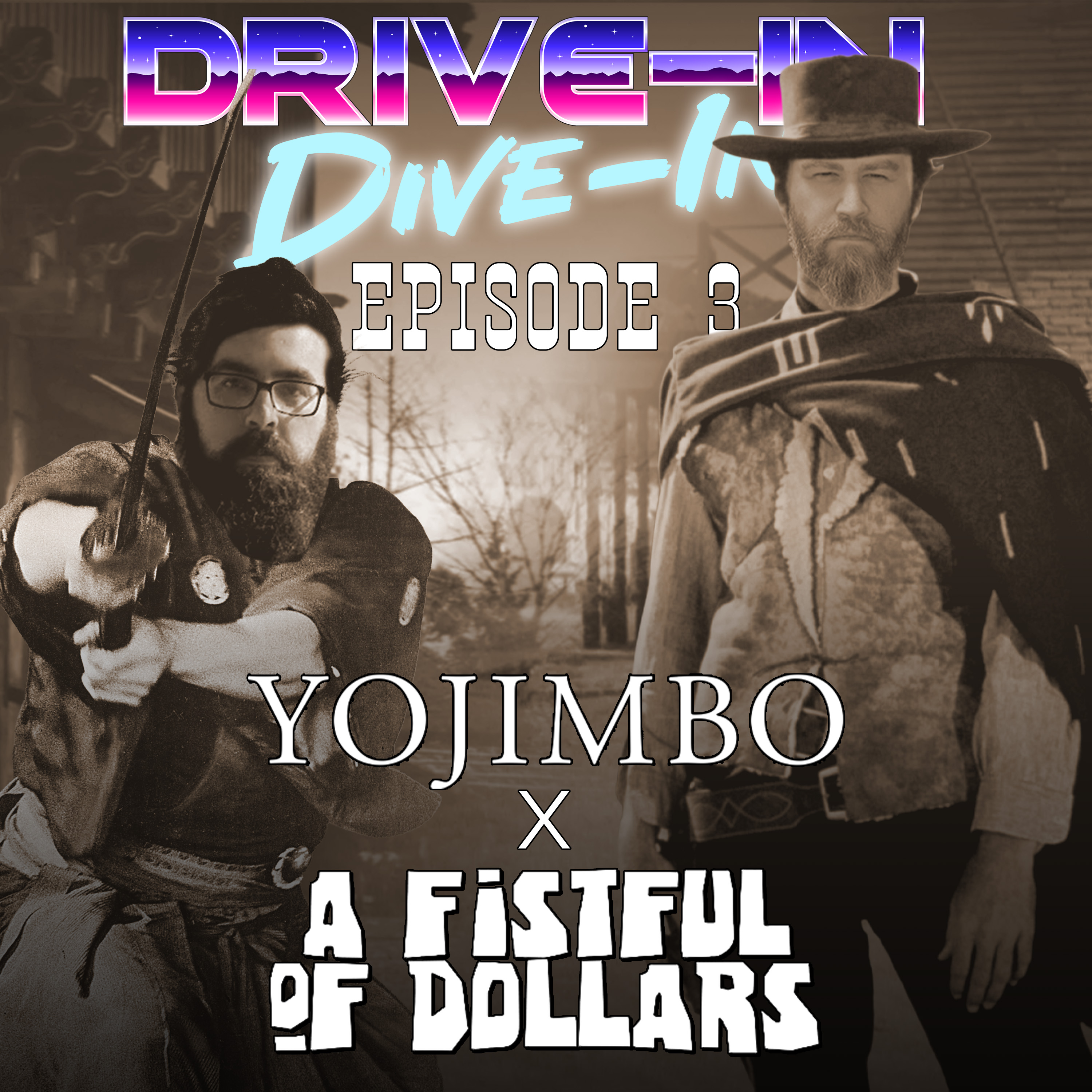
[00:01:17] Speaker B: Thanks for coming back in. Two of my favorite films, we're looking at Yojimbo and Fistful of Dollars. Well, I say favorite. I enjoy them a lot. I've watched them a lot, but yeah, I'm, as always, Luke and this is my cousin Jonathan.
[00:01:32] Speaker A: What's up? And here's a real quick rundown of the two plots. I say quick, but there's kind of a lot to get through. I'll try to make it fast, but still entertaining for you. So Yojimbo opens following an unnamed ronin, masterless samurai for those who don't know, wandering the countryside sometime in the final years of Japan's Edo period.
At a crossroads, he picks up a stick, throws it in the air and walks in the direction that it points. Just kind of aimlessly wandering through the countryside.
So while getting water at a farmhouse, he overhears an elderly couple lamenting that their son ran off to gamble in a nearby town that's overrun by two warring yakuza gangs. He heads to the town and gets the lowdown from the tavern owner. The two gangs are fighting over the gambling trade in the town. One side, run by Saibae, currently has control of the gambling operations and is aligned with the long standing mayor of the town. The other side is run by Ushitora, who used to Be Saibe's right hand man until Saibae named his useless son as successor Instead, Ushitora aligns himself with the local sake brewer and proclaims him the new mayor. So you have warring towns and warring mayors, just basically a whole, you know, rivalry over control of the town and its modes of production.
Our ronin decides the town will be better with both sides dead and that he will stick around to help make that happen. Three of Usitora's men try to accost him, and he effortlessly kills all three. Afterwards, he convinces Saibe to hire him. When Saibe asks him his name, he looks out the window where he sees a mulberry field. So he says his name is Kuabatake sanjuro, which means 30 year old mulberry field. So we're going to call him Sanjuro at this point, Saibe decides to finish Ushitoro once and for all now that he has Sanjiro's help. Sanjiro overhears Saebe's wife conspiring to have Sanjiro killed after the battle so that they don't have to pay him. So Senjiro leads Saibe's faction to the fight. But right before the battle begins, he resigns, resigns over the treachery, climbs up onto this tower to get a high vantage point, and just watch the gangs massacre each other.
The plan, unfortunately, is foiled when a government worker arrives and both gangs retreat with zero casualties. The workers investigating the murder of a colleague from a nearby town and Sanjuro learns that some of Usitora's men were the assassins. He captures them and sells them to Saibe. He then tells Usitora that Saibe's men caught the assassins and gets paid for that information. Ushitora retaliates by kidnapping Saibe's son and offers to swap him for the assassins.
During the exchange, Ushitora's brother shoots the assassin dead with the only gun in town. Saibe reveals he expected this double cross and had the brother's mistress, a woman named Nui, kidnapped. The next day, Nui is exchanged for Saibe's son. Sanjuro learns that Nui is a local farmer's wife being kept against her will as payment for a gambling debt. Sanjiro tricks Ushitora into revealing where Inui is, goes there, kills the guards, and reunites her with her husband and son. He tells them to leave town immediately. He then trashes the house where Nui was being kept and goes to Ushitora and blames the dead guards in the trashed house on Saibe. The gang war escalates with Ushitora burning down Saibe's mayor's silkware house and Saibe trashing Ushitora's mayor's brewery.
Ushitora's brother gets suspicious of Sanjuro and finds evidence of betrayal. Usitora's men beat Sanjiro to a bloody pulp, imprison him in the brewery and torture him to get Nui's location, which he never gives them. Ushitora decides to take out Saibe once and for all, and Sanjiro escapes.
The tavern owner smuggles Sanjiro out of town in a coffin as Ushitora and his men kill Saibe and his family. He recuperates in a temple near the cemetery and prepares for a final confrontation. When Sanjuro learns that the tavern owner has been captured by Ushitora, he comes back to town and kills Usitora, his brothers and his gang members. He kills everybody.
He spares the son of the elderly couple from the beginning and sends him back to his parents. And with the victims freed and the criminals all dead, Sanjuro walks out of town to continue his aimless wandering through the countryside. Whereas A Fistful of Dollars opens following an unnamed stranger riding a horse through the desert.
Sometime in the age of the Wild west. Totally different.
While getting water from a well near two houses, he sees a kid sneak from one house to the other and crawl in through a wind. We hear the kid being scolded by somebody inside and he's chased off and shot at by the drunken criminals that were inside that building. The boy runs into the arms of his father who was in the adjacent house. And we see a woman watching from the window of the criminal's house. As the criminals beat the kid's father. The criminals notice a stranger watching the whole thing from the well and stop what they're doing. And everybody goes back inside their respective buildings. We're going to call the stranger Joe, since that's what he is. In the credits. Joe rides to a nearby town where he meets the innkeeper and learns about the feud between two crime families fighting for control over the town. The Rojo brothers and John Baxter and his family.
John Baxter also happens to be the town sheriff, so Joe decides to make some money by playing these gangs against each other. Four of Baxter's thugs try to accost him and he easily kills all four, shooting them dead. Don Miguel Rojo hires him as a result. And while they're talking, the criminal who is shooting at the kid in the opening scene Enters. Don Miguel introduces this guy as Chico, one of his most trusted men. Joe watches the Rojos impersonate US Soldiers and massacre a detachment of Mexican soldiers in order to steal their gold. That night, he secretly takes two of the soldiers bodies to a nearby cemetery and props them up to look alive. Then tells both gangs that he saw two survivors of the attack hiding out in the cemetery. Both gangs arrive at the cemetery to either capture or kill these survivors, and a gunfight breaks out. Ramon Rojo kills the surviving soldiers and Esteban Rojo captures Jon Baxter's son. While this is all going on, Joe searches the Rojo's place for the gold. Accidentally knocks out a woman named Marisol in the process, who happens to be the woman we saw in the window during the opening scene. He learns that Ramon is obsessed with Marisol and is keeping her captive, so he takes her to the Baxters, who arrange to exchange her for Jon's son. During the exchange, Marisol's son and her husband Julio, who we also saw in the opening, are there. The boy breaks free and runs to his mom, who jumps down from her horse and embraces him. Julio comes to pull the boy back, and Ramon orders one of his men to kill Julio. Joe and the innkeeper dissuade that with guns, and Joe demands Marisol go back with Ramon and that Julio take their son home. Joe learns that Ramon accused Julio of cheating during a card game and took Marisol as collateral for the supposed debt. That night, while the Rojos are celebrating, Joe sneaks off, kills the guards, frees Marisol, gives her money, and tells her and Julio to take the son and get out of town. He trashes the house she was in to make it look like the Baxters were the culprits, and then frames the Baxters to the Rojos. However, Ramon is suspicious, and the Rojos figure out that Joe was the one that freed Marisol. They beat him to a bloody pulp, imprison him in the brewery and torture him, but he manages to escape. The coffin maker smuggles him out of town in a coffin. The Rojos believe that Joe is working for the Baxters, so they burned down their house and killed kill everyone in the family. As they flee the burning building, Joe recuperates a nearby mine and practices his aim. He learns that the Rojos have captured and tortured the innkeeper, so he takes a steel plate from the mine and returns to town. Ramon, who's known for aiming for the heart, wastes his ammo hitting the steel plate that Joe has hidden under his poncho. Joe then uses his precise aim to free the innkeeper and kill every last rojo with a little help from the innkeeper. Now that the victims were freed and the criminals are all dead, Joe rides out of town on his horse to continue his aimless journey.
Looking forward to this one. Some great movies based on some great source material.
You know, despite the debates around it, which we'll get into.
[00:10:01] Speaker B: Yeah, I did a little research at the end of last Episode. We were talking a little bit about some of like the legal issues surrounding it, which I was less familiar with, and the relation to the book. I forget the name Red Harvest. I have it in my notes here. I didn't get a chance to read it, but I read a little bit about some of the similarities and some of the call outs. Apparently we can talk about it later on, but apparently Kurosawa claimed that he was not inspired by the book, even though it was pretty definitely inspired by the book. He said it was inspired by the Glass Key, which was based on the book.
[00:10:37] Speaker A: So the Glass Key is another book of Hammett's. And.
Yeah, so, yeah, I mean, we'll.
If you want to get into that later, I'll hold off on digging in, but yeah, it is fascinating.
[00:10:49] Speaker B: Yeah. But in any case, it was great to watch these films again.
My wife and I both love them, so we watched them together and pretty nostalgic for me.
[00:10:58] Speaker A: Nice. Which is your favorite of the two?
[00:11:02] Speaker B: It's really tough.
Obviously, as Chris always said, Fistful of Dollars is a great movie. Unfortunately it's mine, so it's hard to pick between them. I think there's some stylistic differences which I to talk about, but I love kind of the gothic atmosphere of Yojimbo.
But I think that Fistful actually does the story a service by taking some of the source material a little more seriously. In a way, I think that Yojimbo flits on. I don't want to say satirical or comedic, but especially with some of the score and some of the way that the, you know, the protagonist is just kind of like this otherworldly power. Makes it the stakes a little different. Yeah.
[00:11:44] Speaker A: Kurosawa considered it a comedy. I don't think it's a stretch at all to say that it's comedic. So I prefer Yojimbo with regard to what it has to say at the time that it was saying it.
But as a movie, I enjoy Fistful more. Not to say I don't enjoy Yojimbo, because I do. It's wonderful.
[00:12:03] Speaker B: No, I think I would agree with that. I think that Yojimbo definitely dives a lot deeper into this kind of desolation and I guess more kind of like class warfare. And the hero is more of this mythical figure, whereas the man with no name is.
He does good things, but he feels more like a hired gun. He feels more like he's out for himself for the most part and kind of does good things along the way. Whereas what's his name, Sanjuro, is almost like this.
He has no needs and he just kind of flits about doing good even though he's grumpy about it.
[00:12:38] Speaker A: Right. Yeah. I have to pace myself on how much I get into it. But Sanduro as a character is so much like the Continental Opp and so many ways. And Kurosawa's politics very much aligned with Hammett's politics at the end of his life and when he started writing versus when he was actually a Pinkerton. But we'll talk about that more when we get into the history of stuff.
[00:13:05] Speaker B: He was a Pinkerton. Well, now I want to know about that history.
[00:13:07] Speaker A: Yeah, I mean, now we can just get into it. So.
[00:13:09] Speaker B: Yeah, good logic.
[00:13:12] Speaker A: Hammett is fascinating. Fascinating individual. He created the.
[00:13:17] Speaker B: And this is Red Harvest. Yes, I'm sorry, Hammett wrote Red Harvest.
[00:13:20] Speaker A: Hammett wrote Red Harvest and the Glass King and Nightmare Town, which are the three stories that in my opinion influenced Yojimbo.
And I'll get more into that because I think I'm the only person who's ever mentioned Nightmare Town. But it's pretty obvious when you know it, in my opinion. But yeah, Hammett is fascinating. He was a Pinkerton. So he was like a war hero. World War I war hero, became a Pinkerton, you know, busted up unions, did all kinds of stuff and then retired. And mind you, when he lived, he experienced the Wild West.
He experienced the world of Fistful of Dollars in a very real way.
[00:14:09] Speaker B: Early 1900s.
[00:14:11] Speaker A: Right.
[00:14:11] Speaker B: I think Fistful was set in 1870, but until the 20s even that was still existed.
[00:14:18] Speaker A: And he was born in the late 1800s, you know. Right. So some of his early stories are like plantation Wild west stories.
[00:14:28] Speaker B: Sure.
[00:14:28] Speaker A: But how he became an author after retiring as a Pinkerton and becoming very left leaning and sympathetic to the anarchist movements and communist shiftings happening under the surface of America at the time. He started taking his case notes and making them narratives to publish them to make money. So that's the start of detective fiction. Detective fiction, arguably. Like there's well, hope detective fiction. Right. Like you had whodunits and Things like that.
[00:15:06] Speaker B: But you had Conan Doyle. You had.
[00:15:08] Speaker A: Yeah, but Hammett's books are not whodunits. There are mysteries to them.
But like a characteristic trait of the Continental Op, which all of his early stuff was about, because he was writing about himself and didn't want to characterize himself. So it was just a nameless figure called the Continental Op, which was the stand in for Ham himself in the stories of the cases he really worked.
[00:15:33] Speaker B: And that's a Man with no Name, right?
[00:15:35] Speaker A: That's where the man with no Name comes from and why Sanjuro called himself, you know, 30 year old.
[00:15:41] Speaker B: 30 year old Mulberry.
[00:15:42] Speaker A: Mulberry Female, right, yeah, because that's the character he created, the man with no Name trope in this. He also created the American hard boiled detective fiction because he's writing real stories about when he got the shit beat out of him as a Pinkerton trying to bust up a rum running gang during Prohibition. Like, these are real stories and they have a grit to them that Conan Doyle's stuff never did and the whodunits of the time didn't have. So he created this entirely new genre, an entire archetype of character, and literally all from his real life in a lot the same way that James Bond was Ian Fleming.
[00:16:26] Speaker B: It definitely sounds very much the same vibe, right?
[00:16:29] Speaker A: Exactly, exactly. So really, really fascinating stuff. And yeah, I mean, he just wrote some really iconic stories that have been vamped and told over and over again in a lot of different ways, this being one of them.
[00:16:45] Speaker B: Well, it's interesting because you mentioned this is kind of the beginning of noir.
The inspiration for noir, which I see as a direct kind of sequential offshoot of American Gothic and by proxy, Gothic. And you see within all of these, you see the Byronic hero. Right. Like George Gordon, Byron created this hero who is still doing heroic things, but maybe not acting heroic.
And then that thread weaves its way through, say, the tales of Poe up into the film noir, up into James Bond. He's the best example of, you know, 20th century Byron, a hero.
And so seeing that in the extremely gothic atmosphere of Yojimbo really makes a lot of sense.
[00:17:26] Speaker A: Yeah, absolutely. One of the key traits of the Continental Op is he wasn't smart. He just had such a thick head. He would bash it into anything until he got where he needed to go. Right, sure. And you see that in New Jimbo a little bit. You see that a lot in the man with no Name in Fistful Dollars. Right.
[00:17:45] Speaker B: See, that's interesting because I actually made a note to Myself that the Fistful of Dollars puts a lot of emphasis on intelligent approach.
Not saying that Joe, the Man with no name is, you know, a rocket scientist. He's hardly, you know, going against NASA's best, but typically he wins by at least being thoughtful. He does bash his head into it. With Yojimbo, I think it is a little more of kind of headbutting until they give a up.
But I do think that Fistful of Dollars puts a lot of emphasis on kind of intelligent or they even call it out in the dialogue sometimes. But in any case.
[00:18:23] Speaker A: Yeah, well. And I mean, if you read any of Hammett's work, I've never considered the Continental op an idiot. Right. Like, he comes to very smart conclusions and solves very complex cases. But it's just the kind of the author remembering himself like, just.
[00:18:38] Speaker B: Third. Third time's a charm, right. He keeps hitting it until it works.
[00:18:42] Speaker A: Exactly, exactly, exactly.
I think it also maybe feels more like Fistful. Is that alignment with that, like, stubborn thing. Just because Clint Eastwood is so goddamn gritty and fierce on screen, right? That's just, you know, you remember the makeshift bulletproof vest and getting beaten in, you know, the licker room, which is a direct parallel, which is one of the reasons why it's shot for shot the same scene. There are. Yeah, I'll put it in.
At least for the video version of this. There is on Vimeo.
I will have to shout out the creator on screen over 2 minute side by side of all of the shots that are exactly between the two movies. It's wild.
It starts with them both entering into the town and wandering through. And you've got the dog with the hand in Yojimbo and the Adios amigo guy on the horse in Fistful. And then the close up on the two of them, which is just like exact framing.
And then you've got the standoff between the main character characters and the ruffians of the town for the first time with a lot of similar shots. And that quiet calm before the rapid violence. And then them walking away, the woman running to her son and embracing him.
You've got the violent shootout, sword fight inside the building and then the knocking down of the bamboo. Main character grabbing the woman and bringing her out, rescuing the sun and reuniting them. Then you've got the brawl, them getting the ship beat out of them in the liquor room, which we talked about, crawling under the buildings, them both looking out from the barrel or the. I think it was a coffin in Fistful, practicing their aim before the Big fight. And then that long awesome wide shot standoff. Off with the dust blowing and the slow approach of our main character. Followed by the rapid violence of them defeating their enemies. And their final walk off. Slash ride off out of town. Shout out to Alejandro Villarreal at Alamo City on Vimeo for putting this together. Really great stuff. Looks like he's got some other fun videos on there. Definitely check out his channel.
[00:21:19] Speaker B: It's interesting too because I just watched Fistful the other day. We can talk a little bit about the production in a moment. Moment.
But it's even to the point that it looks to me like Leon used some compositing to make it look like he was using a telephoto lens like Kurosawa did. Except for he had much cheaper equipment. So there's some scenes where it's in that one specifically. I remember there was like a floorboard. But because he didn't actually have a telephoto lens. I think they composited Clint Eastwood behind it so he looked like he was closer to. It's just really funny. He was trying so hard to do it. He didn't have the right lens. So he used other tricks to make it look similar.
[00:21:55] Speaker A: Yeah. I learned in watching the commentary this last time. All of the crane shots were done in a single day because they could only. They couldn't afford a crane. But someone else was shooting a Western in the same area using a crane with a bigger budget production. And Leon negotiated to get access to it on the weekend when they weren't shooting. So he had one day to do every single crane shot.
And like some of them. Like. One of the reasons he wanted the crane shot was to mimic some of the shots from Yojimbo.
But there are a few shots. Like when they are riding up to the ridge line to watch the Mexican American Army's handoff. And the fake Americans kill the Mexicans. Cause it's actually the crooks. And they steal everything.
[00:22:47] Speaker B: Right.
[00:22:48] Speaker A: For the gold. That pan shot. The. That feels like a crane shot. If you watch it. It's not at all. It's just really smart camera movement. But they could not bring the crane out there because they weren't renting the crane. So they managed to fake a crane shot for that. Which is really cool.
[00:23:07] Speaker B: I've got three guys in a trench coat with a camera on top.
No. I love that sort of stuff. And I want to talk about the production a bit in a minute. Yeah.
But so going on from this Red Harvest influence. I believe that there was a little bit I think there was a court case around that, but it was ruled in Kurosawa's favor. Is that correct?
[00:23:30] Speaker A: Yeah. So there was no court case between the Hammett's estate and Kurosawa, which I'll get into. Why the only lawsuit was between Kurosawa and Leon, in which Kurosawa was, in
[00:23:43] Speaker B: my understanding is Kurosawa. Well, they settled out of court, but he came out on top, correct?
[00:23:47] Speaker A: Yeah, he got like 10% or 15% of something.
[00:23:50] Speaker B: Yeah. I saw a note that he made more money from the royalties on Fistful than he did on New Jimbo.
[00:23:55] Speaker A: Yeah.
[00:23:56] Speaker B: Which is funny. But if you know anything more about that, I'd be happy to learn more.
[00:24:00] Speaker A: So some of this is going to be my speculation. I'm going to throw a little shade at some historians and then we'll talk about some things. So if you, if you listen to the historian commentary on Yojimbo, he's very wise and smart about a lot of things, but he's very much a Kurosawa, Stan. And he points to two irregularities in the comparison between Yojimbo and Red Harvest and says, well, so obviously he didn't steal anything from Hammett. And it's like, okay, no, but also. Right, like so. So my speculation on what happened, like Kurosawa has come out and said, yeah, I was inspired by the Glass Key, the film A Glass Key, which was a film adaptation of Hammett's book, A Glass Key, which has also been made as Miller's Crossing. If you've ever seen Miller's Crossing that was based on Glass Key, there are definitely some similarities, especially with the two guys and the woman and kind of that whole situation. A lot of the beats are similar. In Red Harvest, the continental ops of the man with no Name shows up in Poisonville. Personville, nicknamed Poisonville.
And it's being controlled by two criminal enterprises. One that is a rum running thing during the Prohibition. The other controls the police and they're at war.
And he kind of plays both sides, refocuses his energy to save a woman and child and reunite her with her actual husband and helps them escape while kind of bringing about the doom of the other two. So like you're like, well, yeah, that's Yojimbo.
[00:25:49] Speaker B: I've seen that movie.
[00:25:50] Speaker A: Right.
[00:25:51] Speaker B: Twice.
[00:25:52] Speaker A: Twice, exactly.
Where the. One of the places that the historian like puts a flag in and says, well, it's not because this is so different. Is obviously in Red Harvest, the continental op is called to the city on a case. He comes there with purpose in Yojimbo and Fistful, they just kind of wander.
[00:26:12] Speaker B: Yes. And throws the stick up and just walks the way it points and.
[00:26:16] Speaker A: Yeah, yeah. And we just start in the city with Fistful. Right. But if you look at Nightmare Town, which is one of Hammett's early short stories, and it's so good, it was literally, he's like, I wanted to see how much violence I could fit into a short story. Like that was his premise for this short.
This dude is out drinking and gets drunk and takes a bet that he can't drive a car from point A to point B through the desert and gets in this car.
[00:26:49] Speaker B: At least it's in the desert, right? Yes.
[00:26:51] Speaker A: Like they're in one desert town and he's gonna get to another desert town while drunk at night.
In a certain amount of time. I forget the exact details of the bet.
[00:27:02] Speaker B: As you do with the boys when you're out drinking.
[00:27:04] Speaker A: Yeah. So he gets in this car and burns it through the desert and like careens into this town, almost running over a woman.
Gets yanked into like by this almost 7 foot tall guy who yanks him off the street and puts him in front of the crime boss that runs this rum running town.
[00:27:24] Speaker B: Okay.
[00:27:25] Speaker A: From there it diverges. But like, you take that intro.
[00:27:28] Speaker B: Sure.
[00:27:29] Speaker A: Right. Stick that on the Red Harvest story. And now you're feeling a lot more like Yojimbo and Fistful, where it is an unintentional wayward meandering into the town, immediately crossing the thugs in the town, getting accosted by them and getting put in front of one of the leaders and having to work your way out of it.
[00:27:53] Speaker B: Well, and if, you know, if you're Kurosawa and you're obviously familiar with Hammett's work, all art exists in conversation and it's dialogue and you have your influences. Right, right. And so none of this is even to, in my opinion, take anything away. I think some of our greatest pieces of art have come from art and conversation. It just gets a little unfortunate when capital endeavors and copyright laws and things like that bring about more of a business minded approach to it where people have to claim, oh, it wasn't an inspiration, because if it was, then they're in trouble. You know, if I say something, I'm in trouble, so I say nothing.
[00:28:32] Speaker A: Yeah. Which I want to dig into still Curacao a little more. But that brings up a really good point.
I don't know that this is a true story, but an often repeated story.
Is that part of the reason why Clint Eastwood signed on To A Fistful of Dollars. After his co star got turned down the role. By the way, they originally went to his co star on Bonanza.
[00:28:54] Speaker B: Well, yeah, I read that he said the best thing he did in his career was turn that down so that we could find Clint Eastwood or something to that effect.
[00:29:00] Speaker A: Yep. So he was like, hey, you should read for this.
And so Clint Eastwood did. But part of the reason why he did it is because he was like, oh, cool, they're remaking Yojimbo. I love that movie.
When he commented to it to somebody on production, they're like, oh, you can't say that. We can't afford the rights. Like, keep it on the download. It's a wives tale. I don't know that that's true. I haven't seen any, any proof of him saying that. But that is an oft repeated story in the industry, which I find really interesting.
[00:29:29] Speaker B: Well, I was going to ask you if they had watched it on set because Eastwood does the sanjuro, like shoulder shrug that he does all the time a couple of times in the movie.
[00:29:38] Speaker A: Yeah. And they even, I mean, as the hands in the kimono versus hands under the poncho, like, yeah, I. He was. My understanding is he was a fan of the film before signing up. So whether that was Lyon or him or a mix of them, I doubt they actually watched it on set because they were trying to pretend they didn't know the other movie, but they clearly did.
But yeah, just to Kurosawa's inspiration, I don't think anything takes away from it being a fairly original.
If you've read the stuff, you're like, yeah, this is clearly the same story, but it's told in a unique way. It has its own things to say about capitalism and the end of the Edo era and what was happening in modern Japanese society at the time. It's very poignant, very well written. And one of the other, like things that the historian kind of scoffed at is he's like, yeah, he said he was inspired by the film the Glass Key. But Hammett's work wasn't even translated into Japanese and sold in Japan until two or three years before this movie came out. That's more than enough time for him to research the author whose work inspired him to make the movie.
[00:30:47] Speaker B: Like, this time, movies were made in a couple of months.
More than enough time. And it would have been fresh and new in front of mind, you know.
[00:30:55] Speaker A: Exactly.
[00:30:56] Speaker B: Yeah. That's interesting.
Seems like a very, very poor legal defense to me.
[00:31:02] Speaker A: Oh, 100%. Yeah. But like, you know, I'm sure, at least in part, like, because it probably didn't come up until after the lawsuit with Leon and his lawyers were probably like, keep it light, don't admit that. Right. Like, you know, lawyers are smart in that sense. But I don't think even if he come out and said, yeah, I was inspired, like, the movie the Glass Key was inspirational to me. I read more of Hammett's work and I loved Red Harvest and Nightmare Town and they all kind of merged together into this story. I don't think he would have owed Hammett's estate anything because it is very much his.
And I think the only reason or a primary reason why Lyon owed him money is because he stole shots. And there are elements of Fistful that were original to Yojimbo that were not in the books.
[00:31:55] Speaker B: So, yeah, when you can do a side by side comparison where a non expert can tell, I think that's in my understanding.
If a reasonable person would think that it's inspired is usually the burden of proof, which makes sense. I'm trying to find it now.
I've got too many notes on this one. But I read that there was another film that was inspired by both of those that came out in the 90s with Bruce Willis in the same film, Last Fancy. I have not seen that one, but I don't know if there's a.
[00:32:26] Speaker A: That's good.
[00:32:27] Speaker B: Is there any context there with further legal action or did the drama end there?
[00:32:33] Speaker A: No further legal action because that lawsuit had already been settled and the filmmakers came out and said, this is a remake of Yojimbo. What's interesting to me is that the filmmakers are like, oh, no, we never read Hammett. We weren't inspired by Hammett. But like it is prohibition era, full on, like hard boiled detective looking Bruce Willis.
[00:32:55] Speaker B: Okay.
[00:32:55] Speaker A: It just. I'm like, how have you not read, like, how can you tell me you haven't read Bread Harvest, but this is your remake of Fistful in the exact setting that Poisonville was in the time that it was Red Harvest. And that's just Hammett never getting his due. Right. Like. Right.
[00:33:11] Speaker B: I'll have to give that one a watch.
[00:33:12] Speaker A: But it's good. It's not as good as the originals in that sense, but I. I really like it. A lot of really great action. Bruce Willis is being Bruce Willis. So if you're a fan of that, you'll enjoy it.
[00:33:21] Speaker B: Chris Walken. Yeah, we'll have to give it a watch.
[00:33:24] Speaker A: Yeah. I mean, anything with Christopher Walken is great. Right?
[00:33:29] Speaker B: Just immediately makes the movie better.
[00:33:31] Speaker A: It does. I've watched some real obscure, like, I won't call them stinkers, but like low budget, indie, gritty, like crime movies that Christopher Walken was in just because Christopher Walken was in it. And I'm like, you know what? It was worth the watch.
[00:33:46] Speaker B: What's that? Gibson One Rose, Tokyo Hotel or whatever.
[00:33:49] Speaker A: New Rose Hotel, yeah.
[00:33:50] Speaker B: New Rose Hotel. That was.
Anyway, we'll have to do an episode on that because just by itself, we don't need a comparison.
[00:33:57] Speaker A: Yeah.
Anyway, both movies stand really well. We've been doing a lot that feels like kind of throwing shade on Leon because he lifted from Yoonjimbo. But like, I. You gotta give him credit, a lot of people will be like, oh, the western was dying and he resurrected it. And that is true to an extent, but he wasn't the first person even in Italy to be doing what he did in Fistful of Dollars.
That kind of ultraviolent thing was kind of coming about.
The grittier tone was coming about already.
He was kind of of at the forefront of a wave that was building.
He didn't create the wave himself, but again, not to discredit him.
[00:34:46] Speaker B: It's also interesting too that there was this defense that the books had only been out for three years and they made Yojimbo, but Fistful only came out three years after Yojimbo. And they said it must be inspired and obviously was.
But just this thread of. At the time, it seems like three years was the speed of influence.
I think it's even faster now, although production times are longer. Right.
But I really love seeing this kind of thorough line, this kind of circular American goes to Japan, then it goes to Italy and then back to the US and it's just this big circle of influence.
[00:35:19] Speaker A: Yeah, absolutely. Yeah. And that's, you know, I think that's the beauty of film. It's so beautiful. You know, it is. It's beautiful. Especially when looking at this story and the way it's been interpreted and reinterpreted and retold is it kind of just builds on itself.
Some interesting stories from. I know you wanted to get into production, but with Fistful specifically, Westerns at the time had a very specific way of filming shootouts. If you watch anything from John Ford, anything from any of the other guys, like back in the day, prior to Fistful of Dollars, you've got the tight shots on the guys, then you've got a wide shot, maybe a quick close up of the hand pull pulling the gun and Firing. Or a shot of the dude firing the gun. And then you cut to a guy clutching his chest and falling over. Right, right. That was the classic American Western shootout. And Leon didn't know that. And, you know, Clint Eastwood was new. He wasn't gonna tell anybody how to shoot anything. He was gonna be like, well, this is the way we do it on Bonanza. So, like, he just let Leon do his thing. And Leon own. Literally was just like, it. We're going to do it live.
[00:36:33] Speaker B: We'll do it live.
[00:36:34] Speaker A: It.
[00:36:35] Speaker B: Do it live. I can. I'll write it and we'll do it live.
[00:36:39] Speaker A: Wide shot with squibs. Whole shoot. Boom.
Blood fall. Single shot. Cuts.
[00:36:47] Speaker B: Yeah, very. I mean, it's kind of like Tarantino does it now. It's. You know, it's. And I believe Leon was influential to Taro. But just you. You see everything. And you see that, too in Yojimbo, where, you know, they're doing a lot of things. It's kind of pulled back, and it's like more horizontal motion because Sanjuro's running everywhere, hitting everyone with a sword. Again, I think this goes to, like, the. The difference in equipment. Leon, or at least in Fistful, he did a lot where you have one big thing in the foreground. So it kind of looks like you have this telephoto effect. So you've got, like, Clint Eastwood in the foreground, and then the guys down there, there. And then you see all of the action.
It's really cool.
[00:37:24] Speaker A: Yeah, absolutely. It adds a viscerality to it and really elevates the violence. Which is why they started getting called spaghetti Westerns. Because of the blood splatter. Right?
[00:37:34] Speaker B: Spaghetti and meatballs.
[00:37:36] Speaker A: Yeah. But also, part of it was budget. Right. I don't think they could have afforded to do all of the shots involved in the American style of filming a shootout. They're like, all right, we got to do this one shot.
[00:37:47] Speaker B: Let's, you know, we've got one camera. You know, I don't think about one
[00:37:50] Speaker A: shot that much anymore, Mike. You have to think about one shot. One shot is what it's all about. Deer has to be taken with one shot. I try to tell people that. They don't listen. I think the unsung heroes of both films, but especially Yojimbo, are the camera operators. I mean, you watch the tracking shot of the dog carrying the hand in its mouth, which is one of the most famous shots from the movie. I mean, imagine perfectly tracking a dog, right. To keep that in focus as the primary focus. When you don't know exactly where the dog going to be moving. You can't practice blocking with a dog. Right.
And Kurosawa himself was like, yeah, that dude is a miracle worker. I don't know how he does the stuff he does.
[00:38:29] Speaker B: Well, in both films use this kind of framing aesthetic super well, using, like I said, this foreground background compositional technique to immediately show you what's important to show you detail up close. Action. Eastwood is drawing his gun as well as being able to focus on. On like the farther action the, the guys out there. It's just really beautiful. Or when you're in the sake house, you've got all the, the framing through the window. Literally through the windows, which they do also in Fistful, it doesn't look as good because I think it's a lot of is composited again.
But yeah, it's really cool.
[00:39:05] Speaker A: Yeah, absolutely. And it's. In a lot of ways it's an art that we're losing. I think I sent you that TikTok video, that clip that was talking about why everything looks the way it looks now. And it's because nobody uses the long depth of field where we can see everything. Everything's super tight, shallow depth of fields with, you know, the backgrounds blurred out, which is cheaper for production, easier for digital, but just simply does not look as good.
[00:39:29] Speaker B: Well, and both these films use the natural lighting. We don't do that at all. Everything's super blown out like my background right now. Sorry about that.
[00:39:36] Speaker A: But yeah, yeah, and it's, you know, it's that shift to digital in a lot of ways. And I think, you know, it's. There's a lot of reasons why something shot on film looks different. And I'm not going to be here and be like, film is superior. I think that digital has its place as well. I think, you know, I mean, we could not do the mandalorian in the 1970s and have it look the way that it looks.
The new technology that they're using there is incredible. I'm not here to shit on technology, but I do think that there's an art and a finesse to camera operation that's going away in part because it's just not something you can do on certain digital cameras. So lower end, you know, more indie filmmaking is kind of losing that. You don't have dudes who just got out of film school and know how to do, you know, tracking shots and, and, you know, track focus and stuff like that. You, you're just putting a lens adapter on an iPhone and shooting. And it looks good. So, like, cool. Like, let's just go with it. And that's fine. And I think that that is a style of filmmaking, but then you watch something by one of the greats, you watch anything by Spielberg or even Tarantino, Scorsese, any of these guys. Pta. Like one battle after another, right? Like, you watch anything by one of the masters, and it looks different. There was a scene, I think it's in Minority Report. It might be in something else, but it was a Spielberg film. And I saw somebody calling out how impressive the camera work was on it. It's a single shot. There's people in the foreground. There's somebody in the background. They walk downstairs and come up to the person in front of them. It's rack focusing between the guy walking and the person talking. They come up front, the camera is shifting, shifting so that you get faces while they're talking. And then the person's moving on. And like, it's all one shot. It's all perfectly rack focused. And it's.
You just don't see that in Marvel movies, right? Like, you know, and I love them. See you. I'm not. I'm not here to shit on them. It's just there's.
When I talk about the artistry of filmmaking, it's something that you see in Yojimbo, you see in Fistful Dollars. And it's something that you don't see in a lot of modern movies that may be vampire.
Some elements of them.
[00:41:59] Speaker B: Yeah. I mean, it's really telling. Sometimes when I watch certain older films or even newer films by some of these older directors, one that comes immediately to mind to me. And again, I haven't been to film school. I'm doing this to learn more about film, as you know.
But Sam Raimi loves to use these split shots with. And I forget the name of the lens, but it's one that can double focus.
And apparently they're very rare these days to get actual ones. And there's ways to do it digitally, but it looks kind of bad, right?
And so you'll see old Sam Raimi films and he loves to do these things where. When you have double focus and it looks very weird to us now because nobody uses it anymore, but it gets a really cool kind of. He uses it for this kind of claustrophobic effect and Evil Dead films like that. But you even see it in his new Doctor Strange film, which is basically an Evil Dead film, if you ask me 100%.
He just snuck in Evil Dead 4.
His own Evil Dead 4 before Rise came out.
[00:42:59] Speaker A: Right.
[00:43:00] Speaker B: But yeah, I love picking up on those little things and effects that you don't see anymore or watching. I just started my probably fourth or fifth rewatch of Twin Peaks and the way that David lynch is so intentional with his shots and what's focused and framed and the lighting is all very natural. It's not all blown out now. I just love seeing that it gives such a different atmosphere. Whereas every Netflix movie looks the same now.
[00:43:25] Speaker A: Yep.
Yeah, 100%. And you know, it's the difference of you're talking about two guys that came up in indie film when equipment wasn't accessible. And I think that accessibility is a double edged sword because you get movies like Milk and Cereal, which was made for I think $500 or $800 and it's one of the best found footage movies of the last five years. It's incredibly smart, well paced, well shot, solid lighting, shot on iPhone, but looks good and tells an awesome story and is incredibly entertaining. And those guys, like, if we didn't have the accessibility, would not have been able to make that. I mean, maybe they made a ton of money off of their social media platform, but like, you know, they, in theory, theory would not have had access to even have the platform to make the money to shoot that. Right.
But then you also get just, yeah, every Netflix movie ever, just doing it the cheapest and easiest way, not caring necessarily about the artistry. And that's not to say the people involved in the filmmaking don't care about making art. I want to be clear about that. Like, the Netflix movies are still really good. Movies are entertaining. Like, part of what why this podcast is what it is is because I advocate for movies that people say are shit or that people trash on. Like, I think that there is art to be found in a movie because it got made. Even like some of the worst movies I've ever watched. And when I say worst movies, man, like, what a piece of shit. More. Y' all don't understand how bad some of these movies are. But at the end of the day, you know what? They made a movie, they sat down, they put together some equipment and some friends and they made something and it was fucking terrible. And they probably shouldn't do it again, but like, good for them for doing.
[00:45:19] Speaker B: Sometimes you gotta just make the things so you can learn something and move on, you know?
[00:45:23] Speaker A: Okay, the now. Yeah. The only ones that I ever say maybe you should stop are the people that I've seen two or three of them and they haven't gotten better. And I'm like, you're not learning anything. Just stop.
[00:45:31] Speaker B: Like, yeah, but you're having fun. I've seen a few. Yeah, I've seen a few in a. That vein where it feels almost like a vanity project by somebody maybe with a little too much money or something.
[00:45:41] Speaker A: Yep. Yeah, exactly. Exactly. And, you know, it's. That's fine.
[00:45:45] Speaker B: Well, even just to tie this back into, we've gone a little far afield. But this is related on the production side, with Fistful's budget being something like half of Yajimbos.
[00:45:55] Speaker A: Right.
[00:45:55] Speaker B: And some of the amazing things, they. I mean, obviously had much more global appeal. And I talked about things like compositing and doing little tricks with. You don't have the right lens, but you can do things like with the blocking that make it look like you're doing these cool focus effects. Very creative by somebody who obviously knew what he was doing.
[00:46:12] Speaker A: Absolutely. Yeah. And that was really the point I was getting at is like, necessity breeds invention, right?
Raimi and lynch created a lot of techniques and a lot of stuff
[00:46:29] Speaker B: when
[00:46:29] Speaker A: they made their early things. Like, I'm sure you've heard the stories about lynch making Eraserhead and, you know, essentially like, cutting it at. I think it was NYU on weekends and sleeping there.
But, like, he invented a lot of audio techniques to get those sounds. Like sound in film is the way it is today because of the stuff that David lynch did for Eraserhead because he wanted something that didn't exist. And a lot of some of the things that Raimi did, same thing. Right. And we're talking about Hammett, who created a lot of things that are now indicative of storytelling because he was just trying to turn his case files into a way to make money because he was retired and needed wanted. Right. And then you have Kurosawa, who birthed so much of modern filmmaking and modern storytelling on film. And then, yeah, Leon, who also did the same out of necessity, out of a smaller budget and really pushed the envelope forward.
[00:47:39] Speaker B: Well, also kind of taking these dramatic ideas that Kurasawa in this case, but making something that was a little bit inaccessible, like the three hour film, it's a little harder to follow for, say, a spaghetti Western audience. And making making something shorter accessible, but still very dramatic. Still great storytelling. Doing some things that I like a little better. I mentioned the soundtrack earlier, for instance. I think that it's mostly just a guitar and some guy whistling, but it does so much for the aesthetic that I think that each of them brought something as you were saying, new partially out of necessity, but partially out of creativity.
[00:48:25] Speaker A: Yeah, absolutely. And I think in doing so, they both also really defined a lot of elements of their genres. Right. Like the way that samurai carry themselves in samurai films pre and post. Yojimbo is very different, especially in Western movies about samurais. I don't think there's a single Western movie about a samurai that isn't just vamping Sanjuro in Yojimbo. Right.
[00:48:51] Speaker B: Keanu Reeves is just. What's his name? Mifune, but.
[00:48:56] Speaker A: Yeah, exactly, exactly.
[00:48:57] Speaker B: You've gotta be, like, a little irreverent, a little gritty.
[00:49:02] Speaker A: And I don't think there's a single one of us that, when we were a kid, didn't whistle Morricone's whistle theme when we were pretending to have a shootout, playing cowboys as kids.
Yeah, right. Like you.
[00:49:17] Speaker B: Well, sure, it's iconic.
[00:49:18] Speaker A: You think Western, you think the Tril. The Fistful trilogy and that music and those shots, and Clint Eastwood, specifically as Blondie, the Man with no Name. Like, there's just defining moments in culture that are so vibrant and tap into this kind of base instinct and ideal that has been being retold so many times throughout humanity that it's kind of tied into our DNA and just becomes part of the cultural zeitgeist.
[00:49:52] Speaker B: Just love seeing where these elements come from, too. Or on the whistle theme, the shootout, it's iconic to have the blowing tumbleweed, but that kind of comes from Kurosawa.
I had read that an enormous portion of his budget went to wind machines, which you can tell Leon did not have in Fistful, although they kind of fake it at the end by having a big explosion that can kind of make a dust storm blowing through so they can kind of get the effect. But, yeah, it is super windy. And it's interesting, too, because apparently having all the wind machines in the cleanup A was a big portion of the budget, but it forced, like, all the actors to be squinting all the time and things like that, which you see reflected in Fistful, partially because you're in the middle of the desert, but partially because that was kind of the aesthetic of what they were going for.
[00:50:39] Speaker A: Yeah, no, that's really fascinating and kind of made me think to another point that I wanted to bring up, which is that you're talking about how there's actual dialogue commentary to man with no Name and Fistful being more thoughtful, and he's up on the second floor surveying and like, things like that. And that was very much Lyon seeing Kurosawa do that. With Senjiro and putting it in his movie because he was telling the same story. But Kurosawa was doing it because Sanjuro was a stand in for Kurosawa. Like, there are multiple moments where he's up watching and, like, directing, and there's these, like, cheeky nods to the audience of, like, hey, you know, this is me. Like, he was making a lot of commentary about filmmaking and about himself and his position in things.
And that's something that was lost in the translation to Fistful, but, like, you still got the positioning of the character and the scoping, but it was interpreted differently and thus translates differently in the other film, which is pretty interesting.
[00:51:58] Speaker B: Yeah, Senjuro, he'd be up in the bell tower almost kind of in the whole time he's directing the events until the climax, basically, when they kind of catch on to him where it feels less like, I'll just call him Joe because Man with no Name is slung here. But it feels like Joe is less of a director and more of an observer and responder.
[00:52:16] Speaker A: Exactly.
[00:52:18] Speaker B: I think the only specific instance I can think where it kind of, kind of borders on the same direction was at the very beginning. He goes down to the Rojos and speaks very quietly, but apparently the guy's just at the window listening. He's like, hey, come out and watch this. And he goes and shoots four guys on the way. The. The great. He says, get three coffins ready. And he comes back and says, make that four.
Just a great sequence altogether, but that's the only time I can think of where it feels like he's directing. And the rest of the time, Joe feels like he's responding.
[00:52:49] Speaker A: Which is another reason why I think Fistful feels more like Red Harvest.
Because, you know, I wouldn't say that the Continental op is ever chasing his tail, but he is most certainly never in charge of and directing people. He's using them against each other and using his cleverness to kind of orchestrate things. But not to the degree that Sanjuro is actively directing action in Yojimbo.
[00:53:18] Speaker B: Senjuro just feels. Even when he's captured, he feels in charge to a point.
But maybe there's something metaphorically there about how Leon was following Kurosawa kind of adapting his work. Maybe it's just even at the time, and I don't know enough about these people to really make a sequence. But if I were writing this from a literary perspective, it would be that he was more of a follower than that kind of director innovator. Even though he did a lot of great things himself.
[00:53:47] Speaker A: Yeah, absolutely. Absolutely. You could say the same of Tarantino. Right. But he's one of the premier auteurs of our time. Whether or not he's a shithead as
[00:53:57] Speaker B: an individual, justice for Dano.
[00:54:00] Speaker A: Absolutely. But, you know, like, a majority of what he did is take what he thought was cool and do it again. Do it again, you know? And, I mean, that's okay, right? I think that that's true in a lot of ways. I. I am. If you look at Eli Roth, and I don't think we've talked about him on here, I am an Eli Roth defender. I think he's very misunderstood. I think he's a very talented and very visionary filmmaker that people just don't get. And, like, I'll take flack for that online. I don't really care. You know, I can have a Eli Roth diatribe another time. But I bring it up because Cabin in the woods, which anyone who even doesn't like his stuff will say, yeah, that was. That was a good movie. He did pretty good there. Had some weird moments, but it's a good horror movie. That's Evil Dead.
When he first saw Evil Dead or Evil Dead 2, I forget which, it kind of blew his mind.
I think it was the first one because he was like, whoa. They just brought a camera to a cabin in the woods and just made a movie. You could just do that. That's crazy. I'm gonna do that. And that was what inspired him. So he wanted to make his own cabin in the woods movie where you go to a secluded cabin with your friends, and. And there's an evil that is taking over your friend's body, and you have to kill your friend to keep that evil from getting inside you.
[00:55:18] Speaker B: Right.
[00:55:19] Speaker A: He made it a disease instead of actual demons, but it was him doing Evil Dead and made a great movie as a result.
[00:55:31] Speaker B: I mean, Shakespeare complained there were no do stories. So it's not like this is anything new.
[00:55:35] Speaker A: Yeah, exactly. And how often are we retelling, you know, Shakespeare stories?
[00:55:39] Speaker B: You read any Shakespeare? I know all Shakespeare. The Tempest.
[00:55:43] Speaker A: Some of the best films and some of the best modern stories are stories where we are telling tales that are intrinsic to us as humans and humanity. Right. Like, I think that part of why. To get a little heady and philosophical, part of why everything kind of boils down to waves and vibrations.
[00:56:07] Speaker B: Right?
[00:56:07] Speaker A: Right. Light waves, sound waves, gravitational waves, you know, is because resonance and sound are intrinsic to being and existence. And so telling stories is intrinsic to us, not just as entertainment, but as the methods of prolonging and perpetuating ourselves and society. Society.
[00:56:34] Speaker B: At length, when I was studying literature, the mantra is that narrative or literature is an exploration by people of what it means to be people.
But to expand upon that, we understand everything through stories. Stories we tell ourselves, stories that we're told. If I see. I'm looking at a light switch cover right now. I know what that is because I'm telling myself, that's a light switch cover. And this is what it is. Does the conflict is I want the light to turn on? How does that happen? There's resistance. Like, it's all based around storytelling. Otherwise we would be plants that just simply react.
You know, we couldn't be proactive in any way.
[00:57:13] Speaker A: Although, actually, plants have consciousness, too.
[00:57:18] Speaker B: You know what I mean?
[00:57:19] Speaker A: I do, I do. I know. That's why I did the fake pushing up the glasses.
[00:57:24] Speaker B: Well, actually, you get the glass. Glasses gleam.
Yeah.
[00:57:28] Speaker A: You know, I won't get too into that, but there is a really fascinating study that recently came out that plants can see.
There's also been others that they remember and can react and communicate to each other.
[00:57:39] Speaker B: Of course they can see. They eat with their eyes.
[00:57:41] Speaker A: Right?
[00:57:42] Speaker B: So do I.
[00:57:43] Speaker A: But, like, see to the point that they recognize, like, faces, like, and I understand.
[00:57:47] Speaker B: Oh, okay, That's.
[00:57:48] Speaker A: Yeah. And they can recognize other plants. And, like, what is and is not, like, like, same plant.
There's there.
When I said. When I said plants are racist. Yeah, yeah, yeah. Well, no, but when I said plants have consciousness, like, it's for another time, but, man, like, way more than we have realized. Plants have consciousness, like, even beyond, like, fungi. We've kind of learned in the last decade or two that, like, they have, like, a really interestingly rich consciousness and inability to communicate across long distances. But all plants, we are learning, have more consciousness than we realize, which is throwing a lot of question with regards to how we define consciousness.
[00:58:32] Speaker B: And so what will the vegans eat now?
[00:58:36] Speaker A: Exactly?
You know, nothing that casts a shadow.
[00:58:43] Speaker B: You can't photosynthesize, so I don't know.
[00:58:46] Speaker A: That was a Simpsons deep cut.
[00:58:48] Speaker B: I'm a level five vegan.
[00:58:50] Speaker A: I won't eat anything that casts a shadow. Wow. I know you. We dug into the production a little bit, but are there some other elements of the production that you wanted to
[00:59:00] Speaker B: Maybe the last thing that I thought was interesting was the towns. Kurosawa built his own town. That's right. And it's interesting because obviously Lyon had to use an existing city set. But the way that Kurosawa's town was built was kind of how they were already building western sets. So he was able to find something that worked, I think, very well.
They didn't have a bell tower, obviously, but I think the cantina balcony is actually a better metaphor for the. The western anyway.
And other than that, remarkably similar constructions, even though he was using an existing set.
[00:59:33] Speaker A: That's fascinating. I love, you know, when that happens and it happens less and less with modern filmmaking.
But, yeah. One of the titles that I've worked on,
[00:59:47] Speaker B: Information is highly classified.
[00:59:49] Speaker A: My feathers get a little ruffled when people trash on the production. Like, if you didn't like the end result, like, okay, fine, you know, we can have another conversation about that.
But to insinuate that anyone on the production did not care deeply about what they were doing is very disingenuous and very unkind to people that put in a lot. They built an entire town just to burn it down.
[01:00:22] Speaker B: Yeah.
[01:00:22] Speaker A: So that it's all real. All the fires real, all the buildings are real. Like, they. They built it, shot in it, burned it to the ground. Like, you don't do that if you don't love what you're doing. Right. If you don't love the movie or the show that you're making, there's significant amount of work and labor that goes out of that.
[01:00:40] Speaker B: No, absolutely. I think that there's a lot of disconnect in people's minds. We live in an era of every opinion must be the maximum. You even see this with YouTube slop, which I love my YouTube slop. I go and slurp it out of the trough every day. But everything is like the 10 best packaged ramens or whatever it is. Nothing can just be. Here's some pretty good stuff that I like, and I wanted to tell you about it. It has to be the best. The biggest. The most expensive cruise that you'll ever be on. The. The Mr. Beastification of. Of everything.
[01:01:13] Speaker A: Yep.
[01:01:14] Speaker B: And it's. You know, we see it in politics. Everyone is an extremist, even if, you know, and we call each other extremists. And. And I can never accept any of your opinions. Sometimes I just kind of like the thing. And that's okay.
[01:01:26] Speaker A: Yeah.
[01:01:26] Speaker B: So anyway, I'm not gonna go on my whole diatribe, but it really.
It really pisses me off how every time I bring up a film or a book or something and someone's like, I hated that. Like, couldn't you just mildly dislike it or just be okay with the fact that I kind of like it, you know?
[01:01:40] Speaker A: Yeah. Absolutely. You know, and it's like, you know, we kind of talked about, I think in episode one, like, people are like, oh, you know, this MCU movie is the worst movie I've ever seen. It's like, is it. Or are you just, you know, having extremist opinions, or are you just uneducated? And this is actually the worst movie you've ever seen because you only watch what you're fed by the studios and their advertising machines, which, like, if that's your life, that's fine.
[01:02:07] Speaker B: And we even see it from our. The people that we should be respecting as artists. Tarantino with the Paul Dano thing that just happened. Or speaking of the mcu, it's Scorsese just saying that it's like, all trash. It's simply not true. And you, as someone in cinema should know that that's not true. Right, right.
[01:02:22] Speaker A: Yeah, exactly. Exactly. You know, but it's all about extremist opinions, and it's a real tragedy because it's marred discourse. And, yeah, it started, you know, a while ago, like, all, you know, as a millennial kind of take some of it on my shoulder of. Everything was awesome and epic and the greatest ever. Right. And it's just like. That's exhausting.
[01:02:42] Speaker B: We're great, dude.
[01:02:43] Speaker A: Yeah, the 90s were great, but, you know, where.
[01:02:47] Speaker B: The early 2000s, you know, in their own way. Different ways.
[01:02:50] Speaker A: Exactly. But, you know, it's just.
Yeah, the. The extremification of discourse has really made it difficult for people to appreciate things for what they are, and it's kind of marred film appreciation and art appreciation in general. I mean, imagine if we talked about paintings the same way. Ah, dude, Dega fucking sucks, man. You can't. You could barely see his paint strokes at all. What the is that?
[01:03:19] Speaker B: You know, Okay, I hate to say it, but I think with AI now it's getting to that point. Right?
Maybe in a slightly different way, but I. It really breaks my heart. Heart. I see this on Reddit a lot. There's like, these subreddits are all about, is this AI or not? And there's so many times where it's just not. It's just every. No one trusts anything anymore.
I think this is, like the next step where first it was extreme and I'm always right, and then now it's. I can't trust anything, so I'm extra. Right. Whatever I think is reality.
[01:03:51] Speaker A: Right. And I mean, that's, you know, not to, like, get too far down the AI rabbit hole, because that's a massive void but you know, I mean that's the main danger of it is not. Well with our current technology, the exclusively speaking to the current technology, the main danger is not that it's going to take over everything and murder humanity. It's that it is just convincing enough to make everyone doubt and dismiss everything and anything and basically makes discourse and discussion near impossible. Yeah and I see that a lot like there, you know, anytime a new art book comes out or a new board game gets announced on Kickstarter.
Was this art AI? This is Mafro. She's a new breaking out metal artist.
[01:04:54] Speaker B: Over the edge Cuz my head is in over dry I'm sorry but it's too late and it's not worth saving don't come rain on my parade
[01:05:11] Speaker A: I
[01:05:11] Speaker B: think we're doomed I think we're doomed
[01:05:17] Speaker A: now there's no way back I met messaged her about this. This doesn't feel good. She doesn't like the fact that she's finally breaking out and people are questioning her for absolutely no reason. If you're a little bit confused because you're paranoid and you don't want to be following AI music, I understand it. And yet there are content creators on YouTube who are making posts questioning if she could be AI making someone's humanity content like oh could she be real or not? It's not cool. And if you're going to make big bold accusations, do a little bit of research. And I understand the concerns around it. I'm not like. But like when people are. If you have to scrutinize it really hard and you're still not sure, like maybe err on the side of not shitting on a real artist who maybe spent a lot of time on that just because you think that it could possibly be AI because this brushstroke looks a little weird to you, right?
[01:06:10] Speaker B: Well, I've got to be honest, I'm. I'm probably much more of a proponent of AI than many people. People. If used in the right way, I think it's an excellent tool for creatives to shore up some of their weaknesses and speed up some of their processes.
But that also doesn't mean go slap a prompt into ChatGPT and then just publish that as a trading card.
There's a lot more to it than that. Is it great for concepting? Absolutely. Is it a great coding aid? I can tell you personally that it is. You've seen the little Gemini powered app that I've been working on, the movie recommendations app.
There's good uses for it. My fear is that it's going to. And I think the Matrix actually predicted this better than something like Terminator. Take away the joy of what it means to be human.
Right. Not that it's going to kill humans. Not that it's going to enslave us so much more that it just takes away all the things that bring us joy. And all that's left is for us to kind of wither, you know?
So, anyway, this is getting a little existential.
[01:07:06] Speaker A: No, I'll.
[01:07:06] Speaker B: Good. It's existential, yet it's so accessible.
[01:07:10] Speaker A: Where I push back against AI is that like, I don't want AI to make my art. I want it to do my fucking laundry. Right. Like, just. I want it to do the things I don't want to do, not take away the things that I do want
[01:07:26] Speaker B: to do, which I think is in line with what I'm saying.
[01:07:28] Speaker A: Absolutely. And that's, you know, to. On a practical level. Right. As somebody who works in creative advertising and creative marketing, we do a lot of things that are first to market. We do a lot of concepts that are really new and are pushing things in directions that people are not familiar with. And anyone who's in the industry or in this kind of job knows the decision makers do not have imaginations. And I'm not.
I have to be careful. I'm not trying to slander them. I'm not saying they don't. I just mean they're really busy. They see a lot of stuff. They don't have the time to imagine what your idea could be because it's the 10th one they've seen in the last hour and a half. They need you to show them what you envision it is. Right.
So we could either, as a company, spend $15,000 that we're not getting paid if we don't get the job to have designers design every concept in a deck and spend three weeks to a month to build that deck.
Or we can use AI to iterate and build and create proof of concept looks that show what these ideas are.
[01:08:51] Speaker B: Right.
[01:08:52] Speaker A: With our designers that are already in house at a fraction of the time and get a proposal out in a week.
[01:09:01] Speaker B: Well, and don't get me wrong, I think that's actually an effective use. As long as the understanding is this is concept.
[01:09:07] Speaker A: That's exactly it.
[01:09:08] Speaker B: We're using our creative brains, then we're going to go do the work.
[01:09:12] Speaker A: Yeah, exactly.
[01:09:13] Speaker B: And maybe there's ways that AI can help us do the work, but. Yes.
[01:09:16] Speaker A: Yeah, yeah, we're not. We're not, you know, know, using AI in the final product. We're not taking that AI thing we stuck in a deck and then putting it up on social media or like whatever. Right. But when you have executives who don't have the time to imagine with you and need you to show them the thing. Yeah.
You want to spend the money where it matters and that's on producing the actual output that they're paying you for. Right, yeah. And it just, it allows us to focus on what's important and do better work overall because we're not wasting time and money comping up ideas that never get sold, which is 80% of any ideas.
[01:09:54] Speaker B: Well, and I have two points here. The first one, you know, and as you know, and I think I've said before, I work in the games industry, so this is very front of mind for me probably as much as it is for you. In different ways.
Basically every part of the games industry is being touched by AI in some way.
Some companies are using it very toxically, I think, in a way that they're going to regret.
And some are actually, actually doing a good job of saying, hey, this is a tool that will help us be faster.
But it's a tool, not an end product. That's point one. So totally on board there. Point two. And this is how we wrap it all back into our conversation.
Who's to say Leon didn't take Yojimbo? And he said, well, I need a funding pitch. He said, I'm going to make this, but with broader appeal.
I think this is not a perfect cognate to this whole AI discussion, but just speaking to the idea of being able to shorthand and utilize that sort of inspiration is very, very useful, very effective. You know, I mentioned the issues that I have with copyright and things like that earlier. It's unfortunately because, you know, art is a product now, AI is commodifying it to an even greater extent. So there's a lot of conversations that need to happen around that. It's not necessarily always a bad thing, it's just how. How going all the way back to the core of what we were saying R is it needs to represent humans exploring humanity. I don't need, forget my French, a clanker exploring humanity for me.
[01:11:24] Speaker A: Right, yeah, absolutely. And I think that it in a lot of ways ties back to how, and this is tying back into Yojimbo's messaging a little bit too, how consumerism and capitalism specifically has marred the landscape to a point where people are struggling to get by and to put food on their tables. And to pay rent. So, yeah, if I do something creative and somebody else is using it to make money, I should be getting, like, sure, own the means of production, right? Like, 100% agreed. You know, but like, there's also, you know, I'm a little older than you, but, like, I got into computers because I saw hackers when I was in seventh or eighth grade, and, like, it blew my fucking mind. And I wanted to be a hacker. And I went and hunted down the Rainbow books and, like, started learning networking and all this stuff. They're hackers.
[01:12:26] Speaker B: Hackers penetrate and ravage private and publicly owned computer systems. Hack the planet. Hack the planet.
[01:12:33] Speaker A: And, like, that idea of freedom of information, the free flow of information, right, Also translated to art. Like, we were making zines and shit and putting things out in print and online with no pretense that we were going to make any money on any of it, right? We're just like, this is our outlet. This is our output. We are disseminating information and it is free to everyone.
[01:13:00] Speaker B: Well, I think that intent is what. What make it. Makes it virtuous, if you will. And again, you mentioned, you know, Yojimba said during Edo period, right, when Japan was kind of having this consumerist collapse. And we have these ronin who are now masterless samurai because it's no longer of commercial interest for them to support them and these sorts of things. And he's kind of a last bastion of this more noble age where you do things because it is virtuous to do rather than profitable.
I'm surprised we were able to bring this conversation back so well. But it is all related so closely. And I don't want to cut you off on the. The. The shared media in zine thing, but it is. That word virtuous just popped into my head, and it seems so pertinent.
[01:13:39] Speaker A: Yeah, absolutely. You know, I think that there really is, you know, I mean, keyboard cowboys, you know, if you look at, you know, Neuromancer and stuff like that, like, it was just very idiomatic to the mindset behind the, like, the punk movement, which is why it was cyberpunk, right? And the hacker movement, which was birthed from. From the punk movement and the concept of cyberpunk and all of that stuff. And there was a virtuous nature to all of it, right? There's a reason why Nazis would get the shit beat out of them if they came to a punk show back when I was a teenager because there was a virtuosity to the movement.
And that's not to say, oh, all art should be free. But when YouTube first came out, and not even first came out for a really long time, even pre YouTube, when we were doing flash animations and putting things up on, was it newgrounds and sites like that? Right. Or self hosting, like, okay, kids, so before YouTube and social media existed, if I wanted to share a picture with my friend on a message board, I had to had my own web hosting where I could put up the photos in a public folder that I could then hotlink in my post on a forum.
[01:14:59] Speaker B: What's going on? 10 minutes to get root access to a Python web server, expose its SSL
[01:15:04] Speaker A: encryption, and then intercept all traffic over its secure port.
[01:15:06] Speaker B: Well, even, even the first iterations of commercialization of that were free. Like geocities. Yeah, it was, it was. And that made it a lot easier, but it was not a commercial endeavor.
[01:15:15] Speaker A: Absolutely. In MySpace, what, like, I'm getting. Putting on my old man hat, like, to an nth degree. Right. But like, even the first iterations of social media, like, there was no concept of commercialization. Right. MySpace, like, it's why everybody will forever love Tom. Like, he said off corporations for a really long time. He didn't build MySpace to make money. He built it because it's something that he wanted to do. And like, it gave people the ability.
[01:15:45] Speaker B: Tom's my friend.
[01:15:46] Speaker A: Yeah, it gave people the ability to express themselves in a much easier way and got of a lot, a lot of people into coding by, you know, doing the, like, editing the HTML for your MySpace page, which is the same thing GeoCities did, which before that, like, we were just, you know, going in, like, some dude was like, hey, I've got some servers in my closet. I've got some server space if anybody needs it. Cool. Yeah, let me put a PHP message board up, you know, for my friends. Like, literally we would just. I had a message board from my band and I had a message board for like my friend group. And like, there was a message board for the, you know, Orlando hardcore scene.
[01:16:21] Speaker B: Just get to the message board.
[01:16:22] Speaker A: That was what you did. And like, just this, like, we're free, we're talking. And so, like, we would make videos, like AMVs, anime music videos. Right. Like, we're such a big ubiquitous part of early Internet. And what was it?
[01:16:33] Speaker B: It was people discovered so much music, right? Yeah.
[01:16:36] Speaker A: And it was people taking songs they didn't have the rights to and clips from shows they didn't have the rights to and cutting together a music video and putting it up for people to love. And people discovered music as a result and things like that. And there's.
That's like, where. Where you and I, I think, both, like, have this love, hate relationship with copyright. It's important that people who do creative work own said work. As somebody who has written, you know, about two dozen screenplays in my life and who has been in bands and done a lot of creative, like, you know, there is an important aspect to owning, and if somebody's gonna be making money, it should be the person that created it. But, like, it doesn't allow for the further expression and express expansion of art by using other people's art. Right. It's like we're the sample.
Sample wars. Right. And. And the takedown of sampling, which, you know, we could get into. Whether or not that was racist in
[01:17:34] Speaker B: and of itself, it's about to get a lot worse. There's a new product that. Yeah, there's a new product being adopted that's about to basically snitch on. On samplers and. Yeah, anyway.
[01:17:44] Speaker A: Yeah, yeah. And, you know, but like, that, in a lot of ways, the sample litigation was backed by people who didn't want rap music to get the stranglehold on culture that it ended up getting. Right. It was very targeted to an underground movement. Hip hop was to the black community what punk was to the primarily white community. For lack of, you know, obviously it's a lot more nuanced than that. But, like, they are not. They were born of similar expression in similar circumstances for similar reasons, and they got the same or very similar forms of pushback as well.
Whereas, you know, punks were being targeted for the way that they dressed and, you know, labeled as criminals just for having a mohawk and a spiky jacket. Right.
And then you had, you know, obviously significantly worse things happening to the black community around hip hop and rap at the time. But, like. Like all that to say that sampling got this negative stigma in large part because of something that was very political.
[01:18:56] Speaker B: Well, and using litigation as a tool to silence voices. I'm even thinking of the Columbine, Marilyn Manson thing. Now, Marilyn Manson is kind of a piece of shit. We know that now, but that was a totally different thing. Or even thinking about the Kendrick Lamar drama, using litigation to try to silence a voice, I think that's never, never a good thing. And even going back to this, the. The litigation between Leon and Kurosawa, and again, you know, they settled. And actually, I think the settlement is what should have happened. He's paying a royal 100. That makes sense. Yep. Yeah.
[01:19:27] Speaker A: Yeah. Because he was retelling the same story. Right. Like, the person. Like, there should be. And in my opinion, maybe a little bit should have been thrown back to the Hammond estate. But, you know, that's, you know, a whole other. Well, it's not a whole other conversation, but it's debatable.
[01:19:40] Speaker B: Do as I say, not as I do. Do exactly as I say.
[01:19:44] Speaker A: You've got that level of respect of like, hey, like, this is from you and I. I, you know, I don't fault people who. When something is completely stolen. Right. Like the Butterfly song. Feel my butterfly sugar baby Crazy town Come my lady Come, come my lady Feel my butterfly sugar baby from the early 2000s, or maybe it was late 90s.
That song, other than the lyrics, is literally a loop of an instrumental break from a Red Hot Chili Pepper Peppers song.
[01:20:15] Speaker B: Sure.
[01:20:15] Speaker A: Right. So, like, yeah, Chili Peppers gets the money for that. Right.
[01:20:18] Speaker B: I think a portion of it. I mean, it has been. It has been transformed. It's transformative. Right?
[01:20:23] Speaker A: Yeah.
[01:20:23] Speaker B: But acknowledgement and that sort of thing is important. That's more what I could do.
[01:20:27] Speaker A: Yeah. You know, Bittersweet Symphony by the Verve was the instrumental from a Rolling Stones song. So Rolling Stones gets a majority of that. Right. Like, there's. There are times where it's like, yeah, you should have given credit, you know? But also, I think on the part of the artist, I think that there is a. If you want to transform the this, you're free to. And Beastie Boys did that. They released instrumentals of a lot of their records and are like, hey, do whatever you want with this. Remix it, sample it, do mashups like, whatever. Like, we're releasing this for you to use. And I think that's very true to the core of what it is to be an artist for the reasons that we talked about previously. Right, right. Nothing new is under the sun. Everything is, in some way or another, a rehash of something else. The question is, are you making it new or are you just putting it on a loop and saying sugar baby over top of it?
[01:21:25] Speaker B: Sure. Right.
And I think it's hard to put. What's the percentage of transformation? That's correct. It has to be.
I mean, even the way that our legal system works, it has no clear defined things. There's room for nuance, which unfortunately is also room for abuse of that said nuance.
[01:21:46] Speaker A: Yeah.
[01:21:46] Speaker B: But even getting into.
I think we're both fans of Ice nine Kills.
Do you like Ice nine Kills?
[01:21:56] Speaker A: Not really. Their early work was a little bit
[01:21:58] Speaker B: too seen for me. But when the silver screen came out. I think they really came into their own. Most of their work is they remake samples and things like that and they're retelling stories and it's highly inspired. And I would argue that they don't necessarily owe any royalties on that stuff.
But, like, what. That's a huge level of transformation. Right? Whereas, like, there's these very minor levels of transformation. Like, I don't know, a three minute sequence that's shot for shot exactly the same.
[01:22:26] Speaker A: Yeah, yeah, that's exactly it. You know, and. And I think that it's up to.
I don't know. I don't know who it's up to. I really don't. And I'm not the person to make that decision, I guess. But I think that, you know, if the artist feels like they may or may not have justification. But bringing it back to AI, I've been advocating since pretty much since midjourney first came out and we came to understand how they built the model for that and how the primary stable diffusion models and other things were built.
I am of the opinion there should be an opt in, opt out for artists.
Be like, yes, you can use my art to feed your AI model, or no, you can't. But if yes, and this is the AI people are. You know, when I say AI people, like the actual companies like OpenAI would fucking balk at this idea and be like, it's impossible for us to do that. We couldn't possibly. But like, how your model should tell you what percentage of what sources it used.
And then at the end of the month, I, as an artist get a check for how much of my art was used in your model.
[01:23:42] Speaker B: I agree with you and I don't think it's anywhere near impossible. Like, sure, what we're doing is we're throwing a prompt into a huge, large language model that uses diffusion algorithms in order to shoot something back that it thinks you might like. Right.
It's the same thing that's happening with the video and in the images. It's technically like using the same sort of thing it says, well, I associate these words with these things. So I'm going to sample all of this and kind of find out what the most common patterns are and spit that back at you. It's gotten really good at that. It's also why you shouldn't trust everything it says to you as gospel truth. Because it just wants you to believe it.
[01:24:17] Speaker A: Yeah, exactly.
[01:24:19] Speaker B: And they're getting better about like Gemini now will spit sources back at you if you use like the deep thinking mode and stuff like that, which is really cool and really useful. When they're real sources, I would recommend it. I use. What's that?
[01:24:29] Speaker A: When they're real sources.
[01:24:30] Speaker B: When they're real sources, yes. It links out to the sources. Now, I'll be honest. I use Gemini in my research and things like that. I like to do the backlinks to the sources and things, but it just really helps you kind of find some direction. In the same way as Wikipedia helped me do research papers when I was in college.
Also links out to its sources.
Also one of the last bastions of truth on the Internet. Go Wikipedia. Don't let Elon Musk buy you.
Where was I going with this? Oh, but they can almost certainly find a percentage model of what's happening there. The problem is, A, OpenAI is not yet technically profitable, even though they're lying. That they are, because a big Ponzi scheme that they're doing, of course. And B, they don't want to share the money. That's all that it is.
[01:25:13] Speaker A: That's it. 100%. 100%. Yeah. When I said they would say they couldn't, I don't believe them. But yeah, it's to the points you made. They would push back on it. But like, if I go and I say, give me a picture of Spider man and in the style of Todd McFarlane. Todd McFarlane should be getting whatever percentage of my monthly cost, you know, he
[01:25:33] Speaker B: was in the prompt. It's easy to find. Exactly.
[01:25:35] Speaker A: Right. Whereas if I say, like, give me a comic book style drawing of Spider man swinging between buildings. And it's like, you can't tell me that we don't know what percentage of John Ramada Sr. What percentage of Tom McFarlane. But. Right. Like, it knows at the end of the day what it's building off of.
You know, whether or not you built something that you could extract that from is on you. You should have thought about that when you were building this in the first place and taking everything from the Internet.
[01:26:07] Speaker B: Yeah, but YouTube does it.
Spotify does it. You know, artists get paid for their work.
Fucking Leon did it. Right. Like, the artists get paid for their work.
[01:26:17] Speaker A: Yep.
[01:26:18] Speaker B: Who's laughing now?
[01:26:22] Speaker A: Shut up.
[01:26:23] Speaker B: No, we're. Old man yells at Cloud that's what I feel like right now.
[01:26:26] Speaker A: 100%. 100%. But yeah, you know, TLDR, like, cite your sources and, you know, don't steal without respecting and, you know, giving credit to what you're stealing from, because then it is stealing.
But also don't feel bad when, like, you're, like, your idea for a story is, I'm going to take the Iliad and put it, you know, on Venus in the year 3587. Like, okay, cool. Like, how's it different? What are you actually saying? Right. Like, that's, you know, to my point of why I thought you were about
[01:27:02] Speaker B: to shit on my favorite musical.
[01:27:03] Speaker A: So. No, but, you know, to my earlier point of, like, why I don't fault Kurosawa, and I wouldn't call what he did stealing from Hammett at all, is he took Hammett's ideas and very much made them his own. Whereas Leon took Kurosawa's movie and made it again with his own twist. And there's a difference. And there's a difference, but it was
[01:27:29] Speaker B: a lesser level of transformation. We're also getting into another great point here. Like the old versus the new.
You have in Yojimbo, you have kind of the fall of the virtuous idea deal, leading to roving bands of gangs replacing provincial governors, the ronin no longer having masters, mirrored in Fistful of Dollars with kind of the lawlessness of the Old West. You even have a microcosm of it where in both films, Yojimbo. What's his name? I can't remember his name. The main bad guy has the gun and good old human skill and virtuosity wins out in the end. And Fistful, he's got Winchester, which would have been a newer rifle at the time, I believe.
[01:28:15] Speaker A: Yeah.
[01:28:17] Speaker B: In ingenuity and, you know, skill and tenacity went out again.
I. I see those two sequences as kind of microcosms of that struggle as well.
[01:28:25] Speaker A: Yeah, absolutely. Yeah. And, you know, I was looking at over here, screen rant every movie based on Yojimbo.
[01:28:33] Speaker B: Oh, no. So there are quite a lot of them.
[01:28:34] Speaker A: There are, yeah. And. And, you know, to different extents for each. Right. So obviously, Fistful of Dollars, which we've been talking about, Django, which is another great spaghetti western, highly recommend.
[01:28:45] Speaker B: I've never seen the original. Maybe we should do that with Tarantino someday. Yeah, well, actually, my understanding is there are a lot of Django movies.
[01:28:51] Speaker A: There are. So the original Django is 66. And then there was, like, Django, you bastard.
There's. I'm gonna butcher all the names, but there's many Django movies.
And then. And then there was a really interesting and odd take called Sakayuki Western Jengo, which I believe it's a Takashi Miyake that was brought over under the wing of Quentin Tarantino, producing international distribution of it. I saw it in theaters and it's real weird and awesome.
[01:29:37] Speaker B: Not too shabby.
[01:29:55] Speaker A: And Quentin Tarantino is all about goodbyes.
English language masterpiece.
Sukiyaki Western.
[01:30:05] Speaker B: Django.
[01:30:08] Speaker A: The Django movies are super cool and just like the most anime you'll get with a spaghetti traditional spaghetti Western. Like, there's literally like one of the movies, he buries a minigun in a grave at the beginning and then at the end, like, lures them out and like, pulls the minigun out of the grave and mows them all down.
[01:30:32] Speaker B: Like, it's just very sick.
[01:30:33] Speaker A: Yeah, I know.
[01:30:34] Speaker B: They're badass.
[01:30:36] Speaker A: Yeah. Highly recommend, the Django movies. They're a lot of fun. And then the Warrior and the Sorceress, which is Roger Corman movie from 84.
Sword and sorcery, you know, but it's the same story as Yojimbo, but very, very transformed. And one of the more narratively fleshed out movies from Roger Corman, Last Man Standing, which we already talked about.
And then not an entire movie. Obviously. We. Well, I say obviously we know, but we haven't talked about it on here. But I'm sure you know as well as I do that Star wars was heavily influenced by Kurosawa, primarily Hidden Fortress for A New Hope. But there's this scene where Obi Wan cuts off the dude's arm and Mos Eisley Barr. And that is a shot for shot of when Sinjiro cuts off the dude's arm.
[01:31:28] Speaker B: Yeah, well, there's just a history of it now with what's his name, Dave Filoni, kind of continuing into the Ahsoka.
[01:31:34] Speaker A: Yeah. Then there's even, you know, there's like omega Doom from 96, Inferno from 99.
And then 1976, there's an Italian movie called the Last Round. I haven't seen any of those, but those are listed on here as well.
And then we already talked about how the Coen brothers were essentially redid the glass key with Miller's Crossing and the name Blood simple from their movie. Blood simple was taken from Hammett's writing.
And in general, that, you know, was very inspired by, but not a direct adaptation of anything. And then you've got, you know, Ryan Johnson, Tom, tying back to someone who's worked on Star Wars. But have you seen Brick by Rian Johnson?
[01:32:21] Speaker B: I have not.
[01:32:22] Speaker A: It was his first movie. It is so good.
[01:32:26] Speaker B: Put her in front of the gun.
There's not much chance of coming out clean.
[01:32:36] Speaker A: I hesitate to recommend it to anyone who hasn't read, like, Hammett's work because it is very much like, I'm gonna take 1920s pulp Detective fiction and put it in a modern high school, but they're gonna talk the same.
[01:32:54] Speaker B: Throwing at me if you want. Hash head. I got all five senses and I slept last night. That puts me six up on the lottie, bro.
[01:33:03] Speaker A: It's so, so good. It was his first feature. Joseph Gordon Levitt.
[01:33:07] Speaker B: Joseph Gordon Lovett. Yeah. Okay. I mean, I'll just watch it for him.
[01:33:10] Speaker A: So, yeah, it's. I love it. It's a bit contentious. Like, if you don't buy into the speaking patterns and the narrative structure and you don't get what he's doing, it's gonna bump. And so some people really don't like it because of that. But I.
I've read all of Hammett's work. I've read all of Chandler's work. I've read a lot of that. Like, I just. I had a period of time where I got super obsessed with, like, the pulp detective literature.
[01:33:38] Speaker B: Yeah. Not something I've explored yet. Maybe I'm on a rave. Bradberry cake right now, but maybe afterward I'll take a little dive.
[01:33:43] Speaker A: Yeah, I'll give you a recommendation of, like, the top line stuff to read. But, you know, at the very least, Red Harvest, it is considered in many lists in the top 200 literary works, like American literary works of the 20th century. So definitely, at the least read that. But. But, yeah, Brick is awesome and very inspired by that. It's not a direct adaptation of any of Hammett's work, but Rian Johnson was obsessed with or very inspired by the Coen brothers. And in recent years, I mean, we
[01:34:16] Speaker B: even see it in Rogue One. Right. They've got kind of these sequences, knives out a little bit less. So. But yeah, I think it's pretty evident that this hammock guy was very influential. So at the very least, I'd like
[01:34:32] Speaker A: to read Red Harp List, but Absolutely, absolutely. Highly recommend.
And, yeah, I mean, we got, you know, two of the best films of, you know, the 20th century out of it as well.
Yeah.
Cool.
[01:34:48] Speaker B: Well, that's awesome. Well, I'm. I'm feeling pretty good on this one. I'm looking forward to. I think next we're talking about doing Thesis and Scream, which we've talked about, I think, maybe a little bit last time. Time.
But I had the chance to watch them and hopefully we can talk about those soon.
[01:35:03] Speaker A: Yeah, very excited to dig into those. I've watched Scream countless times, but I'm gonna watch it again. And I'm also gonna watch Thesis again because I've only seen it once. But I was just really taken aback and struck by how fascinating it was that two movies were making similar statements in very similar ways in different countries at the same time, because they both came out the same year.
[01:35:33] Speaker B: Well, I was texting you while I watched it, and then I had to stop myself so we had something to talk about. But I'll at least watch Thesis again because Andrea hasn't seen it yet and she needs to see that.
[01:35:44] Speaker A: Nice. Awesome. Yeah. Well, definitely looking forward to it. This was great.
Thanks again for tuning in to drive in. Dive in, as always. I'm Jonathan. This is Luke.
[01:35:57] Speaker B: Bye.
[01:35:58] Speaker A: Bye.